Carbon Moto USA / Rider support
BMW R 1300 GS Weight Reduction: Engineering a Lighter Adventure Machine

Trimming static mass anywhere on an adventure motorcycle helps, but strategic weight relocation above the boxer cylinder heads delivers an outsized transformation in agility. BMW engineered an impressive 12 kg drop from the previous platform, yet technical terrain quickly exposes the stubborn physics of high-mounted mass. When you negotiate slow-speed rocky switchbacks or flick through rapid tarmac transitions, that remaining upper leverage works against your inputs. Executing targeted R 1300 GS weight reduction isn't about chasing arbitrary numbers. It's about lowering the roll axis and eliminating pendulum inertia to regain absolute poise.
You don't have to sacrifice factory durability or electronic integration to build a sharper, more responsive machine. Discover how strategic weight reduction transforms BMW R 1300 GS handling, acceleration, and off-road agility. Below, we break down the critical physics of unsprung versus sprung mass, evaluate aerospace-grade composite bodywork, and outline a methodical blueprint to strip high-mounted bulk while preserving structural integrity.
Key Takeaways
- Establish an accurate baseline by examining how factory chassis updates and engine placement reshaped the bike's mass distribution.
- Discover why targeted R 1300 GS weight reduction above the cylinder heads yields disproportionate gains in steering response and trail agility.
- Master the physics of sprung versus unsprung mass to identify which component upgrades deliver the highest performance return.
- Evaluate the strength-to-weight advantages of aerospace-grade carbon fiber composites compared to factory thermoplastics.
- Execute a structured, four-phase blueprint to systematically shed poundage while preserving factory mounting tolerances and structural integrity.
Evaluating the Factory BMW R 1300 GS Weight Baseline
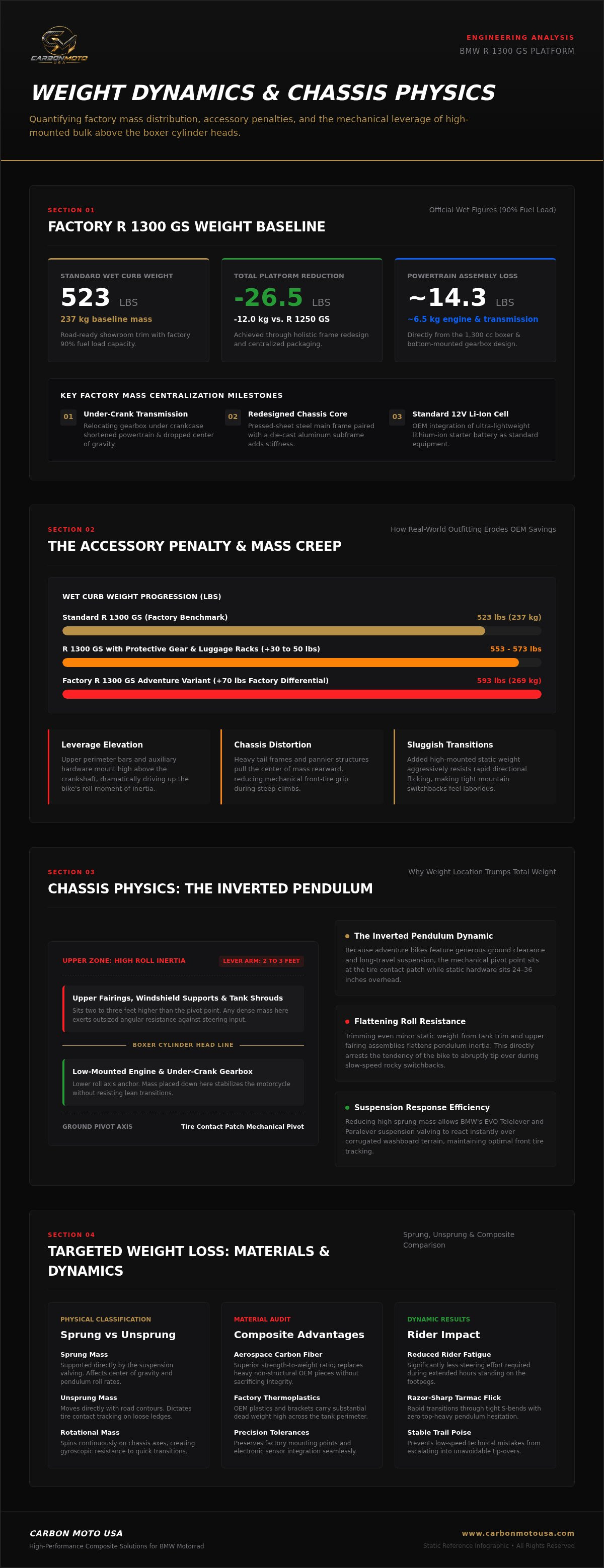
Every serious performance build begins with an accurate baseline. BMW made headlines by clocking the standard R 1300 GS at a road-ready wet weight of 523 lbs (237 kg) with a 90% fuel load. That represents an official 26.5 lb (12 kg) reduction compared to the outgoing R 1250 GS. Most reviews stop there, treating the factory figure as an unalterable benchmark. In reality, that published curb weight reflects a stripped-down showroom configuration. The moment you prepare the machine for real-world adventure riding, practical mass management becomes critical.
Factory Mass Optimization: The Boxer Engine and Monocoque
BMW achieved genuine engineering milestones with this generation. According to documented BMW R 1300 GS factory specifications, the redesigned 1,300 cc boxer engine and bottom-mounted transmission shed roughly 14.3 lbs (6.5 kg) as a unified powertrain assembly. Relocating the gearbox directly beneath the crankcase shortened the overall powertrain length while pulling heavy mechanical components closer to the ground.
Chassis architecture followed a similar philosophy. Engineers replaced the traditional tubular steel trellis with a pressed-sheet steel main frame and a die-cast aluminum subframe. This structure increases torsional stiffness while centralizing mass. BMW even integrated an ultra-lightweight 12V lithium-ion starter battery as standard equipment. These updates create a noticeably more responsive baseline, but factory mass centralization only solves half the equation.
The Accessory Weight Penalty on Modern Adventure Bikes
Factory weight savings evaporate quickly once protective gear and travel equipment enter the equation. Standard factory options, steel crash bars, heavy skid plates, and hard luggage racks can easily add 30 to 50 lbs back onto the chassis. For comparison, the factory R 1300 GS Adventure variant carries a wet curb weight of 593 lbs (269 kg), showing just how rapidly structural framing and auxiliary hardware accumulate bulk.
This added mass creates specific handling liabilities:
- Leverage elevation: Upper tank bars and perimeter racks mount high above the crankshaft, dramatically increasing the bike's roll moment of inertia.
- Chassis balance distortion: Heavy tail racks and pannier mounts pull the center of mass rearward, lightening front-tire mechanical grip during trail climbs.
- Sluggish transitions: High-mounted hardware resists rapid direction changes, making tight switchbacks feel laborious.
True performance refinement requires intentional intervention. Meaningful R 1300 GS weight reduction doesn't mean stripping essential protection; it means auditing non-structural OEM components and replacing dense factory plastics and brackets with engineered composite alternatives.
The Physics of Mass: Sprung, Unsprung, and High-Mounted Weight
Every ounce removed from a motorcycle changes its dynamic behavior, but where you remove that mass dictates the outcome. Engineers categorize chassis weight into three distinct realms: sprung mass supported by the suspension, unsprung mass moving directly with road contours, and rotational mass spinning on an axis. Adventure motorcycles feature generous ground clearance and long-travel suspension, making them uniquely sensitive to mass distribution. Understanding these physical forces separates ineffective cosmetic alterations from purposeful engineering.
Why High-Mounted Mass Matters Most on Adventure Platforms
An adventure bike acts mechanically like an inverted pendulum. The pivot rests at the tire contact patch, while substantial mass sits two to three feet higher in the chassis. Fuel, navigation consoles, upper fairings, and tank trim exert outsized leverage against your steering inputs. The taller that mass sits above the crankshaft, the more effort required to initiate lean angle or arrest a slide.
Reducing upper-chassis mass directly flattens this roll resistance. Shedding even a few pounds from fairings, windshield supports, or tank shrouds accelerates side-to-side transitions through tight mountain esses. On loose, technical switchbacks, lowering the center of mass prevents that sudden tipping sensation where a slow maneuver turns into a drop. Strategic R 1300 GS weight reduction above the cylinder heads restores control, directly cutting down rider fatigue during long days standing on the pegs.
Suspension Dynamics and Damping Efficiency Gains
Chassis weight directly dictates how effectively the EVO Telelever and Paralever systems track terrain. To keep a tire planted over corrugated washboard or rocky ledges, suspension valving must react instantly. Technical analysis regarding the dynamics of unsprung weight demonstrates that lighter components at the wheels and swingarm allow dampers to control wheel deflection with superior accuracy. For instance, swapping stock cross-spoke wheels for BMW's Enduro Forged wheels sheds 1.8 kg (4.0 lbs) of rotating unsprung mass, multiplying inertia benefits across acceleration and braking.
Sprung mass plays an equally vital role. When heavy bodywork loads the chassis under hard compression, the shock absorbers must dissipate massive kinetic energy, often blowing through their stroke into harsh hydraulic stops. Trimming dead weight from the upper structure lets the factory dynamic suspension maintain its ideal mid-stroke operating window. Exploring engineered composite panels from specialists like Carbon Moto USA provides an effective route to lower high-mounted sprung mass while preserving factory mounting tolerances.
Targeted Weight Loss: Carbon Fiber vs. Factory Plastics and Metals
Factory trim panels serve a basic functional role, but injection-molded plastics carry unnecessary density. Original equipment manufacturers rely heavily on acrylonitrile butadiene styrene (ABS) and polypropylene (PP) because they are cheap to cast at high volumes. Replacing these pieces with autoclaved pre-preg composites yields immediate, measurable dividends. Across modern vehicle architectures, data on lightweight composites and structural materials highlights how continuous carbon fiber matrices cut mass by 40% to 60% compared to traditional polymers and stamped metals while substantially increasing structural rigidity.
| Component Area | OEM Material | Dry Carbon Composite | Dynamic Benefit |
|---|---|---|---|
| Upper Tank & Beak Fairings | Injection-Molded ABS | Autoclaved Pre-Preg Weave | Reduces high-center roll leverage |
| Frame & Subframe Covers | Textured Polypropylene | Toray Carbon Fiber | High abrasion resistance, zero flex |
| Lower Engine & Exhaust Covers | Stamped Steel / Thick ABS | High-Temp Carbon Matrix | Thermal stability and direct mass shed |
Material Superiority: Autoclaved Pre-Preg Carbon Fiber
True performance composite manufacturing requires high heat and intense atmospheric pressure. Pre-impregnated (pre-preg) carbon weaves are cured in autoclaves, ensuring optimal resin-to-fiber ratios without the heavy resin pooling found in cheaper wet-lay carbon parts. High-grade UV-stable clear coats preserve the finished weave against stone chips, roost, and prolonged sun exposure. Upgrading to direct-fit R 1300 GS carbon fiber frame covers replaces brittle stock panels with structural components that withstand off-road boot friction while eliminating excess grams.
Supplementary Weight Reduction Targets: Exhaust and Lithium Power
Bodywork forms the core of high-mounted mass removal, but pairing composite panels with mechanical components unlocks comprehensive chassis gains. The stock stainless steel silencer can be swapped for a titanium slip-on with a composite end cap to shed high-mounted rear overhang weight. For closed-course setups, aftermarket titanium headers eliminate the heavy factory catalytic converter, dropping approximately 8.4 lbs (3.85 kg) from the lower frame.
Electrical mass is already managed at the factory. Unlike previous GS models that required an immediate battery swap to shed ballast, the R 1300 GS features an OEM lithium-ion starter unit from day one. That leaves unsprung rolling assemblies, the exhaust tract, and upper bodywork as the primary targets for mechanical refinement. Compounding composite body panels with focused exhaust upgrades creates a comprehensive R 1300 GS weight reduction program that sharpens directional response across all terrains.
Step-by-Step Blueprint for Shedding Weight on the R 1300 GS
Executing an effective build requires a methodical approach rather than haphazard parts swapping. Removing mass without a clear plan can compromise weather protection, impact defense, or electronic chassis integration. Follow this four-phase framework to achieve structured, functional R 1300 GS weight reduction while preserving the bike's long-distance capabilities.
Phases 1 & 2: Electrical and Hardware Optimization
Begin with a comprehensive mass audit. Calculate the weight of every bolt-on accessory currently mounted to your machine, noting that steel protection bars and auxiliary lights quickly inflate overall mass. For solo expedition setups, unbolt redundant passenger footpeg assemblies and cast pillion grab handles. This instantly clears high-mounted ballast from the aluminum subframe.
Next, evaluate the electrical architecture. Because BMW equips the R 1300 GS with an ultra-lightweight lithium-ion battery from the factory, avoid redundant battery replacements. Focus instead on stripping out tangled accessory harnesses, unused 12V auxiliary adapters, and oversized steel bracketry. Replace heavy auxiliary light cradles with minimalist billet mounts to keep forward mass tight to the steering stem.
Phases 3 & 4: Composite Conversion and Luggage Refinement
Phase three addresses body mass. Replace dense ABS beak panels, air outlet covers, and fuel tank shrouds with aerospace-grade autoclaved carbon fiber. These composite panels mount directly to factory BMW mounting points without requiring chassis modifications. Upgrading these high-mounted surfaces drops critical mass from the roll axis, immediately sharpening low-speed steering response. To begin selecting precision-engineered panels for your motorcycle, explore BMW R 1300 GS carbon fiber upgrades at Carbon Moto USA.
Complete the transformation by overhauling your cargo strategy. Heavy aluminum panniers and steel side racks hang extensive weight behind the rear axle, destabilizing the bike over rocky steps. Shift to modular rackless soft luggage systems mounted close to the subframe:
- Phase 1: Strip non-essential hardware, pillion pegs, and passenger grab handles.
- Phase 2: Audit electrical routing and remove redundant accessory mounting brackets.
- Phase 3: Install direct-fit dry carbon bodywork across the upper tank and nose fairings.
- Phase 4: Swap rigid aluminum pannier sets for low-profile modular soft luggage.
Always verify fastener torque to factory BMW specifications following panel installation. A methodical build ensures every component performs reliably under aggressive off-road conditions.
Transforming Your GS with Carbon Moto USA Performance Components
Executing an uncompromising build requires components engineered to the highest mechanical standards. Carbon Moto USA specializes in premium motorcycle composites, delivering dedicated bodywork that pairs motorsport-grade mass reduction with exacting craftsmanship. While factory accessory options lean heavily toward utility bars and metal brackets that add pounds back onto the frame, focused composite replacement works in the opposite direction. It strips upper chassis mass to elevate every dynamic characteristic of the machine.
Engineered Precision and Flawless OEM Fitment
Upgrading composite bodywork shouldn't involve slotting holes, wrestling mismatched tabs, or forcing gaps to line up. Carbon Moto USA components rely on precision tooling developed around original BMW mounting points and factory fastener locations. Every panel aligns seamlessly with integrated chassis tabs and radar sensor housings. This ensures clean, direct bolt-on installation without modifying factory wiring or body brackets.
Off-road adventure environments demand real durability. Autoclaved dry carbon construction provides outstanding structural rigidity, resisting extreme engine cylinder heat, stone strikes, and harsh roost on rocky paths. These panels don't soften under thermal load or crack under trail impacts like basic thermoplastics. Browse the dedicated BMW R 1300 GS carbon fiber parts catalog to locate precision replacement nose fairings, tank panels, wind deflectors, and protective covers engineered for real adventure use.
Elevating Dynamic Agility and Premium Aesthetics
The handling transformation becomes obvious within the first mile. Trimming dead weight from the nose, tank perimeter, and frame transforms how the motorcycle responds to rider input. Deep sand tracks require far less steering muscle to keep the front end tracking true. Tight mountain switchbacks yield quicker, lighter turn-in, and fast sweeping tarmac corners reward you with unshakeable line-holding composure.
This functional agility pairs naturally with an elevated aesthetic. Carbon Moto USA components feature pristine twill weaves protected by UV-stable finishes that highlight the raw composite architecture. Whether you prefer a deep high-gloss surface or a subdued matte weave, the finish integrates smoothly against BMW factory paint schemes and aluminum finishes.
Transforming your motorcycle into an agile, highly responsive adventure platform starts with eliminating unnecessary upper mass. When you are ready to execute your build, explore BMW R 1300 GS carbon fiber components engineered specifically for precision fitment and meaningful R 1300 GS weight reduction.
Mastering Chassis Dynamics Through Precision Engineering
Unlocking the full dynamic potential of your adventure build comes down to where you eliminate mass. BMW engineered an impressive baseline, but executing strategic R 1300 GS weight reduction above the boxer cylinder heads flattens roll resistance and sharpens front-end feedback. Replacing dense factory bodywork with aerospace-grade pre-preg carbon fiber eliminates high-mounted inertia while preserving uncompromising structural integrity on punishing terrain.
Every ounce removed from the upper chassis translates directly into less rider fatigue, crisper directional transitions, and superior suspension compliance. As a dedicated US-based distributor specializing in premium European and American motorcycle performance, Carbon Moto USA supplies components manufactured to strict factory BMW tolerances. Each piece delivers direct bolt-on fitment using original hardware mounting points without modifications or compromises.
Upgrade Your Adventure: Explore BMW R 1300 GS Carbon Fiber at Carbon Moto USA. Equip your machine with precision-crafted composite bodywork, shed dead weight, and command every backcountry pass with absolute confidence.
Frequently Asked Questions
How much weight can realistically be shaved off a BMW R 1300 GS?
Riders can realistically shed between 15 and 25 pounds of non-essential sprung and rotational mass through targeted aftermarket upgrades. Swapping heavy fairings and tank covers for autoclave-cured composite panels drops high-mounted body mass significantly. Pairing that with a lightweight titanium silencer and forged wheels removes additional rotational bulk. Systematic R 1300 GS weight reduction delivers a noticeably sharper, more responsive machine without compromising structural capability.
Does replacing OEM bodywork with carbon fiber affect the motorcycle warranty?
Replacing external cosmetic panels with carbon fiber components does not void your BMW factory motorcycle warranty. Under consumer protection regulations like the Magnuson-Moss Warranty Act in the United States, a manufacturer cannot deny warranty claims unless an aftermarket part directly causes a mechanical or electrical failure. Direct bolt-on body panels reuse original mounting locations, leaving factory wiring harnesses, engine sensors, and chassis components untouched and fully protected.
Will lightweight carbon fiber components withstand off-road tip-overs and debris?
High-grade autoclaved carbon fiber components handle rock strikes, roost, and low-speed tip-overs better than brittle factory thermoplastics. Pre-preg composites offer high tensile strength and rigid structural matrices that absorb kinetic energy without cracking. Quality composite pieces flex slightly under localized impact before returning to form, whereas OEM injection-molded ABS often snaps at the mounting tabs. High-impact clear coats also prevent cosmetic gouging from flying gravel.
How does reducing high-mounted weight change the feel of the Telelever suspension?
Shedding high-mounted mass noticeably speeds up initial steering turn-in and improves front-end trail feedback through the EVO Telelever system. Telelever suspension separates steering forces from braking forces, but top-heavy leverage still creates roll resistance. Lightening upper tank and nose bodywork lowers the chassis center of gravity. As a result, the front wheel tracks terrain with less damping hesitation, letting the shock valving react to rapid terrain changes rather than battling upper-body roll inertia.
Can I install carbon fiber weight reduction parts at home with basic tools?
Yes, you can complete the installation in a home garage using standard Torx hand tools. Precision carbon components replicate OEM mounting tabs and fastener locations, requiring no drilling, trimming, or specialized modifications. Keep in mind that Carbon Moto USA retails parts directly and doesn't offer in-person installation services. Simply follow factory panel disassembly steps, transfer any rubber grommets carefully, and torque all fasteners to official BMW torque specifications.
What is the difference between wet carbon and dry pre-preg carbon fiber?
The primary difference lies in the resin application, structural density, and overall component weight. Wet-lay carbon uses manual epoxy application, resulting in excess resin, uneven thickness, and heavier finished parts. In contrast, dry carbon utilizes fabric pre-impregnated with a precise resin ratio, which cures under high heat and pressure inside an autoclave. The result is a lighter, substantially stiffer component that maximizes the performance return of your R 1300 GS weight reduction build.