
Carbon Moto USA / Rider support
Road Glide feels unstable in corners

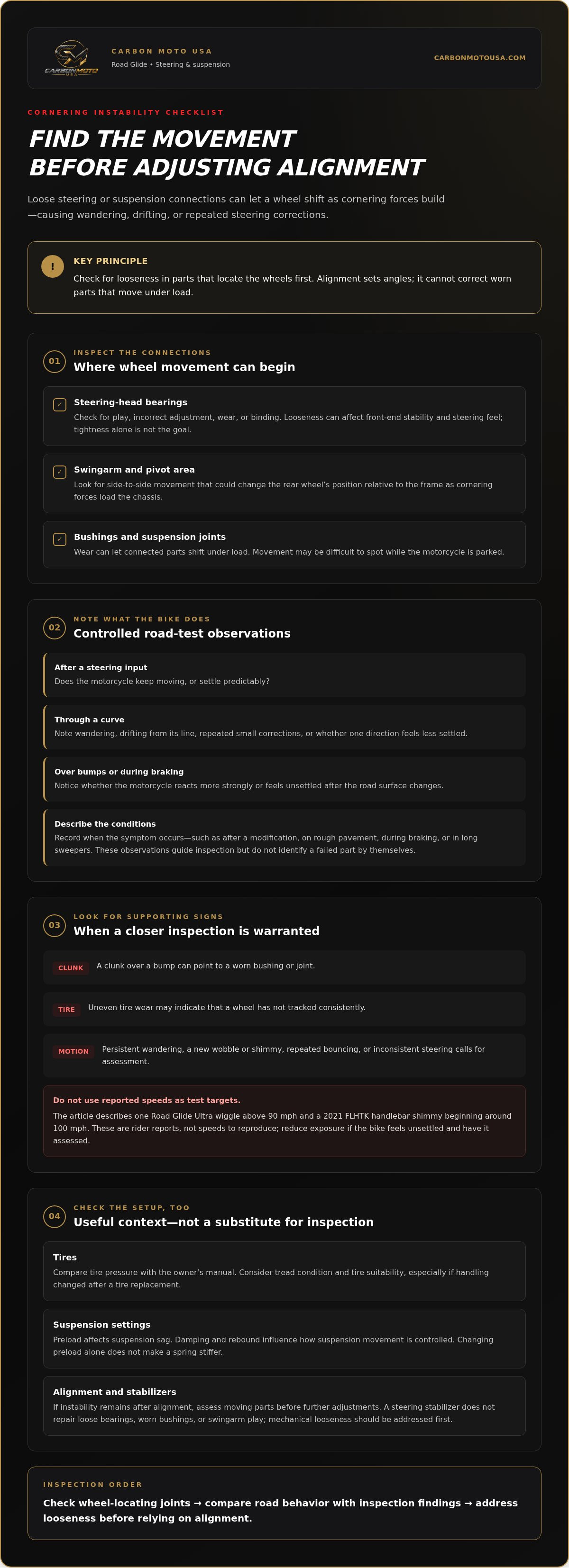
Loose steering or suspension joints can make a Road Glide feel unstable in corners. Play in the steering-head bearings, swingarm, or suspension can let a wheel shift as cornering forces build. You may notice wandering, a change in direction after a bump, or the need to make small steering corrections through a curve.
Tires and suspension settings can affect how a motorcycle tracks, so they’re natural places to start. But looseness in a joint or worn component matters too: an alignment adjustment won’t correct parts that move under load. When the instability occurs and how it feels can help narrow down what needs attention.
This article explains how loose steering and suspension components can affect cornering, what a road test may reveal, and which signs call for an inspection. Clunks over bumps, uneven tire wear, and persistent wandering shouldn’t be dismissed as handling quirks. Read the symptoms in context to decide whether the motorcycle needs a closer mechanical assessment.
Key Takeaways
- Check steering-head bearings, swingarm movement, and suspension joints for play before considering an alignment adjustment.
- A controlled road test can help reveal whether the bike keeps moving after steering input or reacts differently over bumps and during braking.
- Compare tire pressure with the motorcycle owner’s manual, and consider tread condition and tire suitability when handling changes after a tire replacement.
- Preload affects suspension sag, while damping and rebound influence how the suspension controls movement; changing preload alone doesn’t make a spring stiffer.
- Clunks, uneven tire wear, persistent wandering, or repeated bouncing are reasons to arrange a steering and suspension inspection.
Loose suspension and steering joints
A Road Glide can feel unsettled when a steering or suspension joint moves beyond its intended range. In a corner, tire forces load the front end, swingarm, bushings, and steering-head bearings. If a joint has play, the wheel can shift slightly as the load changes. The motorcycle may wander, drift from its line, or need small steering corrections through a curve.
Start with the steering-head bearings. Looseness can affect how the fork and front wheel track, while incorrect bearing adjustment can also contribute to wobble. A technician checks for movement at the steering head and whether the bearings move smoothly through their range. Tightness alone isn’t the goal: the assembly must be adjusted correctly and free from wear or binding.
Next, consider the swingarm and its pivot area. Side-to-side movement can change the rear wheel’s position relative to the frame, especially as cornering forces load the chassis. Worn suspension bushings or joints can have a similar effect by allowing components to shift under load. Movement may be hard to spot while the motorcycle is parked, so inspection findings should be considered alongside how it behaves on the road.
- Steering-head bearings: Play or incorrect adjustment can affect front-end stability and steering feel.
- Swingarm: Side-to-side movement can influence rear-wheel tracking through a turn.
- Bushings and suspension joints: Wear can let connected parts shift as cornering forces build.
- Alignment: Adjustment won’t correct worn parts that move under load.
A controlled road test can help connect a symptom to a component. Notice whether the motorcycle keeps moving after a steering input, feels less settled in one direction, or reacts more strongly when braking or crossing a bump. For example, a Road Glide that tracks smoothly on level pavement but wanders after a rough patch may be responding to movement in a joint or suspension part. These observations can guide an inspection, but they don’t identify a failed component on their own.
Look and listen for supporting signs. A clunk over a bump can point to a worn bushing or joint, while uneven tire wear may indicate that a wheel hasn’t tracked consistently. If the motorcycle still feels unstable after an alignment, have the moving parts assessed before making further adjustments. Alignment sets angles; it can’t hold them when worn components shift under load.
A steering stabilizer addresses a different part of the handling picture. The Harley Davidson Road Glide Death Deleter Steering Stabilizer Kit is designed for Road Glide models, but a stabilizer doesn’t repair loose bearings, worn bushings, or swingarm play. Diagnose and correct mechanical looseness first. Consider a stabilizer when the steering system is sound and the concern is steering movement, not as a substitute for inspecting worn joints.
Before making further adjustments, check for looseness in the parts that locate the wheels. An alignment cannot correct looseness in worn suspension or steering parts, so those parts should be checked before alignment adjustments. A Harley-Davidson forum participant recommended checking the steering-head bearings because looseness or incorrect tightness can contribute to wobble. A Harley-Davidson forum participant also recommended checking swingarm side-to-side movement, since play can contribute to wobble. These are useful inspection leads, not proof that either component is the cause. The rider estimated front suspension sag at about 70 mm; keep that estimate in context with the handling symptoms rather than treating it alone as a diagnosis.
A road test can help assess unstable handling. Note whether the motorcycle keeps moving after a steering input, whether one direction feels worse, and whether braking or bumps reveal looseness. Compare those observations with inspection findings at the steering head, swingarm, bushings, and suspension joints. Describe when a symptom occurs and what the motorcycle does rather than assuming a particular part has failed. This information helps a technician decide which moving connections to inspect closely. If looseness is found, address it before relying on alignment adjustments to improve tracking.
Symptoms that warrant a steering and suspension inspection
Arrange an inspection if your Road Glide develops a new wobble, shimmy, or persistent wandering. Note when the symptom starts: after a modification, over rough pavement, during braking, or only in long sweepers. That timing can help distinguish a repeatable mechanical change from a handling sensation that varies with road conditions.
Take reported speed ranges seriously, but don’t use them as targets for a test ride. One reported Road Glide Ultra wiggled in long sweepers above 90 mph. A 2021 FLHTK owner described a controllable handlebar shimmy beginning around 100 mph. Those reports show why riders should note the conditions, not try to reproduce instability at speed. If the bike feels unsettled, reduce exposure and have it assessed.
Several patterns deserve prompt attention:
- Wandering on rough highways: Repeated steering corrections suggest the bike isn’t holding a consistent line.
- Repeated bouncing: If the suspension continues moving after a dip or bump, its damping may not be controlling movement effectively.
- Steering that behaves inconsistently: A front end that doesn’t settle predictably after an input calls for closer assessment.
- Clunks or new vibration: A sound over a bump or a shimmy after a modification can help locate when the change began.
- Warning indicators: A traction or stability warning alongside unusual handling deserves attention on a motorcycle equipped with those systems.
Keep a brief symptom record before inspection. Note whether the motorcycle pulls in one direction, whether left and right turns feel different, and whether braking or bumps change the sensation. Record recent changes, such as new tires or modifications, along with any clunk, vibration, or visible uneven tire wear. These details give the technician a useful starting point without requiring you to recreate a risky condition.
Distinguish a steady pull from movement that appears under load. A motorcycle that consistently tracks to one side on a flat road may have an alignment or tire concern. If instability began after alignment work but remains, worn parts that shift under load may be changing the set angles. An adjustment can’t hold its result when a component moves during cornering.
Consider suspension behavior, too. Worn shocks can let the motorcycle’s body lean farther and take longer to settle after a turn or road dip. Uneven ride height may indicate an issue beyond the shocks alone. A clunk over a small bump can also warrant checking suspension connections and mounting points, rather than treating the noise as unrelated to cornering feel.
Use the symptoms to choose the next step, not to diagnose a specific failed part yourself. Describe when the instability occurs, what changes it, and whether it appeared after work or a tire change. If inspection finds sound mechanical parts but steering movement remains the concern, explore Road Glide steering stability options as a separate consideration.
Treat recurring changes as a reason to arrange an inspection, not as sensations to dismiss. Wandering on rough highways or needing constant steering correction warrants attention. So does steering that doesn’t consistently return to center. An off-center steering wheel or a vehicle that pulls on a flat road can signal an alignment issue. Repeated bouncing after dips or speed bumps also warrants inspection. Describe when these symptoms occur so the technician can understand the pattern.
One report illustrates why the onset matters: the original poster reported that the motorcycle began to wag or shimmy in a straight line at 90-100 mph after modifications. Do not try to recreate that symptom; provide the timing and modification history instead. When discussing body movement, note whether it leans farther or takes longer to settle. Worn shocks and struts can let a vehicle's body lean farther and take longer to settle because they lose some control over suspension movement. These observations help direct attention to suspension behavior as well as steering and alignment concerns.
Feel unstable
If your Road Glide feels unstable in corners, check the tires before changing suspension settings. Pressure, tread shape, and tire construction affect how the contact patch responds as the bike leans. A tire that flexes more than expected can make steering feel delayed, while a firmer sidewall may react sharply to broken pavement.
A Harley-Davidson forum participant recommended checking the motorcycle’s manual or chain guard for the correct tire pressure. Riders have suggested starting ranges of 32-36 psi at the front and 36-42 psi at the rear, but those figures aren’t a universal setting for every Road Glide, tire, or load. One rider suggested 34 psi front and 38 psi rear. Treat that as an example, not a substitute for the pressure specified for your motorcycle and tire.
Tire pressure affects how well the tire supports the bike. Low pressure allows extra sidewall flex, which can make steering response feel slow during a turn. Excessive pressure can reduce compliance, causing the tire to bounce over road imperfections instead of absorbing them smoothly. Check pressure when the tires are cold and compare both ends with the correct reference for your motorcycle.
Inspect the tread, not just its remaining depth. Uneven wear can make a Road Glide follow pavement grooves or seams, creating a self-steering sensation. If a tire follows rain grooves more strongly than before, its wear pattern may need attention. If instability begins after new tires are installed, verify pressure and whether the tire type suits the motorcycle. Touring tires can differ in sidewall stiffness even when both have ample tread.
Confirm the sidewall marking matches the motorcycle’s intended tire specification. A touring-bike rider specifically advised checking for an 81H marking rather than 74W. Don’t apply that comparison blindly to every model or tire. Use the manual’s fitment information, because construction and load requirements affect how the tire behaves under cornering forces.
Suspension setup is another part of the feel. Sag describes how much the suspension compresses under the motorcycle and rider. A forum participant suggested about 30 mm, or 1.25 inches, as a sag reference. That figure is a starting point, not a universal factory specification. Rider weight and load matter: one rider weighing 250 pounds noted that the factory preload reference was for a 150-pound rider.
Preload changes the suspension’s starting position and available travel; it doesn’t make the spring stiffer. A rider reported setting rear sag to 27 mm after measuring slightly above 30 mm. That example illustrates why measured sag is more useful than copying another rider’s setting. The owner’s manual may also provide a preload reference, such as the reported 6.5-mark factory setting for a 150-pound rider.
Make only small adjustments, then assess the same familiar route and conditions. Compare how the bike holds a line through a curve, crosses pavement seams, and settles after a dip. One rider suggested using about 80% of fork travel during normal riding, excluding panic stops. If pressure, tire suitability, sag, alignment, or damping still leave the bike unsettled, have those systems assessed together rather than compensating with a single adjustment.
Vehicle feels
A Road Glide’s cornering feel depends on how its tires and suspension work together. If the motorcycle drifts, resists turning, or needs repeated steering corrections, note whether the sensation changes with the road surface or direction. A crowned road can make a small alignment issue more noticeable. Grooves and pavement seams can also amplify uneven tracking, so consider where the symptom appears rather than judging it from one curve.
Front and rear wheel alignment, fork alignment, and suspension damping and rebound all affect tracking. Alignment describes how the wheels relate to the motorcycle’s chassis and each other. Fork alignment concerns the position and movement of the front assembly. Damping and rebound control how suspension movement is managed after compression. A change in any one area can alter how predictably the bike follows a line.
Pay attention to how the bike responds after a steering input. If it keeps moving instead of settling, the suspension may need assessment. If one direction feels different from the other, compare turns on a familiar route and note whether the road surface differs. Don’t force a repeat test at speed. Consistent observations give an inspection a useful starting point without deliberately provoking unstable handling.
- Pull or drift: Note whether the bike tracks to one side on a level road or only on a crowned surface.
- Uneven corner response: Record whether left and right curves feel different under similar conditions.
- Delayed settling: Observe whether movement continues after steering input or after crossing a dip.
- Surface sensitivity: Track whether grooves, seams, or broken pavement change the steering feel.
Separate a road-surface effect from a repeatable mechanical symptom. For example, a Road Glide that follows a pavement groove more strongly on one route may be responding to the surface. If it also wanders on smoother roads, the broader pattern suggests a closer look at alignment, suspension movement, or tire tracking. The distinction matters because adjusting one system won’t correct movement in another.
Consider suspension damping and rebound when the motorcycle feels unsettled after a bump or dip. A fork or rear suspension that doesn’t control movement smoothly can affect how consistently the tires meet uneven pavement. Assess alignment alongside the components that maintain it. If worn parts let angles shift under load, an alignment adjustment alone won’t keep the wheels tracking as intended.
Keep a concise record of the road type, turn direction, braking input, and what the motorcycle did afterward. Include whether the sensation began after tire replacement, suspension changes, or other modifications. These details help distinguish a surface-triggered response from a persistent handling change. Have the front and rear alignment, fork alignment, damping, and rebound considered as a connected system, not as isolated settings.
Once handling concerns are understood, explore motorcycle components for your next build or refinement.
Carbon Moto USA: BMW R 1300 GS Carbon Fiber
Carbon Moto USA offers carbon-fiber components for riders planning a broader motorcycle build. These parts are separate from diagnosing corner instability: they don’t replace inspection or repair of tires, steering, or suspension components. Address handling concerns first, then consider carbon fiber for a compatible motorcycle project.
Offerings include BMW R 1300 GS Carbon Fiber, BMW R 1250 GS Carbon Fiber, Harley Davidson Pan America Carbon Fiber, and Ducati Carbon Fiber. Each category serves a different motorcycle platform, so choose based on the bike you’re building rather than a Road Glide handling symptom. For product information or help with your build, contact Carbon Moto USA.
Make the Next Ride a More Informed One
If your Road Glide feels unstable in corners, treat the sensation as information, not something to push through. Describe the conditions clearly and keep a handling concern separate from plans to personalize another motorcycle. That distinction helps put mechanical diagnosis and a future build in the right order.
For riders considering a different platform or a carbon fiber project, Carbon Moto USA offers BMW R 1300 GS Carbon Fiber, BMW R 1250 GS Carbon Fiber, and Harley Davidson Pan America Carbon Fiber. These offerings suit separate motorcycle builds; they aren’t a fix for Road Glide cornering instability.
Ready to discuss a project or product question? Contact Carbon Moto USA and take the next step at your own pace. Keep your focus on a well-understood motorcycle and a considered build. A thoughtful decision is a strong place to start.
Frequently Asked Questions
How do loose or misaligned steering components cause cornering wobble?
Loose steering parts can let the front wheel shift as cornering forces build, while misalignment can make the wheels track unevenly. Either condition may disturb the bike’s line and prompt corrective steering inputs. For example, if wobble begins after front-end work, have the steering-head bearing adjustment and fork alignment assessed together. A stabilizer can influence steering movement, but it can’t correct worn or loose components.