
Carbon Moto USA / Rider support
Motorcycle Tank Slapper Causes: Road, Speed and Parts

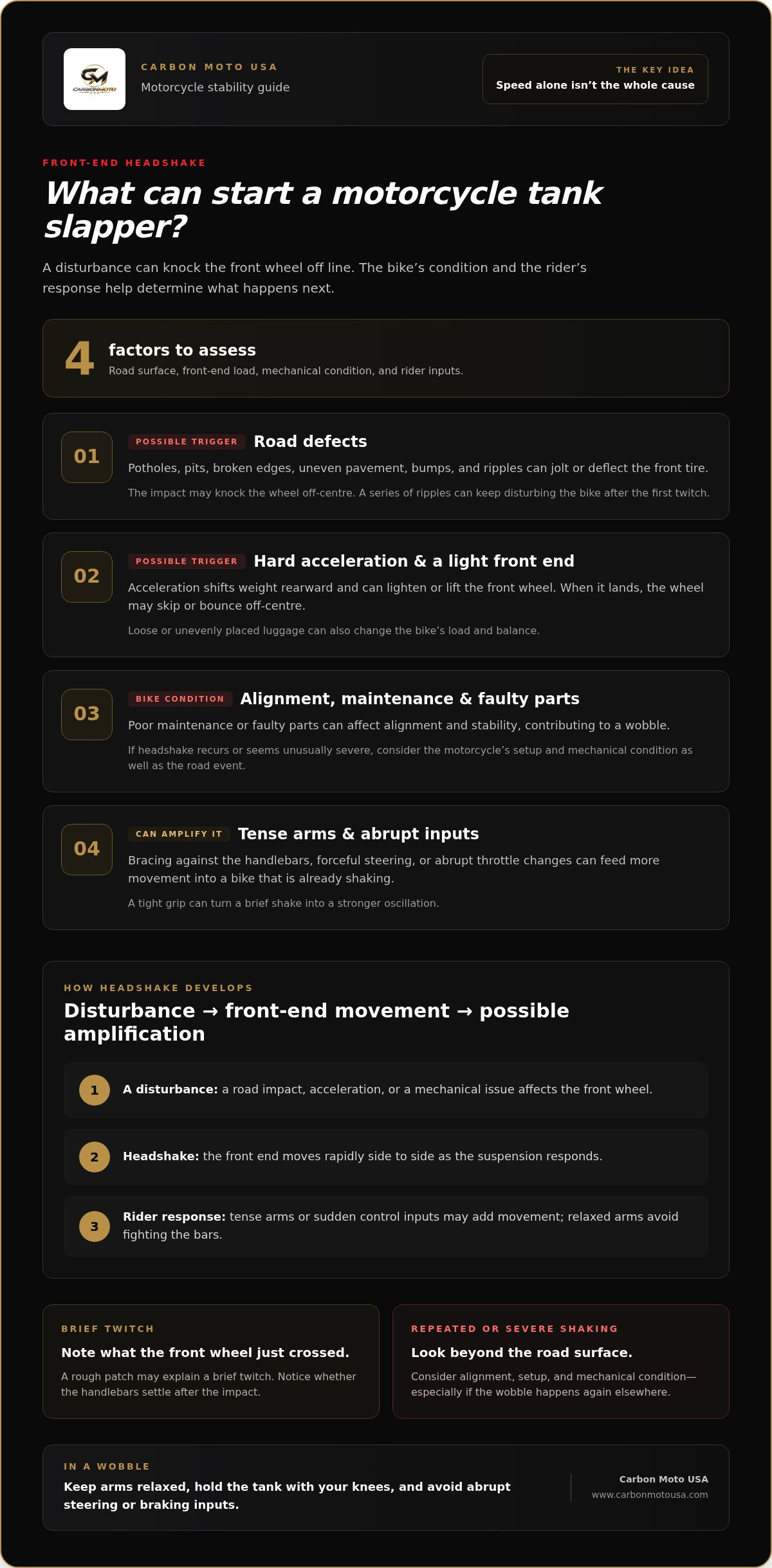
A front wheel knocked off line is central to what causes a motorcycle tank slapper. A pothole or pavement ripple can start the headshake, while hard acceleration can lighten or lift the front wheel, leaving it to bounce off-centre when it lands. Poor maintenance or faulty parts can also contribute to misalignment and instability that trigger a wobble.
It makes sense to suspect speed when the handlebars begin to shake, but speed alone doesn’t explain every tank slapper. The road surface, load on the front end, and the motorcycle’s mechanical condition all matter.
This guide explains how road defects, acceleration, a light front end, and faulty parts can set off a wobble. You’ll also learn how headshake develops and why the steering and suspension components matter when assessing the cause.
Key Takeaways
- Keep your arms relaxed during headshake; a tight grip can transfer movement through your body and intensify the wobble.
- Watch for potholes, uneven pavement, and road ripples that can knock the front wheel off-centre and start a wobble.
- Hard acceleration can lighten or lift the front end, making the wheel more likely to bounce off-centre when it lands.
- Separate a brief headshake from a violent tank slapper, and consider how the road, riding inputs, and bike condition contribute.
- Faulty parts and poor maintenance can affect alignment; steering dampers can help limit the travel and intensity of headshake.
What Causes Motorcycle Wobble?
A motorcycle wobble, often called headshake, is a rapid side-to-side movement of the front end. It can start when the front wheel is disturbed and continue as the suspension responds. A pothole, pavement ripple, hard acceleration, or mechanical fault can provide the initial disturbance. The rider’s response matters too: tense arms and abrupt handlebar inputs can feed more movement into the motorcycle.
A tight grip can turn a brief shake into a stronger oscillation. Because the rider’s arms connect the handlebars to the body, bracing against each movement can transfer tension back through the bike. Imagine crossing a pavement ripple and clamping both hands around the grips. Trying to force the bars straight may add another input while the front end is already moving. Aggressive throttle or steering changes can make the wobble worse, too.
Stay calm and avoid fighting the handlebars. During a wobble, the front end may realign if you let it move instead of resisting each shake. Don’t brake immediately or make sudden steering corrections. Grabbing the front brake or sharply changing direction can introduce another force while the front wheel is unsettled. Focus on reducing tension rather than overpowering the movement.
Use a controlled posture: hold the motorcycle with your knees against the tank and keep your arms relaxed. During a tank slapper, avoid muscling the bike; loosen your grip, grip the tank with your knees, and lift your butt slightly off the seat. This posture reduces rigid arm movements transmitted through the handlebars and helps separate your upper body from the front end’s motion.
Headshake should stay at the front of a correctly set-up motorcycle in good mechanical condition. If shaking seems to spread toward the rear, that may point to a setup or condition issue rather than a simple rider-input problem. After a violent tank slapper, regain control before assessing the motorcycle. Then check whether the front brake lever feels soft. If brake pressure has faded, pump the lever to restore pressure before continuing.
In short, what causes a motorcycle tank slapper depends on both the initial disturbance and what happens next. The road or acceleration may start the headshake, while a tense grip, abrupt throttle, or forceful steering can amplify it. Relaxed arms, knees against the tank, and calm inputs help avoid adding to the oscillation. Alignment and mechanical condition matter too, so recurring or unusually severe headshake deserves attention.
Road defects and motorcycle wobble
A road defect can disturb the front tire’s path and start a wobble. The defect’s shape and position influence how the motorcycle responds.
Road Defects That Trigger Wobble
Potholes, pits, uneven pavement, and bumpy speed breakers can jolt a motorcycle’s tires and contribute to misalignment. A front wheel that no longer tracks straight can make the motorcycle feel unstable. For example, a pothole in the wheel’s path can deliver a sudden impact that shifts its direction, which the rider may feel through the handlebars.
Different defects affect a motorcycle in different ways. A depression can drop the tire abruptly, while a raised or broken edge can deflect it sideways. Uneven surfaces may also disturb the tire’s contact with the road. These impacts don’t automatically cause a tank slapper, but they can provide the initial disturbance that starts headshake.
Bumps and Pavement Ripples
A bump or pavement ripple can knock the front wheel slightly off-centre and initiate headshake. The wheel may continue oscillating after the surface disturbance has passed. For instance, a shallow ripple across a lane can nudge the tire off its line. The rider may feel a quick handlebar twitch before repeated shaking begins.
The motorcycle’s response depends partly on where the tire meets the irregularity and how directly the surface deflects it. A bump under the front tire can produce a different reaction from rough pavement beneath the rear. A series of ripples can keep disturbing the bike as it crosses them, rather than delivering one isolated jolt.
Read the road ahead. A pothole, broken pavement, or uneven speed breaker gives you a chance to anticipate a change in surface. Avoid abrupt steering or throttle inputs over rough pavement, since sudden control movements can add disturbance. Notice whether the handlebars settle after the impact or keep shaking once the motorcycle has cleared it.
Road defects can complicate the diagnosis after a wobble. If the front wheel strikes a pothole, the impact may trigger the wobble, while existing tire misalignment contributes to the instability. The road event and the motorcycle’s condition can both play a part. Consider both if the same motorcycle wobbles again on a different stretch of pavement.
A single rough patch may explain a brief twitch, but repeated headshake calls for a broader assessment. Note whether the wobble began just after a bump, followed a series of pavement ripples, or appeared without an obvious road disturbance. Those details help distinguish a surface-triggered event from a recurring alignment or mechanical concern.
Hard acceleration and a light front end
Hard acceleration can unload the motorcycle’s front end as weight shifts rearward. If the front wheel lifts, it temporarily loses contact with the road. When it touches down, it may skip or bounce off-centre. That landing can start headshake, especially if the tire meets an uneven surface or the bike is already unsettled.
Loose or unevenly loaded luggage can contribute to instability by shifting the motorcycle’s load. A bag that moves during acceleration may change how the bike responds, while uneven placement can affect its balance. Secure luggage and distribute it evenly before riding, especially before hard acceleration or a rough stretch.
The transition matters. As acceleration lightens the front end, steering can feel less settled because the tire has less contact with the road. If the wheel lifts, the rider can’t guide it over the surface in the same way. A front tire that lands at an angle may be deflected further, turning a brief touchdown into repeated side-to-side movement.
Consider a motorcycle accelerating over a crest. The front wheel may become light as the road rises, then touch down while the bike is still gaining speed. If the wheel lands off-centre, its first correction can develop into headshake. A pavement ripple or bump at touchdown can add another disturbance, combining with the acceleration and road shape.
Control inputs can influence what happens next. Abrupt throttle changes or forceful steering while the front end is shaking can add movement instead of settling it. Avoid aggressive inputs and keep your arms relaxed if headshake begins. The goal is not to force the handlebars straight, but to avoid feeding the oscillation with extra movement.
Check luggage before a ride, not only after a wobble. A loosely fastened bag, for example, can shift when acceleration pushes the bike rearward. Unevenly placed bags can also leave the motorcycle carrying its load asymmetrically. Secure and balance luggage, then note whether a wobble appears only with a particular load or during acceleration.
A light front end is a condition, not a complete diagnosis. Hard acceleration can start the disturbance, but touchdown, road surface, luggage movement, and mechanical condition shape what follows. Note whether the wheel lifted, landed over a bump, or the motorcycle carried shifting luggage. These details help distinguish an acceleration-related wobble from one that begins without a clear change in load or contact.
Meaning of a motorcycle tank slapper
A tank slapper is a violent, rapid side-to-side oscillation of a motorcycle’s front wheel and handlebars. The movement can become forceful enough for the bars to swing toward the fuel tank, which gives the event its name.
Tank slappers aren’t tied to one specific speed. They can begin whenever a disturbance sets the front end oscillating, so speed alone doesn’t identify the cause. A bump, an off-centre landing after acceleration, or a mechanical problem can each contribute in different riding conditions.
The key distinction is intensity and control. A brief headshake may settle as the front end realigns, while a tank slapper is a more severe, repeated movement that can make steering difficult. For example, a quick handlebar twitch after a pavement ripple differs from bars swinging forcefully back and forth after the front wheel lands off-centre.
That distinction matters because the event isn’t simply a rider steering from side to side. The front end is oscillating, and aggressive steering or throttle inputs can add movement. A tightly braced rider may also transfer tension through the handlebars. Recognizing this helps explain why trying to overpower the bars can make the shaking more violent.
Several conditions can combine. A pothole may deflect the front wheel, hard acceleration may leave it light, and an alignment-related fault may make the motorcycle less stable. Imagine a wheel touching down after a lift while crossing uneven pavement. The landing and road surface can create successive disturbances, turning an initial shake into a stronger oscillation.
The consequences can extend beyond loss of control. A tank slapper can cause brain injuries, traumatic brain injuries, fractures, facial and eye injuries, joint swelling, and muscle damage. These injury types show why a violent front-end oscillation deserves serious attention, even if it lasts only briefly. The severity of an outcome depends on the crash and resulting impact.
After a violent episode, separate what happened during the oscillation from what may have triggered it. Note whether the motorcycle hit a pothole, accelerated over a crest, or carried shifting luggage. Once control returns, assess the bike’s behavior and mechanical condition rather than assuming speed alone caused the event. A recurring shake points to a pattern that needs attention.
A tank slapper describes severe movement, not one unique mechanical failure. The initiating disturbance, the motorcycle’s condition, and rider inputs can all shape the event. That’s why two similar-looking episodes may have different causes, even when both involve the front wheel and handlebars moving rapidly from side to side.
Motorcycle maintenance and faulty parts
Poor maintenance and faulty parts can contribute to tire misalignment and other conditions that cause wobble. Inspect the tires, chassis setup, and steering components as parts of one connected system.
Tire Pressure, Wear, and Wheel Balance
Tire pressure, tread wear, and wheel balance affect how smoothly a motorcycle tracks. An irregular tire or imbalanced wheel can add instability to the front end.
For example, uneven tire wear can create an inconsistent contact surface, while an imbalance can cause vibration as the wheel turns. Incorrect pressure can also change how the tire meets the road. Check tire pressure against the motorcycle manufacturer’s specification, and look for uneven wear or damage rather than relying on appearance alone.
Suspension, Bearings, and Wheel Alignment
Suspension setup, steering head bearings, and wheel alignment determine how the front end moves and holds its line. Looseness, binding, or misalignment can make steering response inconsistent.
A suspension setup that doesn’t suit the motorcycle’s load can leave the front end responding poorly to road inputs. Worn or incorrectly adjusted steering head bearings may allow play or restrict smooth movement. Misaligned wheels can make the motorcycle track unevenly. If a wobble returns after a road impact or setup change, inspect these systems together instead of treating the tires as the only possible cause.
Steering Dampers and Wobble Control
A steering damper resists rapid steering movement, helping limit the travel and intensity of headshake. By reducing abrupt handlebar oscillation, it can help control a wobble before it develops into a more violent tank slapper.
A damper doesn’t correct misalignment, worn tires, or faulty steering components. Treat it as part of a sound setup, not a substitute for maintenance. Carbon Moto USA offers Death Deleter steering stabilizer kits for Harley-Davidson Road Glide and Street Glide models. Riders of those motorcycles can explore the relevant kit as an option for steering control.
Use a methodical inspection after recurring headshake. Check tire pressure, wear, and balance first, then assess suspension response, steering bearings, and wheel alignment. A single defect may not explain every wobble, but several small issues can combine. Regular maintenance and attention to road damage help address conditions associated with tank slappers. A correctly suited steering damper, alongside sound mechanical condition, supports more controlled front-end behavior.
Carbon Moto USA: BMW R 1300 GS Carbon Fiber
Carbon Moto USA offers BMW R 1300 GS Carbon Fiber for riders refining a model-specific build. Its offerings also include BMW R 1250 GS Carbon Fiber, Harley Davidson Pan America Carbon Fiber, and Ducati Carbon Fiber.
Carbon fiber parts are separate from diagnosing headshake. They don’t replace sound tires, correct wheel alignment, or a steering damper when addressing wobble. First focus on the motorcycle’s mechanical condition and factors that can trigger oscillation. Then consider model-specific parts as part of your broader build.
Explore Carbon Moto USA’s carbon fiber offerings for your motorcycle.
Build Your Next Ride with Purpose
Use your next ride to build a clearer picture of how your motorcycle responds. Record the conditions surrounding any recurring instability, separately from decisions about appearance or customization. Knowing what causes a motorcycle tank slapper can help you prioritize mechanical integrity before choosing parts for a considered build.
For riders planning a model-specific update, Carbon Moto USA offers BMW R 1300 GS Carbon Fiber, BMW R 1250 GS Carbon Fiber, and Harley Davidson Pan America Carbon Fiber. These offerings support a different goal from diagnosing a wobble, so keep the motorcycle’s condition and your build plans in view as separate decisions.
Choose components that suit your motorcycle and the direction you want to take its design. A deliberate plan helps keep performance concerns grounded in mechanical assessment while giving customization its own clear purpose. Explore options for your next motorcycle build, and move forward with confidence.
Frequently Asked Questions
What Is Tank Slap/Wobble?
Tank slap is a severe form of motorcycle headshake, with the front wheel and handlebars oscillating rapidly from side to side. A short twitch after a road seam isn’t necessarily a tank slapper; repeated, forceful bar movement is more characteristic. Note whether the handlebars settle once the motorcycle clears a rough patch or continue swinging afterward. That distinction helps describe the event and identify its likely trigger.
What causes tank slappers?
Tank slappers begin when a disturbance sets the front end moving and the oscillation continues or intensifies. A pothole, pavement ripple, or front wheel touching down off-centre after acceleration can trigger one. The motorcycle’s condition and rider inputs also affect what follows. For instance, a road impact may start the movement, while a tight grip or forceful steering adds to an already unsettled front end.
What is a motorcycle tank slapper and how does it happen?
A motorcycle tank slapper is rapid, forceful front-end oscillation that can make the handlebars difficult to control. It happens when an initial disturbance deflects the front wheel, then the wheel and steering continue moving side to side. Picture a front tire crossing a broken pavement edge: it can be knocked off line, and the steering may begin shaking. A tank slapper describes that violent movement, not one single mechanical failure.
What mechanical problems cause motorcycle tank slappers?
Mechanical problems that contribute to tank slappers include poor maintenance, faulty parts, and conditions that lead to tire misalignment. A motorcycle that tracks unevenly after a wheel impact, for example, may have an alignment or component issue that compounds later disturbances. Steering dampers can reduce headshake intensity, but they don’t correct an underlying fault. Treat recurring wobble as a reason to assess the motorcycle’s condition rather than relying on a damper alone.
How can road bumps, potholes, or speed trigger a tank slapper?
A bump or pothole can deflect the front wheel from its line, while pavement ripples can create repeated disturbances. Speed alone doesn’t tell you when a tank slapper will occur; the trigger and the motorcycle’s response matter. For example, a front wheel touching down off-centre after hard acceleration may be disturbed again by rough pavement. If a shake follows a road impact, note the surface and riding conditions around it.
What should a rider do when a tank slapper starts?
Stay calm, relax your grip, and avoid resisting each handlebar movement. Hold the motorcycle with your knees against the tank, keep your arms loose, and lift your butt slightly off the seat. Don’t apply the brakes immediately. Once control returns, check whether the front brake lever feels soft; if pressure has faded, pump the lever. These actions reduce added input and help you assess the bike after the event.
What should riders avoid doing during a motorcycle tank slapper?
Avoid muscling the handlebars, making abrupt steering corrections, or changing the throttle aggressively. Those actions can feed movement into the front end. Don’t grab the brakes immediately, either, because that adds another control input while the motorcycle is oscillating. For example, if the bars start shaking after a pavement impact, resist the urge to force them straight. Keep your arms relaxed and let the bike move rather than bracing rigidly against it.
How can riders inspect and maintain a motorcycle to prevent tank slappers?
Build a routine around the motorcycle’s tires, wheel alignment, suspension, steering components, and any fitted damper. Look for tire wear or damage, and note changes in how the bike tracks after an impact or adjustment. Regular maintenance can help catch faults before they contribute to misalignment or instability. Pay attention to road defects too, since avoiding a pothole or rough speed breaker can prevent a sudden disturbance to the front wheel.