
Carbon Moto USA / Rider support
How to Prevent Tank Slappers on a Bagger and Respond to Wobbles

Preventing tank slappers on a bagger starts with a mechanically sound motorcycle and a setup suited to its load. Keep the tires, wheels, steering components, suspension, and luggage in good condition. If a wobble begins, stay relaxed on the bars, avoid fighting the oscillation, and ease off the throttle smoothly rather than making a sudden correction.
A speed wobble can escalate quickly, so it’s understandable to focus on what to do in the moment. Preparation matters just as much: maintenance, load placement, road conditions, and riding inputs all affect how a motorcycle behaves.
This guide covers practical ways to reduce risk before a ride, how speed and road conditions can contribute, and how to respond if the front end starts to wobble. It also explains when a recurring wobble calls for a closer look at the motorcycle’s setup, so you can make informed decisions without treating a steering stabilizer as a substitute for sound fundamentals.
Key Takeaways
- Inspect tires, wheels, steering, and suspension regularly, and keep tire pressure aligned with the motorcycle manufacturer’s guidance.
- Use smooth throttle and steering inputs, especially over uneven pavement or while carrying luggage.
- If a wobble starts, keep your grip steady, avoid fighting the handlebars, and ease off the throttle smoothly.
- Pay attention to changes in tire wear, balance, load, or setup that may contribute to recurring headshake.
- Choose model-specific components to complement your motorcycle’s design, while treating them as part of a broader setup rather than a substitute for sound maintenance.
Avoiding speed wobbles
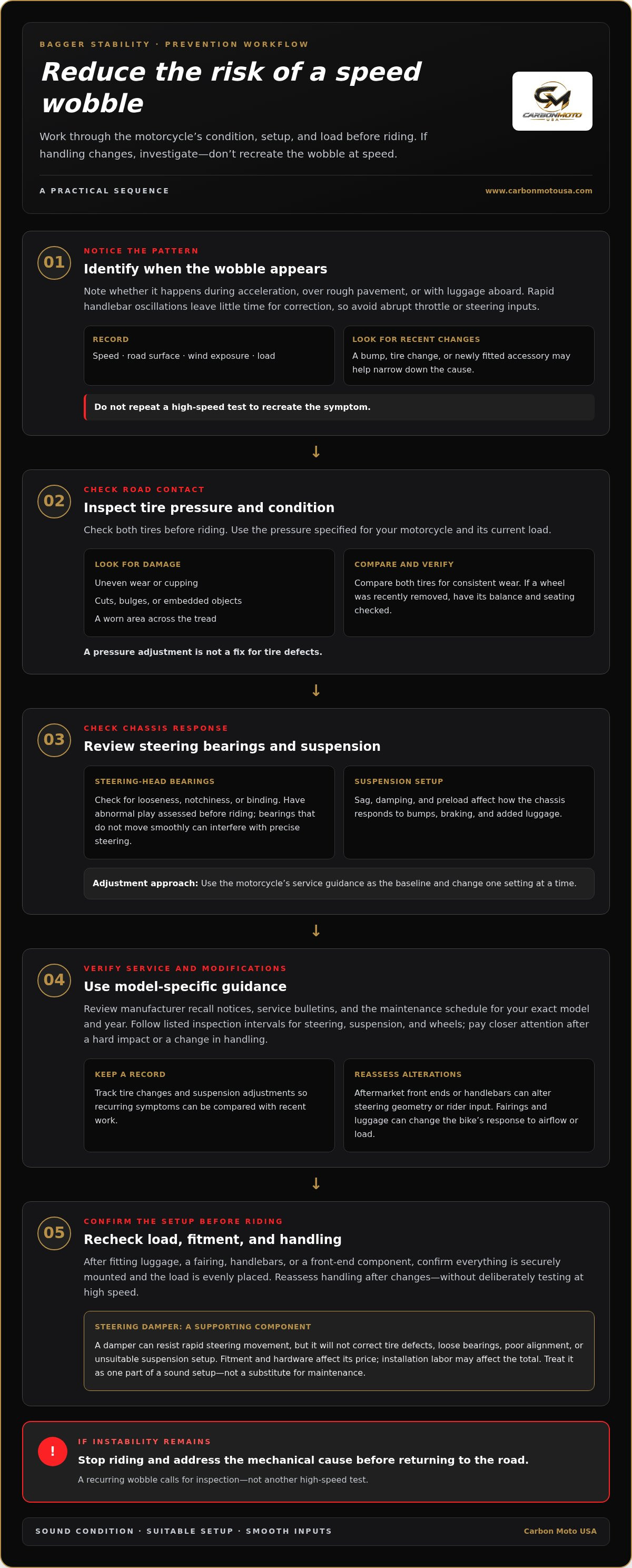
Reduce wobble risk by checking the motorcycle’s condition, setup, and load before riding. Use smooth inputs on the road, and respond promptly to changes in handling.
-
Identify wobble causes and conditions
Start by noting when a wobble appears: during acceleration, over rough pavement, or with luggage aboard. A motorcycle speed wobble can involve rapid oscillations of the handlebars. That rapid movement leaves little time for correction, so avoid provoking it with abrupt throttle or steering inputs.
When a wobble occurs, record the speed, road surface, wind exposure, and load. A new vibration after hitting a bump, changing tires, or fitting accessories can help narrow down the cause. Don’t repeat a high-speed test to recreate the symptom. Inspect the motorcycle before riding into the same conditions again.
-
Check tire pressure and condition
Check both tires before riding, using the pressure specified for your motorcycle and its current load. Inspect the tread and sidewalls for uneven wear, cuts, bulges, or embedded objects. Irregular wear or visible damage can compromise predictable contact with the road, so don’t treat a pressure adjustment as a fix for tire defects.
Look for cupping or a worn area across the tread, and compare both tires for consistent wear. If a wheel has recently been removed, have its balance and seating checked. A consistent inspection routine helps prevent tank slappers on a bagger by catching changes before they affect handling.
-
Review steering bearings and suspension setup
Check steering-head bearings for looseness, notchiness, or binding, and have abnormal play assessed before riding. Bearings that don’t move smoothly can interfere with precise steering. Suspension setup matters too: sag, damping, and preload affect how the chassis responds to bumps, braking, and added luggage.
Use the motorcycle’s service guidance as the baseline for adjustments, and change one setting at a time. Aftermarket front ends or handlebars can alter steering geometry or rider input. Fairings and luggage can change the bike’s response to airflow or load. Reassess handling after modifications instead of assuming the original setup still applies.
-
Check service guidance and damper options
Review manufacturer recall notices, service bulletins, and the maintenance schedule for your exact model and year. Follow the listed inspection intervals for steering, suspension, and wheels, and pay closer attention after a hard impact or change in handling. Keep records of tire changes and suspension adjustments so you can compare recurring symptoms with recent work.
A steering damper can resist rapid steering movement, but it won’t correct tire defects, loose bearings, poor alignment, or unsuitable suspension setup. There’s no single cost for every bagger: fitment and hardware affect the price, while installation labor may affect the total. Treat a damper as one part of a sound setup.
-
Reassess changes before riding.
After fitting luggage, a fairing, handlebars, or a front-end component, confirm that everything is securely mounted and the load is evenly placed. Preventing tank slappers on a bagger also means reassessing handling after changes, without deliberately testing at high speed. If instability remains, stop riding and address its mechanical cause before returning to the road.
Responding to speed wobbles
Act smoothly when the handlebars begin oscillating. Prioritize control, reduce speed without abrupt inputs, and stop somewhere safe to inspect the motorcycle. A measured response helps prevent tank slappers on a bagger by avoiding sudden rider inputs that can further unsettle the chassis.
-
Keep your arms loose and your gaze forward. Hold the handlebars firmly enough to steer, but don’t lock your elbows or wrestle the front end. A stiff grip can feed unwanted steering inputs into the motorcycle. Look toward a stable path ahead, not down at the handlebars or roadside hazards.
Stay seated and keep your body balanced over the motorcycle. Avoid sudden weight shifts, sharp steering corrections, or unnecessary reaches for the controls. Let the motorcycle settle while maintaining a predictable direction. Don’t try to force the front wheel straight with your arms.
-
Ease off the throttle gradually. Don’t snap the throttle shut or accelerate to outrun the oscillation. A rider reported that a stock 1981 Yamaha XJ550 developed a high-speed wobble near 185 km/h, and that rolling off the throttle stopped it. That report illustrates one response, not a guaranteed outcome for every motorcycle.
Keep your inputs smooth as speed falls. Avoid abrupt braking or downshifting while the handlebars are moving, since sudden changes can further disturb the chassis. Once the front end settles, reduce speed progressively and choose a clear place to pull over.
-
Stop and inspect before continuing. Move away from traffic, park securely, and check for fresh damage or an obvious change. Look at the tires, wheels, luggage, and visible steering components. A pothole strike, loose load, or new vibration can point to a condition that needs attention.
Don’t accelerate again to see whether the wobble returns. Note where it began, the road surface, your speed, and whether you were accelerating or carrying luggage. These details create a useful record for diagnosing the event without deliberately recreating it.
-
Take recurring headshake to a motorcycle mechanic. Stop riding and arrange an inspection if headshake returns, continues after slowing, or follows an impact or recent component change. Recurrence can signal a problem with the tire, wheel, steering, suspension, or setup. Continuing to ride without identifying the cause undermines efforts to prevent tank slappers on a bagger.
Describe the conditions precisely, including the road surface, throttle input, load, and recent tire or suspension work. Ask for a systematic inspection of tire condition, wheel balance and runout, steering-head bearings, and suspension setup. Don’t use a steering damper to mask recurring symptoms before assessing the underlying cause.
What causes tank slappers on a bagger motorcycle?
-
Trace the disturbance that starts the oscillation. A tank slapper begins when the front end is deflected and the steering movement continues instead of settling. A bump, uneven pavement, or change in tire contact can initiate that movement. Record what happened just beforehand: a road impact, acceleration, a corner, or a change in the motorcycle’s load.
Use the sequence as a diagnostic clue, not proof of a specific fault. If the wobble followed a pothole, inspect the tire and wheel for impact damage. If it began after service, include the recent work in your notes.
-
Consider the surface and line through a corner. A rider reported that a tank slapper on a GPZ B1 1100 began while cornering at 70 km/hr, after the front wheel struck a roadworks lip. The example shows how a sharp pavement edge can disturb the front tire while it’s loaded in a turn.
Scan ahead for joints, ridges, patched asphalt, and abrupt changes in pavement. If a safer line is available, avoid striking an edge while leaned over. Don’t make a sudden steering correction that adds another disturbance.
-
Investigate tire and wheel causes separately. In one reported case, an out-of-balance front wheel was identified after a rider described a wobble beginning at speed. This illustrates why wheel balance deserves attention, especially when vibration appears after tire service or a wheel impact.
Check for uneven tire wear, damage, incorrect seating, and balance concerns. A wheel can look fine while still needing measurement. Have balance and runout checked with suitable equipment, and don’t assume a steering damper can correct a wheel problem.
-
Review the whole chassis after changes. Steering-head bearings, suspension settings, tire condition, and wheel alignment all influence how the front end responds to a disturbance. A recent tire replacement, suspension adjustment, or front-end modification can change how the motorcycle tracks and settles.
Compare the current setup with the motorcycle’s model-specific service guidance. Check whether the wobble began after carrying different luggage or changing its position. A bagger’s load and accessories can affect handling, so note what changed instead of treating speed as the only factor.
-
Separate initiating factors from amplifiers. The first disturbance may come from a road defect, while a mechanical issue or abrupt rider input can allow the oscillation to grow. Don’t assume a single cause based on speed alone.
Write down the road surface, whether you were cornering or riding straight, throttle input, and recent maintenance. If the motorcycle wobbles again, stop riding and have its tires, wheels, steering, and suspension inspected before another high-speed ride.
What speed and road conditions make bagger tank slappers more likely?
Don’t treat one speed as a universal threshold. Read the road ahead, note when instability begins, and respond to changing conditions.
-
Match your speed to the surface ahead. Pavement joints, abrupt ridges, potholes, and roadwork lips can deflect the front wheel. A rider reported a tank slapper on a GPZ B1 1100 while cornering at 70 km/hr, after the front wheel struck a roadworks lip.
That example combines an impact with a loaded front end. Scan ahead before entering a corner, and choose a line that avoids sharp edges where possible. If you can’t avoid an obstacle, keep your steering input controlled instead of making a sudden correction.
-
Don’t assume there’s one speed where a wobble starts. Rider reports describe different onset conditions. One report placed a motorcycle wobble at 170 km/h and traced it to an out-of-balance front wheel. Another rider reported front-end wobble at 145 while riding a modified 2011 Victory Hammer S.
These examples don’t establish a safe or unsafe speed for every bagger. Motorcycle condition, road surface, load, and rider input all shape the situation. Treat any recurring wobble as a mechanical warning, not a speed target to test again.
-
Allow for the short time available during oscillation. Motorcycle speed wobble oscillations measure 4-10 hertz. Each change of handlebar direction takes 1/10 to 1/4 seconds, leaving little time for a deliberate correction.
Keep your attention on the road and avoid abrupt braking, steering, or throttle changes. Leave space around nearby traffic and obstacles, since a sudden maneuver can add another disturbance. If the handlebars begin oscillating, use smooth inputs and reduce speed progressively.
-
Account for changing road and riding conditions. A smooth highway can become uneven at a bridge joint or roadwork patch. A corner changes how the front tire is loaded, while luggage and accessories can alter the motorcycle’s response. Wind exposure can also affect a bagger’s stability and steering feel.
Before a ride, consider the route, visibility, road surface, and load. Slow before rough sections or corners instead of making a sharp adjustment mid-turn. If the wobble began after an impact, tire change, or setup change, stop and investigate before riding at speed again.
A rider reported wobbling for about 150 yards after hitting a kangaroo on a dirt road. Another rider reported wobbling for about 100 yards after hitting a kangaroo on a dirt road. These accounts show that a disturbance on a dirt surface may be followed by wobbling that continues beyond the point of impact. They do not establish a speed threshold, or predict how long a wobble will last in another situation. Treat an animal strike as a reason to reassess the motorcycle’s stability rather than continue at the same pace. Keep your inputs smooth, give yourself room to respond, and avoid making a sudden steering correction while the bike is unsettled. Once safely stopped, check for damage or changes in the motorcycle’s behavior before setting off again.
What tire pressure and tire condition help prevent bagger headshake?
Use the pressure and inspection guidance for your specific motorcycle and tire combination. A touring bagger carrying luggage needs attention to tire pressure and condition, not pressure alone.
-
Set pressure using the motorcycle’s guidance. Check the owner’s manual or motorcycle label for the recommended cold-tire pressure. Use a gauge before riding, while the tires are still cold. Don’t copy a pressure from another bagger, even if it uses similar-looking tires.
Account for the load configuration described by the manufacturer. Passenger weight and packed luggage can change the motorcycle’s demands. Set both tires according to the applicable guidance, rather than lowering pressure to soften the ride or raising it by guesswork.
-
Inspect the front tire across its full tread. Rotate the wheel slowly and look for uneven wear, cupping, flat spots, cuts, bulges, or embedded debris. Check the sidewall as well as the center tread. A localized defect can be easy to miss if you inspect only the most visible area.
Compare the front tire’s wear pattern with the rear tire’s. Scalloping or a visibly irregular profile can affect how the front end tracks. If you see damage or unusual wear, don’t treat a pressure adjustment as a repair. Have the tire assessed before riding at speed.
-
Check pressure consistently, not by appearance. A tire can look normally inflated while its pressure differs from the motorcycle’s recommendation. Use the same reliable gauge for repeat checks, and record readings alongside tire changes or load adjustments. That makes it easier to compare if handling changes.
Recheck after tire service, a long period parked, or a noticeable temperature change. Pressure readings change as tires warm, so don’t compare a hot tire with a cold-tire reference. Follow the motorcycle manufacturer’s instructions for measuring and adjusting pressure.
-
Connect wear patterns to the motorcycle’s setup. Uneven tire wear can point to more than tire age. Wheel balance, alignment, suspension condition, and load distribution can all affect how a tire meets the road. Note recent changes, such as new luggage or suspension adjustments, if the wear pattern or steering feel changes.
Have wheel balance and runout measured if the front tire shows irregular wear or vibration. A visual check alone can’t measure these conditions. Keep the tire specification and service history available so the inspection accounts for the actual bagger setup.
-
Keep the tire matched to the intended motorcycle. Use a tire type and size specified for your bagger, and avoid mixing unsuitable tire constructions. Fitment, pressure, load, and wear work together. Changing one factor can affect the front end’s response.
For a broader model-specific build, explore motorcycle components alongside a disciplined tire inspection routine.
Keep the tire matched to the motorcycle’s specified type and size, and make sure any replacement is suitable for the actual load. If steering behavior changes after an inspection or adjustment, stop relying on repeated pressure tweaks. Have the tires and related setup checked before continuing at speed.
Carbon Moto USA: BMW R 1300 GS Carbon Fiber
Carbon Moto USA offers BMW R 1300 GS Carbon Fiber for riders planning a model-specific build. This is a customization option, not a remedy for bagger headshake: carbon fiber parts don’t replace tire checks, steering inspections, or diagnosis of a recurring wobble.
If your project involves another supported platform, offerings also include BMW R 1250 GS Carbon Fiber, Harley Davidson Pan America Carbon Fiber, and Ducati Carbon Fiber. Match the component category to your motorcycle and build goals, while keeping stability concerns on a separate mechanical track. A persistent wobble calls for inspection of the motorcycle’s tires, wheels, steering, and suspension.
For model-specific carbon fiber options, contact Carbon Moto USA.
Build with a clear next step
Make the next ride deliberate: record handling changes and address recurring instability before returning to speed. Preventing tank slappers on a bagger begins with a mechanically sound motorcycle; styling and component choices are separate considerations when planning a build. Keep that distinction clear as you plan upgrades.
For riders refining a compatible motorcycle, Carbon Moto USA offers BMW R 1300 GS Carbon Fiber, BMW R 1250 GS Carbon Fiber, and Harley Davidson Pan America Carbon Fiber. These model-specific options support a considered customization project, but they aren’t substitutes for diagnosing a wobble or maintaining steering and suspension components.
Choose the next step that fits your build. Explore Carbon Moto USA’s offerings, and keep your motorcycle’s stability and component choices grounded in careful decisions.
Frequently Asked Questions
How should a rider respond safely when a bagger starts wobbling?
Keep the motorcycle on a predictable path and avoid abrupt inputs. As the wobble settles, create space from nearby traffic and move to a safe stopping place rather than continuing the ride. Once parked, note whether the steering still feels unusual and inspect for visible tire or wheel damage. If control feels compromised or the wobble returns, don’t ride the bagger onward. Arrange assistance.