Carbon Moto USA / Rider support
Death Deleter Stabilizer: 2026 Harley Bagger Guide

Could a steering stabilizer address the front-end movement you’re concerned about, or would it mask a problem that needs a mechanical inspection? That distinction matters when you’re considering a Death Deleter stabilizer review for your Harley-Davidson.
A stabilizer is designed to dampen unwanted steering movement, but it doesn’t fix worn tires, loose bearings, or incorrect alignment. Fitment matters too: the right kit depends on your motorcycle’s model and year.
This guide evaluates the Death Deleter by its intended function, fitment, and installation considerations, without relying on unsupported performance promises. Carbon Moto USA offers Death Deleter kits for Harley-Davidson Road Glide and Street Glide models. Here’s what to assess on your bike and how to plan for installation before deciding whether a kit suits your build.
Key Takeaways
- A steering stabilizer is intended to control unwanted steering movement, not correct underlying issues such as worn tires, loose bearings, or improper alignment.
- This Death Deleter stabilizer review separates product information from performance claims, helping you assess the kit on practical grounds.
- Road Glide and Street Glide kits are model-specific options. Match the kit to your exact motorcycle model and year rather than assuming the fitments are interchangeable.
- Plan installation in sequence: review the product-specific instructions, prepare the motorcycle, install the correct kit, then inspect the setup.
- Consider a kit when its fitment and intended role align with your upgrade objective. Address fitment questions or mechanical concerns before proceeding.
What a Harley-Davidson steering stabilizer is designed to address
What does a steering stabilizer do, and what doesn’t it do? Also called a steering damper, it is designed to resist unwanted or abrupt steering movement. It can influence how the front end responds, but it can’t diagnose the cause of a handling concern or guarantee that a motorcycle won’t wobble.
That distinction is central to a careful Death Deleter stabilizer review. A stabilizer has a specific role, but it isn’t a universal answer to every report of instability. Understand what damping does, then consider the motorcycle’s condition separately.
How a steering damper relates to steering movement
Damping moderates movement rather than locking the steering in place. A stabilizer is intended to resist unwanted steering oscillations, including rapid side-to-side movement. It doesn’t make the handlebars immobile, and its presence doesn’t establish that a bike cannot wobble. For a broader overview of the component’s purpose and use, see this explanation of the steering damper.
On a Harley-Davidson bagger, a rider’s experience can depend on the motorcycle’s condition, setup, load, and the road. An account of how a stabilizer changed the feel of one bike describes an individual experience, not a universal result. Different motorcycles and conditions can produce different impressions.
What a stabilizer cannot tell you about a handling concern
A steering stabilizer can’t identify the cause of a handling problem. Tire condition and pressure, setup, maintenance, load, and road conditions can all affect how a motorcycle feels. A concern that occurs at speed, over uneven pavement, or with a particular load may have more than one possible explanation. A mechanical inspection is needed to diagnose the motorcycle itself.
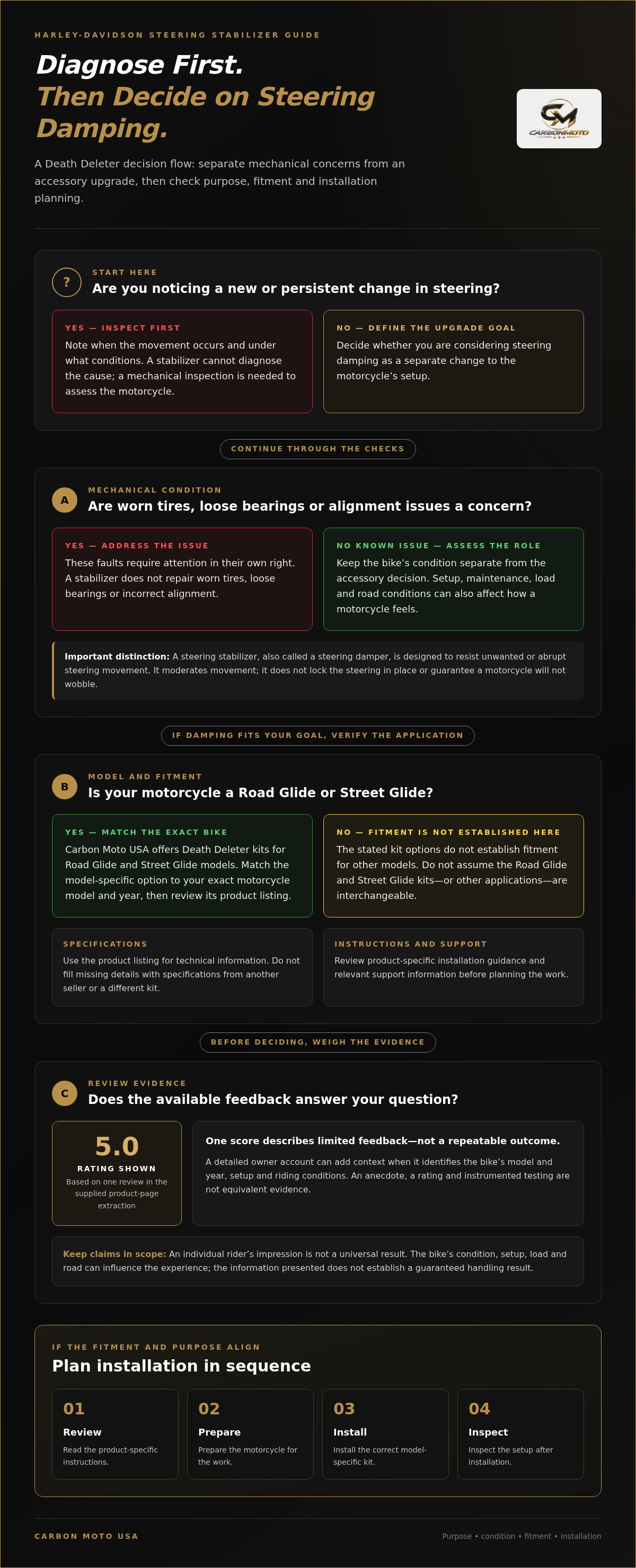
Don’t treat a stabilizer as a repair for unrelated mechanical faults. If you notice a new or persistent change in steering, assess the motorcycle’s mechanical condition before considering an accessory upgrade. Worn tires, loose bearings, and alignment issues require attention in their own right; adding a stabilizer doesn’t correct them.
- Describe the concern: Note when the movement occurs and under what conditions.
- Assess the motorcycle: Address relevant mechanical and setup issues instead of assuming a stabilizer is the diagnosis.
- Define the upgrade goal: Decide whether you’re evaluating steering damping as a separate change to the setup.
Keep those questions distinct. First establish that the motorcycle is in sound condition. Then consider whether a stabilizer’s intended role aligns with your riding concern. That gives the buying decision a firmer foundation than a product name or an isolated rider report.
How to assess the Death Deleter stabilizer as a buying decision
A useful Death Deleter stabilizer review separates what product information establishes from what a rider hopes to feel after installation. Start with purpose and exact fitment, then assess the available technical details, instructions, and review evidence. These are separate questions: a positive impression in one area doesn’t answer the others.
What the available Death Deleter information establishes
Carbon Moto USA offers Death Deleter steering stabilizer kits for Harley-Davidson Road Glide and Street Glide models. These are distinct, model-specific options, not evidence that either kit fits every year or configuration. Start with your motorcycle’s exact model and year, then use the corresponding product listing to match the stated application and review the kit details. Don’t apply measurements or compatibility statements from another retailer to these kits.
Buying consideration | What to assess
Intended use | Decide whether steering damping aligns with your upgrade objective. A stabilizer is a component choice, not evidence that every handling concern has the same cause.
Fitment | Match the Road Glide or Street Glide kit to your exact motorcycle. Don’t assume the model-specific options are interchangeable.
Available specifications | Use the product listing for technical information. Don’t fill gaps with specifications from another seller or a different kit.
Instructions and support | Review the product-specific installation guidance and relevant support information before planning the work.
Motorcycle stability involves broader engineering questions than a single accessory can answer. NASA’s report on motorcycle roll stabilization provides technical context on motorcycle dynamics; it is not a product test of the Death Deleter. Keep that distinction clear when evaluating handling claims.
How to read reviews without overinterpreting them
A star rating is a quick summary, not a detailed account of fit or long-term use. The supplied product-page extraction shows a 5.0 rating based on one review. That is limited feedback: it describes one customer’s experience but can’t establish a repeatable result across different motorcycles, setups, or riding conditions.
A detailed owner account can provide more context if it identifies the bike’s model and year, its setup, and the conditions in which the rider noticed a change. Instrumented testing is different: it measures outcomes using a defined method. Don’t treat a rating, an anecdote, and a controlled test as equivalent evidence.
Product ratings and handling claims need context: one score or rider report can describe an experience, but it can’t establish the same result for every motorcycle. To compare the model-specific options, explore the Harley-Davidson stabilizer kits and use the relevant listing as your reference for fitment and product details.
Death Deleter fitment: match the kit to your Road Glide or Street Glide
Fitment starts with the motorcycle, not the product photo. Carbon Moto USA offers separate Death Deleter steering stabilizer kits for Harley-Davidson Road Glide and Street Glide models. Choose the listing for your model family, then compare its stated application with your motorcycle’s model year and configuration. A shared brand or similar appearance doesn’t establish compatibility.
This distinction matters in a Death Deleter stabilizer review because a product name can identify an intended motorcycle family without answering every year-specific or configuration-specific question. Use the fitment information for the particular Carbon Moto USA kit. Don’t assume details from another seller’s listing apply to a similarly named product.
Confirm the motorcycle details before selecting a kit
Before choosing, note the full model name, model year, and relevant front-end configuration. Compare those details with the fitment information on the corresponding product listing. Keep the two applications separate: a Road Glide kit isn’t automatically a Street Glide kit, or vice versa. Let the model-specific listing, rather than broad family resemblance, guide your selection.
- Identify the bike: Record the exact Road Glide or Street Glide model and model year.
- Note the configuration: Include relevant front-end details and modifications that could affect fitment.
- Match the listing: Use the application stated for that specific Carbon Moto USA kit.
- Resolve mismatches: Don’t proceed based on visual similarity if the listing and motorcycle details don’t align.
Recognize when fitment needs a closer technical review
Modified front ends and non-standard configurations deserve extra scrutiny. A motorcycle may retain its Road Glide or Street Glide name while having changes that aren’t reflected in a standard model description. Compare the product-specific fitment and instructions with the bike as it’s built. Don’t use measurements or compatibility claims from a competitor’s Road Glide or CVO listing to fill in details for a different kit.
If the model year, configuration, or modifications don’t clearly match the relevant listing, pause before purchasing or beginning installation. Establish fitment first instead of treating a close match as confirmation.
Use these checks before selecting a kit:
- The motorcycle’s exact model and year correspond to the chosen listing.
- The listing applies to the correct model family, Road Glide or Street Glide.
- Relevant front-end changes or non-standard parts have been accounted for.
- The selection is supported by product-specific fitment guidance, not third-party details.
Precise matching makes for a more considered buying decision. Once the product application aligns with the motorcycle, plan installation using the instructions for that exact kit.
Installation and post-install checks: plan beyond the purchase
Buying the correct Death Deleter kit is only part of the decision. Follow the instructions for that specific product and motorcycle. Generic procedures can’t replace product-specific guidance, particularly when fitment and setup matter. If you don’t have relevant mechanical experience, have a qualified motorcycle service professional handle the work.
Plan the work in sequence: review the instructions, prepare the motorcycle, install the kit as directed, then inspect the setup. Don’t estimate hardware requirements, torque values, tools, or installation time from a different kit or an online discussion. Use the applicable product documentation for those details.
Prepare for a careful installation
Before work begins, make sure you have the kit that matches your motorcycle and the instructions that apply to it. Read the procedure from start to finish before removing or adjusting components. If the instructions don’t match your motorcycle’s configuration, pause and resolve the discrepancy rather than adapting a generic procedure.
Prepare the motorcycle according to the applicable service guidance, including securing it appropriately for the work. Set aside enough time to follow the instructions without rushing. If a step is unfamiliar or requires tools and skills you don’t have, qualified service support is the sensible choice.
Evaluate the motorcycle after installation
After installation, follow the product instructions for inspection and any required post-install checks. Look for anything the instructions identify as needing attention, and verify that the installation hasn’t created interference with the motorcycle’s movement or nearby components. Use the specified procedure rather than an improvised checklist.
Plan a cautious initial ride only after completing the required inspection. Keep it controlled and attentive, and assess the motorcycle’s steering feel without assuming it must change in a particular way. If you notice unusual steering behavior, noise, or interference, stop riding and investigate before continuing. A new sensation isn’t, by itself, proof that the kit is working as intended.
- Review: Read the instructions for the specific kit and motorcycle.
- Prepare: Secure the motorcycle and follow the applicable service guidance.
- Install: Follow the product procedure, or use qualified service support if the work is beyond your experience.
- Inspect: Complete the required checks before a cautious initial ride.
This sequence is an important part of a Death Deleter stabilizer review. A suitable purchase should come with a plan for correct fitment and careful installation, not assumptions about hardware or setup. Explore the Harley-Davidson steering stabilizer kits as you compare the model-specific options.
Who should consider the Death Deleter, and what to do next
The Death Deleter may suit a Harley-Davidson Road Glide or Street Glide owner with a defined upgrade objective and a motorcycle that matches the appropriate model-specific kit. Base the decision on fitment, product information, and a realistic understanding of a stabilizer’s intended role, not on an assumption that it will solve every handling concern.
If your motorcycle has an unresolved steering issue, address that first. A stabilizer isn’t a substitute for diagnosing mechanical or setup problems. If the bike’s configuration or model-year fitment is uncertain, pause before purchasing. A deliberate fitment check is part of deciding whether this upgrade suits your build.
A practical decision checklist for touring-bike owners
Work through this checklist in order. Start with the motorcycle’s exact model and year, then identify your upgrade goal. Finally, review the product listing and installation guidance. This keeps your preference for an accessory separate from whether it matches your bike and planned use.
- Confirm fitment: Match your exact motorcycle to the Road Glide or Street Glide kit listing. Don’t assume the applications are interchangeable.
- Define the goal: Be clear about the steering movement or setup objective you want to address, without presuming the stabilizer will resolve it.
- Review product information: Read the specifications and installation guidance for the relevant kit before deciding.
- Resolve concerns first: If the motorcycle has a handling problem or its configuration doesn’t clearly match the listing, address that uncertainty before treating an accessory as the answer.
The practical conclusion of a Death Deleter stabilizer review is straightforward: consider the kit when its model-specific application fits your motorcycle and its intended role aligns with a considered upgrade plan. It’s not the right next step if you’re relying on it to diagnose a problem or if fitment and installation remain unclear.
Explore the Death Deleter kits at Carbon Moto USA
Carbon Moto USA offers a Death Deleter steering stabilizer kit for Harley-Davidson Road Glide models and a separate kit for Harley-Davidson Street Glide models. Choose the listing for your model family, then use its fitment and product details to guide your decision. Keep the kit applications distinct and base your assessment on the relevant listing rather than claims about other products.
If the intended use, motorcycle fitment, and installation plan align, explore Death Deleter stabilizer kits. If they don’t, resolve the outstanding questions before making the upgrade part of your build.
Make Your Next Upgrade a Deliberate One
The right performance upgrade starts with a clear objective, not an expectation that one component will resolve every concern. Use this Death Deleter stabilizer review as a decision point: if your goal is defined and the product’s fitment and instructions align with your motorcycle, evaluate the kit on those terms. If a handling issue remains unexplained, make diagnosis the next step before adding parts.
Carbon Moto USA offers a Death Deleter kit for Harley-Davidson Road Glide models and a separate kit for Street Glide models. Review the listing that matches your bike and use its product information to guide your choice. Explore Death Deleter stabilizer kits and make a decision grounded in fitment, purpose, and careful planning.
A considered upgrade is a stronger foundation for the miles ahead. Take your time, verify the details, and build with confidence.
Frequently Asked Questions
What does a steering stabilizer do on a Harley-Davidson?
A steering stabilizer damps steering movement, helping resist unwanted handlebar oscillation rather than guaranteeing stability. It won’t identify or repair every cause of a handling concern. Tire condition, suspension, setup, and mechanical faults can all play a role, so consider them separately. Think of the stabilizer as a component with a specific function, not a diagnosis. Understand the Death Deleter’s operation through its product-specific information rather than assumptions about similar kits.
Is the Death Deleter stabilizer compatible with every Road Glide model year?
A product name alone doesn’t establish fitment for every model year or configuration. Compare the Road Glide kit’s stated application with your bike’s exact model year and any relevant modifications. Carbon Moto USA lists the Road Glide kit separately from its Street Glide kit, so don’t treat them as interchangeable. If the listing doesn’t clearly match your motorcycle, resolve the fitment question before ordering rather than relying on a range shown by another retailer.
Can a steering stabilizer fix a Harley-Davidson that feels unstable?
A stabilizer shouldn’t be treated as a universal fix for an unstable-feeling motorcycle. The sensation may have different causes, so assess the bike for maintenance or setup concerns before considering an accessory. For example, note whether the feeling is new or occurs only with a particular load or road surface, then share those observations during an inspection. Don’t assume the Death Deleter will eliminate a specific symptom.
How do I know whether my Harley needs a steering stabilizer?
Start by describing the handling concern precisely: what you feel, when it occurs, and whether it changes with load or road conditions. Consider the motorcycle’s current condition, setup, and intended use before deciding that a stabilizer is the right upgrade. An accessory can’t replace finding the cause of a mechanical symptom. If you’re considering the Death Deleter, compare your bike’s exact model and year with the corresponding product information.
Does the Death Deleter stabilizer require professional installation?
Professional installation depends on your mechanical experience, motorcycle configuration, and the instructions for the specific kit. Read those instructions before starting, and don’t improvise if a step or fitment detail is unclear. If you’re unfamiliar with motorcycle component installation or lack confidence in completing the work correctly, use qualified motorcycle service support. Avoid relying on generic videos or procedures for details such as tools, fasteners, or adjustment requirements unless they match the product documentation.
What should I check before buying a Harley steering stabilizer?
Check your exact motorcycle model and year against the relevant product listing, then review its stated compatibility, documented specifications, and installation guidance. A generic title may name a model family without covering every year or configuration. A star rating alone can’t establish fitment or predict your results. Keep the applications distinct: use the Road Glide listing for a Road Glide and the Street Glide listing for a Street Glide.