
Carbon Moto USA / Rider support
Cases of rough bearings, front-end wobble, and tire defects

A wandering front end isn’t always caused by the steering head. A Harley front end wandering on the highway can also point to rough or loose bearings, incorrect tire pressure, uneven wear, wheel misalignment, or tire runout. A front-wheel runout test can reveal irregular movement, but it may not show whether the tire, wheel, or bearings are responsible.
That uncertainty can make a wobble hard to diagnose, especially when it changes with speed or road conditions. This guide explains how bearing roughness, front-end wobble, and tire defects can contribute to highway wandering, and what each symptom may indicate. Learn how to distinguish a rough bearing from a tire or wheel issue, why a standard balance check may miss lateral runout, and which related parts to inspect. Work through the evidence in order: check tire condition and pressure first, then assess bearings and wheel movement before deciding what may be causing the problem.
Key Takeaways
- Spin the wheel and feel for grinding, roughness, or play to spot possible bearing problems.
- Assess steering-head movement against the motorcycle’s service-manual procedure, and inspect related components before settling on a cause.
- A balance check can miss lateral tire runout, so consider the tire and wheel together when a wobble persists.
- Check tire pressure, wear, alignment, and bearing condition methodically; correct the underlying issue before considering a steering stabilizer.
Checking wheel bearings for roughness
Begin with the front wheel. Safely support the motorcycle with the wheel off the ground, then rotate it by hand. It should turn smoothly; grinding, roughness, or noticeable play may indicate a wheel-bearing problem. A spin test alone isn’t a complete diagnosis. Check for looseness, and distinguish bearing feel from brake-pad contact or other resistance.
Steering-head check: A fall-away test evaluates steering-head bearings using the measurements in the motorcycle’s service manual. Follow the model-specific procedure rather than adjusting by feel alone. A notch or detent as the handlebars move may indicate worn steering-bearing races. One rider reported replacing races about every two years after repeated exposure to washboard-like freeway surfaces. That account describes a possible wear pattern, not a service interval for every Harley.
Situation: A high-mileage motorcycle may have wear in more than one bearing or bushing. One forum participant said motorcycles at 100000 miles may need bushings and recommended doing the bearings too. Action: Inspect wheel bearings for roughness and play, then assess steering-head movement using the manual’s fall-away procedure. Check axle-nut torque as part of the inspection, since a loose nut can contribute to wobble. Result: These checks help narrow the fault before parts are replaced; they don’t identify every possible cause by themselves.
Suspension settings, incorrect fork-oil condition, and worn shocks can affect the chassis’ response on uneven pavement, making the front end feel unstable. Check suspension condition and settings alongside the bearings. Don’t use them to dismiss detectable play or a notch.
Harley-Davidson tire pressure and steering-head adjustment vary by model. Use the owner’s manual for the correct pressure and the service manual for the bearing-adjustment procedure and measurement. Don’t substitute a generic pressure or preload setting for the specification that applies to your motorcycle.
Harley-Davidson front-end wobble diagnosis
Start by recording when the wobble appears: speed, braking, road surface, and whether acceleration changes it. One Harley rider reported wobble below about 35 miles an hour after releasing the handlebars. Don’t recreate that condition in traffic. Instead, note any repeatable symptoms during normal riding, then inspect the motorcycle while stationary.
Check fork alignment and inspect the front end for signs of twisting or damage. Misaligned forks can leave the front wheel tracking at an angle to the frame, making it harder to hold a straight line. A front-wheel runout test can reveal irregular movement, but can’t distinguish a wheel, tire, or bearing fault on its own. Compare wheel, fork, and frame alignment before replacing components.
Rear components can also feel like front-end wandering. A Harley owner with a 17-year-old motorcycle and 125K miles discussed possible worn swingarm bushings. Inspect the swingarm for play, then check rear-wheel alignment and belt tension. In another case, a friend’s 06 Ultra had rear wandering from a sheared front motor mount. Replacing the mount resolved the reported problem. These examples show why diagnosis should include the chassis, not only the front wheel.
Repair cost depends on the cause and work required. Tire correction, alignment, bearing replacement, and damaged mounts involve different parts and labor, so identify the fault before estimating the repair.
Stop riding if the wobble intensifies, steering becomes difficult to control, or a component is loose or damaged. Move out of traffic safely and arrange an inspection. A steering stabilizer is not a substitute for correcting a mechanical fault.
Tire defects and lateral runout
Lateral runout is side-to-side movement as the tire rotates. A defect in the tire’s belt layers can cause it, even when the tread looks normal. The motorcycle may feel as though it drifts or steers unevenly, particularly at highway speed. A standard balance-machine test checks balance but may not reveal lateral runout caused by a belt-layer flaw.
Distinguish balance from runout during diagnosis. First, inspect the tire for uneven wear, bulges, damage, or a bead that sits inconsistently against the rim. Then rotate the wheel slowly and watch the tire’s sidewall and tread move relative to a fixed reference point. Check the rim separately: movement at the rim suggests a wheel issue, while movement in the tire with a steadier rim points toward the tire assembly. A runout test can identify irregular rotation, but may not isolate its source.
Situation: A Harley continues to wander, but the balance test shows no obvious issue. Action: Inspect the tire and rim separately while rotating the wheel, then compare their movement. If the rim tracks steadily while the tire shifts laterally, investigate the tire rather than assuming another balance adjustment will solve the problem. Result: This sequence helps distinguish tire runout from wheel runout and avoids treating a balance result as the end of the diagnosis.
A tire expert estimated that defects of this kind occur in around 0.1 percent of tires across manufacturers. That estimate describes an uncommon possibility, not a diagnosis for every wandering motorcycle. Treat it as a reason to inspect carefully when other checks don’t explain the symptom.
Note where the movement appears, such as at the sidewall, tread, or rim, and whether it repeats with each rotation. If the tire shows visible damage or pronounced lateral movement, don’t treat balance alone as proof that it’s sound. Use the motorcycle’s service procedure to assess runout and determine whether the tire or wheel needs correction.
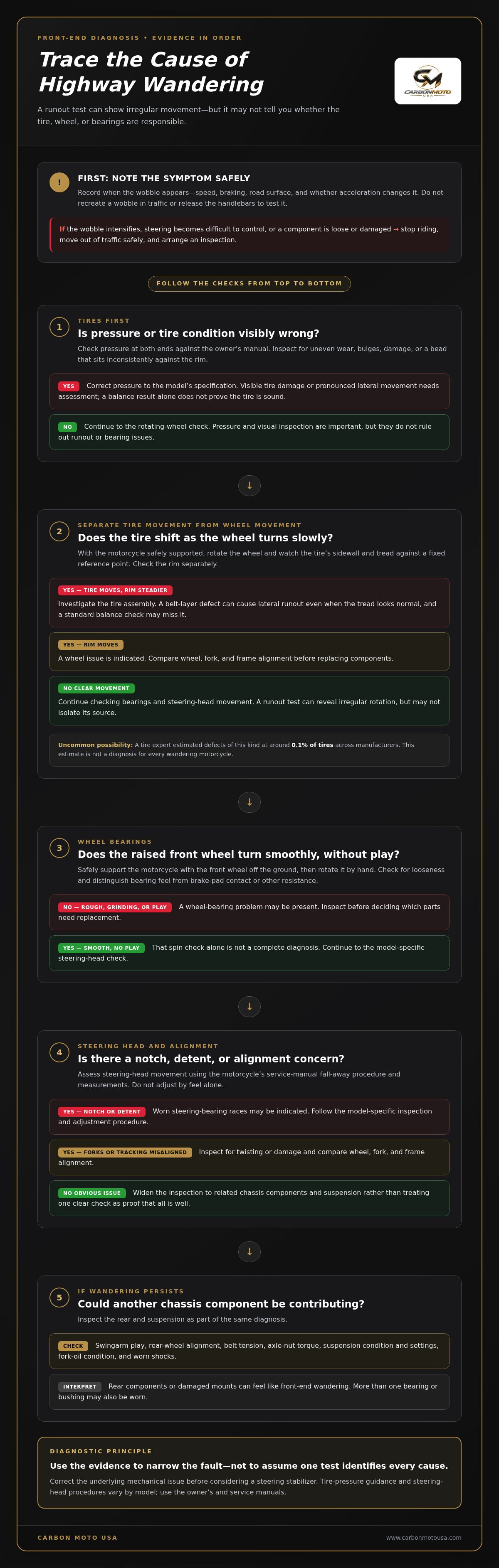
What causes a Harley-Davidson front end to wander at highway speeds?
Start with the tires and pressure at both ends. Low pressure can make steering feel heavy or unstable: one Harley rider reported difficult steering with the front tire at 20 psi. Check pressures against the motorcycle’s specified values, then inspect front and rear tread for cupping or uneven wear. A slow leak matters too. One Street Glide lost about 1 PSI every two to three days, making repeated pressure checks important.
Next, compare wheel tracking and fork alignment. Bent forks or a front wheel misaligned with the motorcycle can affect straight-line handling. Rear-to-front tracking that is slightly off-center may cause drifting, though it doesn’t necessarily create a wobble. Include rear-wheel alignment and belt tension in the inspection.
Situation: A rider described a 2007 Night Train that wandered while traveling straight at any speed, with slight handlebar movement triggering wobble in curves. The bike also had a wide 200 rear tire. Action: Inspect tire wear and pressure at both ends, confirm balance, and assess alignment before assuming one part is responsible. Result: This sequence can narrow the cause without treating a symptom as a diagnosis.
Bearings and chassis components are also possible contributors. Rough wheel or steering-head bearings can affect control, while worn mounts or swingarm components may cause movement that feels like front-end trouble. A runout test can reveal wheel movement, but may not show whether the wheel, tire, or bearings caused it. Match each finding to the component involved.
For a Harley front end wandering on highway roads, record when the symptom occurs, then inspect tire pressure, tread, alignment, and bearing condition in order. Correct the underlying fault first. A steering stabilizer is a separate consideration, not a substitute for diagnosis. After mechanical issues are addressed, explore the Road Glide and Street Glide steering stabilizer kits if one suits your model and setup.
Carbon Moto USA: BMW R 1300 GS Carbon Fiber
Carbon Moto USA offers BMW R 1300 GS Carbon Fiber for riders planning a focused build around that model. Its carbon-fiber offerings also include the BMW R 1250 GS, Harley Davidson Pan America, and Ducati. These components support a different goal from diagnosing highway wandering: they’re for riders considering model-specific carbon-fiber parts, not a repair for rough bearings, tire defects, or misalignment.
If your Harley still wanders, resolve the mechanical cause before choosing accessories. For a Harley-Davidson Pan America build, explore its carbon-fiber offering; for a BMW R 1300 GS project, consider the corresponding parts. Match the offering to your motorcycle and the direction of your build.
Contact Carbon Moto USA to discuss its carbon-fiber offerings.
Take the Next Step With Confidence
A Harley front end wandering on highway roads deserves a methodical response, not a quick adjustment that masks the underlying fault. Make your next step a clear decision: record the conditions, complete the relevant checks, and address the source before returning to normal riding. If instability remains or the cause is unclear, pause the ride and have the motorcycle inspected before adding accessories.
Once your Harley’s handling concerns are resolved, you can turn to a separate build goal. Carbon Moto USA offers carbon-fiber components for the BMW R 1300 GS, BMW R 1250 GS, and Harley Davidson Pan America. Choose according to the motorcycle you’re refining and the direction you want its design to take. Keep the priorities distinct: sound mechanical condition first, customization second.
Contact Carbon Moto USA to discuss your next motorcycle project. A careful diagnosis and a considered build are practical steps toward a more confident ride.
Frequently Asked Questions
How do tire pressure and worn or mismatched tires affect Harley highway handling?
Incorrect pressure changes how the tire profile meets the road, while uneven wear can make steering response inconsistent. Check pressure when the tires are cold and use the motorcycle’s specified values. Compare each tire’s size and type with the model’s approved fitment. After replacing a tire, check that the bead seats evenly and that the front and rear combination follows the manufacturer’s recommendation.
How to check Harley-Davidson steering head bearings for looseness or binding?
With the motorcycle securely supported and the front wheel unloaded, gently push and pull the fork legs to check for steering-head play. Then turn the handlebars slowly from side to side. A notch, tight spot, or resistance can indicate binding; cable or hose tension can also affect movement. Follow the model’s service-manual test and adjustment procedure before changing bearing preload.
How to inspect Harley wheel bearings, spokes, and front axle for handling problems?
Securely raise the front wheel, then check for bearing play by moving the rim side to side and rotating it slowly. On a spoked wheel, look for loose, damaged, or missing spokes and visible rim distortion. Confirm that the axle is fully seated and the spacers are correctly positioned. Use the Harley-Davidson service manual for axle torque and wheel-specific inspection requirements.
What diagnostic steps should a mechanic use to find a Harley front-end wandering problem?
If your Harley front end is wandering on the highway, give the mechanic details about the road surface, braking, acceleration, luggage, and any recent tire or suspension work. These conditions can help distinguish a recurring symptom from a one-off disturbance. The mechanic can inspect tires, steering and wheel bearings, alignment, and runout, then compare measurements with the model’s service specifications. Recheck handling after correcting the identified fault.
How much does it cost to diagnose and repair a Harley that wanders at highway speed?
Cost depends on the cause and work required, such as tire correction, alignment, bearing replacement, or damaged mounts. Identify the fault before estimating parts and labor.