Carbon Moto USA / Rider support
Carbon Winglets for Ducati Panigale: Fitment & Buying Guide

A winglet can match your Panigale’s lines and still be the wrong part for its fairings. A search for carbon fiber winglets Ducati Panigale riders can use quickly reveals why: listings often separate applications by year and version, while product photos emphasize weave and finish. Start with the fairing configuration, not the finish.
It’s natural to focus on the visual change or the promised aerodynamic function. Neither tells you whether the winglet’s shape and mounting points suit your bike. Model-year distinctions matter: listings, for example, separate 2020-2021, 2022-2024, and 2025-and-later Panigale V4 applications.
This guide explains how to identify your Panigale configuration, understand the intended aerodynamic role of winglets, and compare construction, finish, and fitment claims. It also separates functional considerations from styling choices, so you can assess an upgrade on more than appearance alone. Carbon Moto USA sells Ducati carbon-fiber components, including Panigale V4 parts. Use the fitment-first approach below to make a more informed choice for your build.
Key Takeaways
- Start with your Panigale’s exact model, year, trim, and fairing configuration. Similar-looking bikes may use different winglet fitments.
- Compare carbon fiber winglets Ducati Panigale listings by their stated applications, and treat compatibility claims as specific to the listed configuration.
- Understand the intended aerodynamic role of winglets, but keep expectations grounded in factors such as shape, placement, speed, and setup.
- Evaluate construction and finish only after fitment. Weave, surface treatment, and OEM-style appearance are separate considerations.
- Use a fitment-first plan for Panigale carbon-fiber upgrades, including Ducati and Panigale V4 parts available through Carbon Moto USA.
Why Ducati Panigale Carbon-Fiber Winglets Deserve a Fitment-First Approach
Before comparing weave, finish, or styling, establish whether the winglet is intended for your exact Panigale configuration. “Panigale V4” alone may not be enough to identify fitment. Model year, trim, and the fairing currently on the motorcycle can all affect whether a part aligns correctly. A component can look right in a product photo and still be unsuitable for your bike.
A motorcycle winglet is a shaped aerodynamic surface designed to influence airflow around the motorcycle. Its profile and position can affect the aerodynamic load acting on the bike. That purpose is separate from its visual effect: a winglet may sharpen the motorcycle’s appearance, but appearance alone doesn’t establish how it performs. General principles of aerodynamics explain the relationship between shape, airflow, and force, but they don’t prove the performance of a specific aftermarket part.
What Panigale winglets are designed to do
Winglet geometry guides airflow and can generate aerodynamic force as air moves over the motorcycle. The direction and magnitude of that force depend on the design and conditions, not on the carbon-fiber material alone. Speed, rider position, motorcycle setup, and the winglet’s location all affect how it operates. Treat benefits as part-specific claims, not guaranteed outcomes for every Panigale or riding situation.
Set expectations around your intended use. A rider focused on track performance may assess aerodynamic design differently from someone prioritizing a cohesive road-bike appearance. In either case, distinguish what the product is designed to do from what its styling changes. A dramatic profile is not, by itself, evidence of a measurable performance gain.
Why the Panigale model and fairing matter
Record four details before interpreting a fitment listing: model family, trim, model year, and installed fairing configuration. Trim names such as V4, V4S, or V4R identify different versions within the same family. A year range narrows the application, but it doesn’t automatically establish compatibility with every trim or replacement body panel.
Fairings are the physical interface between the winglet and the motorcycle. Differences in panel shape, mounting locations, or surrounding clearance can affect alignment and attachment. A listing that names the Panigale family but gives little year or fairing detail leaves important questions unanswered. Look for a clearly stated application and compare it with the bike’s actual configuration, especially if its bodywork has been changed.
Make fitment the first purchase decision, not a detail to resolve after choosing a finish. For carbon fiber winglets Ducati Panigale owners are considering, note the listed year range and trim, then determine whether the part is described for the relevant fairing. After that, compare construction, finish, and design. This sequence keeps an appealing visual upgrade grounded in compatibility and realistic expectations.
How Carbon-Fiber Panigale Winglets Work Without the Hype
A winglet is a shaped surface that interacts with airflow around a moving motorcycle. Its geometry and position can influence pressure and aerodynamic forces, including drag and downforce. That principle explains the design intent, not the result of every part fitted to every bike. SAE International’s discussion of aerodynamic drag and downforce on motorcycles considers these forces in the context of competition motorcycles.
The effect depends on more than a winglet’s outline. Airflow changes with speed, rider position, surrounding bodywork, and motorcycle setup. Two designs that look similar may interact differently with the air if their shapes or positions differ. Without testing that supports a specific claim, don’t translate a product description into a promised increase in stability, reduced lap time, or other measurable gain.
Aerodynamic purpose versus styling
On a sport motorcycle, winglet surfaces are intended to manage airflow and produce an aerodynamic load. Their visual role is separate: they can emphasize the front fairing, echo racing-inspired forms, or create a more integrated appearance. Those are valid styling considerations, but they don’t demonstrate aerodynamic performance. Evaluate appearance on its own merits, and look for relevant test evidence before treating a performance claim as established.
For road use, track riding, or display, priorities may differ. Consider where and how you use the motorcycle, then weigh the intended function against the design you want. A carbon-fiber finish can make a component visually prominent without changing what the winglet’s geometry is designed to do.
What carbon fiber tells you, and what it does not
Carbon fiber identifies a material choice. By itself, it doesn’t specify the part’s construction, manufacturing process, surface coating, or compatibility with a particular fairing. A visible weave also doesn’t establish how consistently a component was made or how it will perform aerodynamically.
A material label alone cannot establish aerodynamic benefit. Separate the buying questions before comparing parts:
- Material: What material does the listing identify?
- Construction: Does the description explain how the component is made?
- Surface: Is the finish matte, gloss, or another treatment, and does it suit the rest of the bike?
- Fitment: Is the stated application appropriate for the motorcycle’s model, year, trim, and bodywork?
This distinction helps you assess carbon fiber winglets Ducati Panigale listings without treating weave or finish as evidence of engineering performance. Confirm fitment first, then judge material and appearance as separate factors. For a broader, coordinated build, explore Ducati carbon-fiber components alongside your other upgrade considerations.
Compare Ducati Panigale Winglets by Model, Year, and Fairing
Fitment language is useful only when it describes the bike in front of you. The examples below summarize published application statements; they are not universal compatibility guidance. “Not specified” means the information available here doesn’t identify that detail. Compare the full product listing with your motorcycle’s documentation and installed bodywork before treating a claim as applicable.
| Model | Year | Trim | Fairing configuration | Stated fitment |
|---|---|---|---|---|
| Panigale V4 | 2020-2021 | V4, V4S, V4R | Not specified | Some aftermarket listings state fitment for these variants. |
| Panigale V4 | 2022-2024 | V4, V4S, V4R | Not specified | Listings state fitment for V4 and V4S; V4R applications may begin in 2023. Check the individual listing. |
| Panigale V4 | 2022-2024 | V4 SP2 | Not specified | Ducati Performance states fitment for this range. |
| Panigale V4 | 2025-2026 or 2025+ | V4; some listings also name V4S and Tricolore | Not specified | Published claims vary by listing: some specify 2025-2026, while others state 2025+. |
These are seller-stated applications, not independent confirmation that every trim or fairing is interchangeable. Airshaper’s overview of motorcycle aerodynamics and winglet function provides context on design purpose, but aerodynamic principles don’t establish physical fitment.
Check the exact Panigale V4 variant
Record the model year and trim from the motorcycle’s official documentation. Keep V4, V4S, V4R, SP2, Tricolore, and Superleggera references distinct. A product title naming one variant doesn’t automatically cover another. If a listing uses broad family language, look for a precise fitment table and any exclusions instead of extending the claim by assumption.
Reconcile year ranges and fairing revisions
Compare the page title with its fitment list, exclusions, and notes. If one part of a listing says “MY22+” while its title specifies 2022-2024, treat the wording as unresolved rather than assuming a broader range. Note whether the motorcycle retains its original fairing or has replacement bodywork. A shared model name does not guarantee shared mounting geometry.
For a similar model-specific approach to another component, the Ducati V4 carbon-fiber heel guard fitment guide illustrates why identifying the precise application matters across a build. Apply that same discipline to carbon fiber winglets Ducati Panigale listings: match year, trim, and fairing details before comparing design or finish.
Use This Checklist to Evaluate Carbon-Fiber Winglets Before Buying
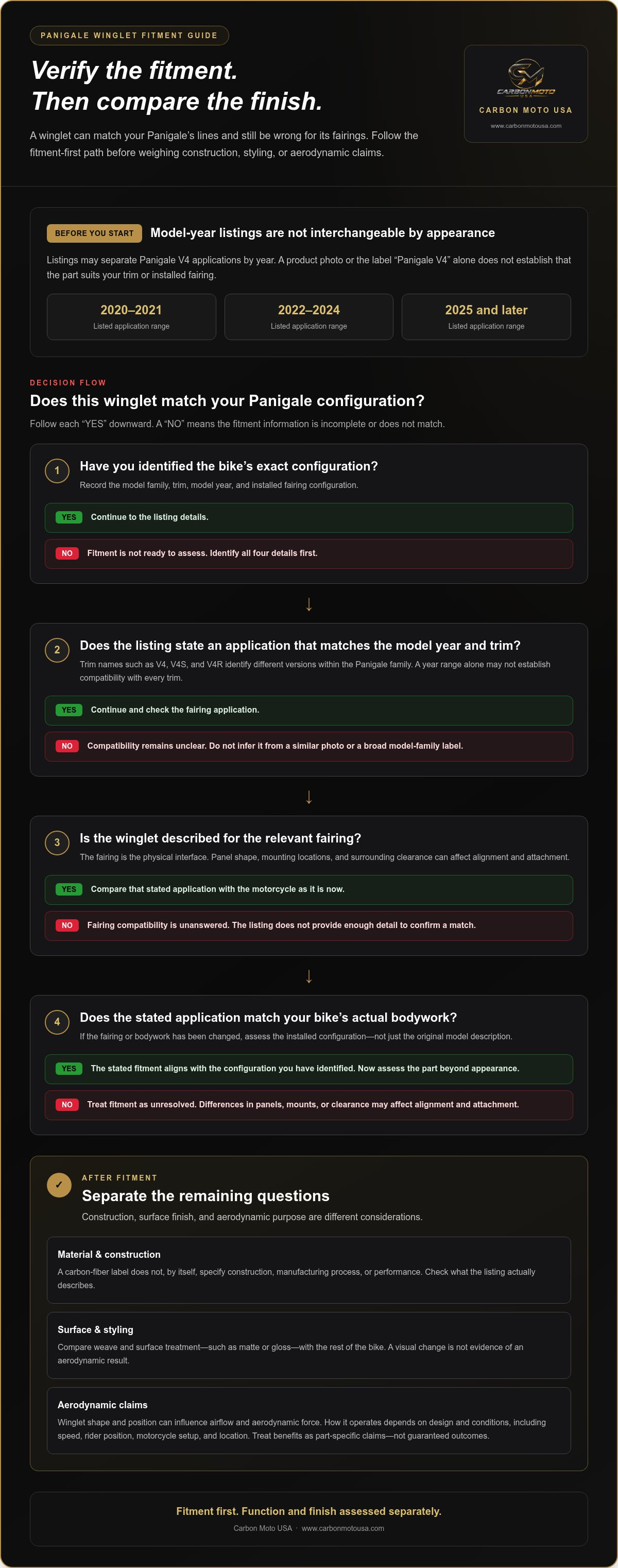
Work through the decision in order. This separates compatibility from appearance, so an attractive finish doesn’t distract from unanswered questions about the part. Use the checklist to compare carbon fiber winglets Ducati Panigale listings on the details that matter to your purchase.
- Identify the motorcycle. Record its model family, model year, trim, and installed fairing configuration. Use the bike’s documentation rather than relying on appearance or a broad “Panigale” description. Note any replacement bodywork, since the current configuration is what the part must suit.
- Confirm stated fitment. Compare the product title, year range, trim list, exclusions, and fitment notes. Look for an application that matches your motorcycle. If one part of the listing conflicts with another, treat the claim as unresolved rather than assuming the broader interpretation is correct.
- Compare construction. Separate information about the material from details about the manufacturing method and component design. Look for documentation explaining what the product is made from and how it is constructed. Don’t infer a construction process or performance benefit from a carbon-fiber label alone.
- Assess the finish. Once fitment and construction are clear, compare the documented weave and surface treatment with the rest of the bike. Choose a finish for the visual result you want, not as a shortcut for judging quality or aerodynamic performance.
Assess construction, weave, and finish
Plain, twill, and forged-carbon appearances create different visual effects, but compare them only when the listing identifies the option. A visible weave describes surface appearance; it doesn’t establish how the part was manufactured. Matte and gloss describe surface finish, not underlying construction. Keep those distinctions in mind when comparing product photos with written specifications.
For an OEM-style look, choose a finish and weave that sit naturally beside the existing bodywork. A more distinct pattern or surface treatment can instead make the winglets a deliberate visual feature. Neither choice is inherently more functional. Prioritize accurate product descriptions and a finish that suits your build.
Plan for installation and intended use
Review the product documentation for mounting details, clearance information, and included hardware. Don’t assume hardware or instructions are identical across different parts. Use the product’s instructions as the reference for installation questions. Consider whether the bike is primarily used on the street or track, but don’t treat intended use as evidence of a guaranteed aerodynamic result.
With the fitment and selection criteria in hand, explore Ducati carbon-fiber parts from Carbon Moto USA as you plan a cohesive Panigale upgrade.
Explore Ducati Carbon-Fiber Parts with a Clear Panigale Upgrade Plan
A considered Panigale build follows a clear sequence: confirm the component’s fitment for your exact motorcycle, understand its design and intended role, then compare material and finish. Keep those decisions distinct. A visual match can help create a cohesive build, but it doesn’t establish compatibility or prove a performance benefit.
Use the same sequence whether you’re researching carbon fiber winglets Ducati Panigale riders may consider or planning a broader carbon-fiber update. Each component has its own application. Don’t assume parts designed for the same model family share mounting points, fairing interfaces, or year coverage. Evaluate each against the motorcycle configuration it will actually meet.
Build a coherent Panigale carbon-fiber setup
Think about the motorcycle as a complete design, but assess every component individually. A consistent weave or surface finish can tie several parts together visually. That aesthetic continuity is one planning criterion; fitment and intended function are separate ones. Before adding a component to your plan, establish its stated application and consider how its design relates to the bike’s purpose.
Carbon Moto USA is an online retailer of Ducati carbon-fiber parts, including components for the Panigale V4. Its catalog brings Ducati carbon-fiber bodywork together for riders planning a broader build. Treat each listing as a component-specific decision: match the part to the motorcycle, then consider how it complements the rest of your setup.
Make the next purchase step straightforward
Before choosing a component, keep a simple record of your motorcycle’s model, year, trim, and current bodywork. Use it to assess fitment information consistently across your build. Then decide whether your priority is visual integration, a particular material appearance, or a component’s stated design purpose. This prevents one appealing feature from standing in for information that answers a different question.
That discipline makes the upgrade process more manageable and keeps expectations grounded. A carbon-fiber finish is a material and styling choice, while a performance claim requires relevant evidence. Review each part on its own, and build around stated fitment rather than assumptions based on a shared model name.
Carbon Moto USA brings Ducati and Panigale V4 carbon-fiber components together in its online catalog. Browse Ducati carbon-fiber parts and plan your Panigale setup with fitment as the first criterion.
Make Your Next Panigale Upgrade a Deliberate One
Let the motorcycle’s configuration guide your next move. Once you’ve identified the right application, choose a component for its intended role and the look you want your build to carry. That approach keeps the decision focused, whether you’re comparing carbon fiber winglets Ducati Panigale riders consider or planning another carbon-fiber addition.
Think beyond a single part. A well-considered build balances fitment, visual coherence, and functional purpose without assuming one choice automatically delivers all three. Evaluate each component on its own merits, then decide how it contributes to the motorcycle as a whole.
Carbon Moto USA offers specialized carbon-fiber components for Ducati motorcycles, including Panigale V4 parts. Explore Ducati carbon-fiber parts and take the next step toward a Panigale setup that reflects your priorities. Start with fitment, then choose the details that complete your build.
Frequently Asked Questions
Do carbon-fiber winglets fit every Ducati Panigale V4 model year?
No. Carbon fiber winglets Ducati Panigale listings may specify distinct year ranges and trims, so don’t treat one V4 application as universal. For example, don’t assume a part described for 2022-2024 fits a 2020-2021 or 2025 model. Compare the listing’s full fitment details with your bike’s documentation, including any exclusions or notes that narrow the application.
What is the difference between Panigale V4 and V4S winglet fitment?
It depends on the specific winglet and its stated application. Some listings name both V4 and V4S; that wording applies only to the product and years identified, not automatically to every part. If you own a V4S, make sure the listing names that trim or provides clear documentation covering it. Don’t infer compatibility from shared styling or another product’s fitment description.
Do Ducati Panigale winglets improve downforce or handling?
Winglets are designed to influence aerodynamic forces, but a specific improvement in downforce or handling depends on the design and operating conditions. A product description alone can’t establish a measurable change for your motorcycle. For a meaningful comparison, look for test information that identifies the component and conditions. Treat handling or performance claims cautiously if they aren’t supported by relevant evidence.
Are carbon-fiber winglets lighter than the original parts?
Not necessarily. Carbon fiber as a material doesn’t establish the weight of a finished winglet or prove it’s lighter than the original component. Compare documented weights for the complete parts, including any hardware, rather than relying on material labels or general claims. Make sure the figures refer to comparable components and configurations. If a listing provides no weight information, don’t assume a reduction.
How can I check whether winglets fit my Panigale’s fairings?
Start with the motorcycle’s model year and trim, then compare them with the part’s fitment notes and exclusions. If the fairings have been replaced, identify their manufacturer and intended model application from their documentation. Product photos can show the component’s shape, but they don’t confirm mounting compatibility. Look for installation or mounting details that specifically cover your fairing configuration before choosing a part.
What is the difference between matte and gloss carbon-fiber winglets?
Matte and gloss describe the visible surface appearance, especially how the part reflects light. Gloss tends to appear more reflective, while matte has a less reflective look. These finish terms don’t identify the underlying carbon construction or manufacturing method. Compare the finish with nearby bodywork in similar lighting, and use the product’s stated finish information rather than relying only on edited listing photos.
Can Panigale winglets be installed on a motorcycle with replacement fairings?
Compatibility depends on whether the replacement fairings match the winglet’s intended mounting geometry and provide the required clearance. The motorcycle’s original model and year alone may not describe its current bodywork. Use the fairing documentation alongside the winglet’s application and mounting instructions. If those documents don’t establish a match, don’t assume the component will align or attach correctly.