
Carbon Moto USA / Rider support
Ducati V4 Carbon Fiber Heel Guards: Fitment & Buying Guide

The best-looking heel guard isn’t necessarily the right one for your Ducati V4. Choosing carbon fiber heel guards Ducati V4 riders can use confidently starts with the exact model, year, and variant, not the weave or finish. A small difference in listed fitment can determine whether a part aligns with the motorcycle as intended.
It’s natural to focus on carbon-fiber styling when building a cohesive look across the bike. But product photos don’t always show mounting points or rider-contact coverage clearly. Material and finish matter, as do the details that shape how a heel guard sits beside your boot and surrounding components.
This guide explains how to assess fitment before buying, what to look for in material and finish descriptions, and how to evaluate coverage and rider contact using the information provided. You’ll also learn how to weigh those practical details against the visual match you want, so your choice supports a considered Ducati V4 carbon-fiber build rather than relying on appearance alone.
Key Takeaways
- Start with your exact Ducati V4 model, year, and variant; fitment wording can differ across versions and model generations.
- Evaluate carbon fiber heel guards Ducati V4 listings by separating documented specifications from details that photos only suggest.
- Compare rider-contact coverage and mounting information before weighing weave, finish, or visual coordination.
- Use a step-by-step checklist to review model identity, fitment, images, finish, and included hardware.
- Plan heel-guard research as part of a cohesive build, then explore Ducati and Panigale V4 carbon-fiber parts for related upgrades.
What Ducati V4 Carbon Fiber Heel Guards Do and Don't Do
A heel guard sits beside the rider’s foot controls, near the area where a boot may meet motorcycle components. It is a localized panel near the rider’s heel and foot controls, not a fairing that forms the motorcycle’s bodywork or a heat shield designed to manage exhaust heat. That distinction helps set realistic expectations when comparing carbon-fiber parts.
On a Ducati V4, a guard’s shape and position affect which surfaces it covers and how it relates to the rider’s boot. Depending on its design and placement, it may provide a barrier between the heel and adjacent components. Don’t assume every item described as a heel guard offers the same contact area, coverage, or protective function.
Where heel guards sit around the Ducati V4 foot controls
Look around the footpeg and rearset, the assembly that positions the footpeg and associated controls. The heel guard occupies this rider-contact zone, near the boot as the foot rests on or moves around the peg. Its outline and mounting location help determine whether it sits beside the heel, shields nearby surfaces, or leaves areas exposed. Don’t assume all Ducati V4 variants share identical geometry.
Heel guards versus fairings and heat shields
These components serve different areas and purposes. A fairing is bodywork; a heel guard sits by the foot controls. A heat shield is intended to limit heat exposure, but that function depends on its construction, placement, and product-specific specifications. Carbon fiber describes a material category, not proof that a particular part provides heat protection. For broader background on the properties and applications of carbon fiber, remember that material alone doesn’t establish a component’s intended use.
- Heel guard: Sits near the rider’s heel and foot controls; assess its documented shape, coverage, and mounting.
- Fairing: Forms part of the motorcycle’s bodywork; it isn’t interchangeable with a localized foot-control guard.
- Heat shield: Intended for heat management; don’t infer that role from appearance or material alone.
That distinction matters for ergonomics. A part’s position can affect where the boot meets the motorcycle, but a photograph can’t establish how it will feel for every rider or riding position. Check images for the guard’s edges, position relative to the footpeg, and visible attachment points. Treat these as clues to shape and placement, not proof of compatibility or rider-contact performance.
When considering carbon fiber heel guards Ducati V4 owners should distinguish a plausible function from a documented specification. Product descriptions and fitment information should support claims about compatibility, mounting, coverage, or heat management. Carbon fiber can contribute to a coordinated visual build, but the material itself doesn’t confirm a guard’s dimensions, strength, finish, or ergonomic effect. Evaluate the documented role first, then consider how the part’s appearance fits the surrounding components.
How Carbon Fiber Heel Guards Fit Into a Ducati V4 Build
A heel guard is a small component, but its material and finish can influence the visual rhythm of a Ducati V4. Treat it as one element in a wider build: consider how it relates to adjacent carbon-fiber parts, painted surfaces, and visible hardware. This approach can create continuity without mistaking a coordinated appearance for proof of mechanical compatibility.
A carbon-fiber label alone cannot establish a part’s fitment, construction, or performance. Those qualities depend on specifications for the individual component. Claims about weight reduction, durability, or heat performance need product-specific evidence, not assumptions based on the material name or a photograph.
Material and finish: what to evaluate
Separate the material description from construction details. A listing may identify carbon fiber without explaining the layup, resin, thickness, or manufacturing process. Don’t infer those details unless they’re documented. Product images can help you assess visible weave, gloss or matte appearance, and surface consistency, but lighting and image editing can change how those features look.
Weave and finish are useful comparison points, not automatic indicators of strength. A particular pattern or glossy surface doesn’t prove a component is more durable or better suited to a specific use. Look for clear, consistent views and descriptions, then distinguish what the listing states from what an image merely suggests.
Matching heel guards to surrounding Ducati V4 components
For a cohesive build, compare the guard with nearby carbon-fiber parts and factory surfaces. Check whether the visible weave direction, color tone, and gloss level appear compatible. If possible, compare images taken under similar lighting; reflections can make the same finish appear lighter, darker, or more reflective. Visual coordination is a styling decision, separate from mechanical fitment.
Think about the motorcycle as a composition rather than a collection of isolated upgrades. A heel guard beside a carbon-fiber panel may look intentionally matched, while a different weave or sheen can create deliberate contrast. Either can work. Decide whether you want continuity or contrast, then compare the part with the components it will sit beside.
- Material: Note exactly what the listing identifies, and don’t fill in undocumented construction details.
- Surface: Compare weave appearance, color, and gloss using images with similar lighting where possible.
- Performance: Look for component-specific evidence before relying on claims about weight, durability, or heat behavior.
- Compatibility: Assess visual matching separately from model fitment and mounting details.
Use this framework when assessing carbon fiber heel guards Ducati V4 riders may consider for a broader build. Appearance can guide the overall design, while fitment and performance need their own supporting details. To plan a coordinated upgrade around model-specific components, explore Ducati carbon-fiber parts as part of your build research.
Ducati V4 Heel Guards: Compare Fitment, Coverage, and Finish
Compare heel guards by separating confirmed product details from what an image merely suggests. A listing’s application should match your exact motorcycle, including model year and variant. “Ducati V4” alone may be too broad to establish fitment: a Panigale V4 reference and a Streetfighter V4 reference aren’t interchangeable by default. Treat each stated application as specific to that listing.
Check Ducati model, year, and variant compatibility
Start with the model name shown in your motorcycle’s documentation, then note its model year and variant. Compare all three with the product’s stated application. If the listing describes a range of years, make sure your year falls within it; if it names a variant, don’t assume the part also fits another version. Resolve fitment before comparing appearance.
Compare coverage, mounting points, and finish
Use product images to inspect the part’s outline and visible coverage near the rider’s heel. Images can help you understand shape, but they don’t prove exact dimensions or how much of the rider-contact area is covered. Treat mounting positions and included hardware as established facts only when the listing describes or clearly identifies them.
The table separates what a product listing should establish from visual clues and general guidance. It doesn’t assign specifications to a particular heel guard.
| Comparison point | Documented information to look for | What not to assume |
|---|---|---|
| Model fitment | Exact model, variant, and applicable model year stated together | That “Ducati V4” covers every V4 motorcycle or generation |
| Coverage | Written description of the guard’s intended coverage | That a product image shows complete rider-contact protection |
| Mounting | Described attachment locations or installation points | That visible holes establish exact alignment or compatibility |
| Finish | Named finish or weave description in the listing | That lighting accurately represents color, gloss, or texture |
| Included hardware | Explicit list of supplied fasteners or other components | That hardware is included simply because it appears in a photo |
Keep visual matching separate from mechanical fitment. A weave or gloss may look consistent with nearby components, but that tells you nothing about mounting alignment. Likewise, a close-up can suggest the guard’s shape without confirming its coverage on your motorcycle. Use images to assess appearance and outline; use written application and specification details to judge the claims they support.
When comparing carbon fiber heel guards Ducati V4 riders should record each listing’s stated model, year, and variant before weighing finish or coverage. If any part of the fitment wording doesn’t match your motorcycle precisely, don’t treat a similar name or photograph as proof of compatibility.
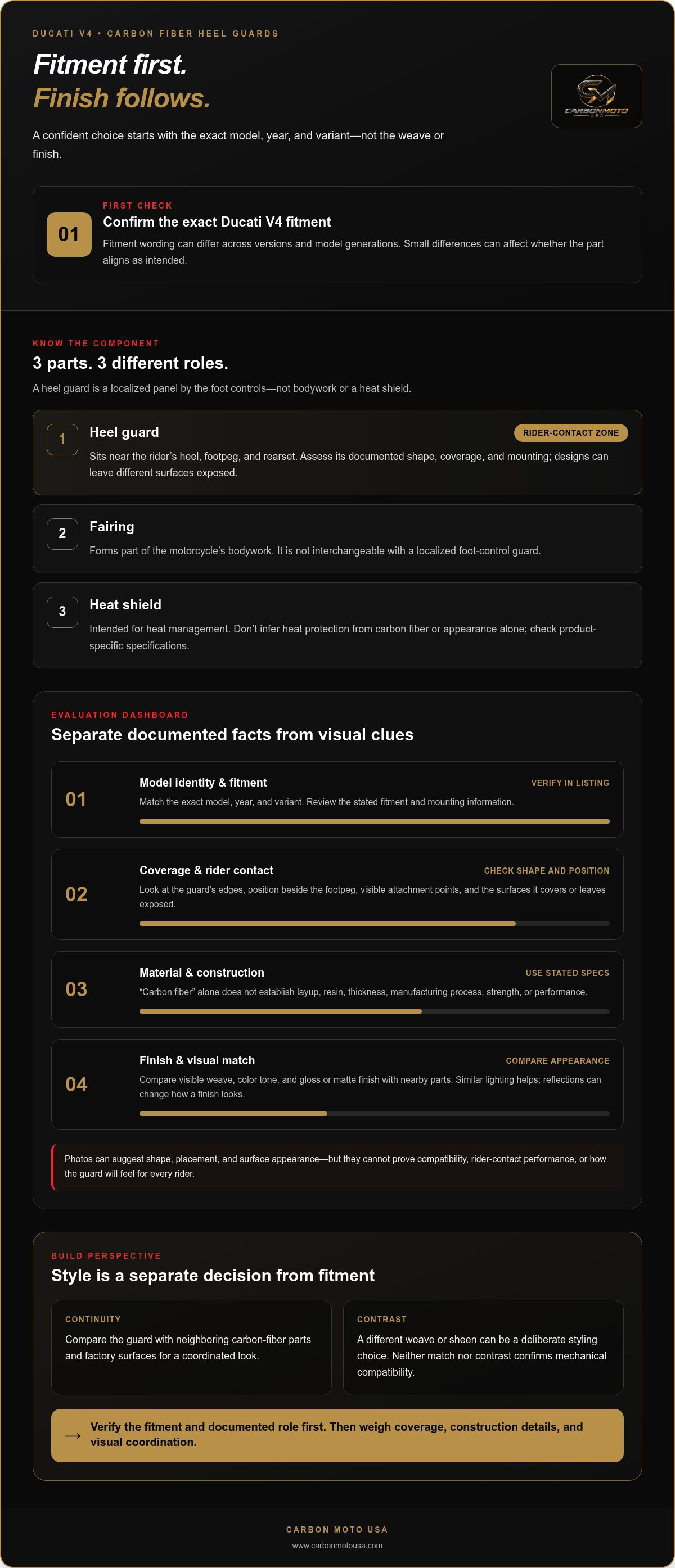
A Practical Checklist Before Buying Ducati V4 Carbon Fiber Heel Guards
Make the decision in sequence. Confirm which motorcycle the part is intended for before comparing weave, finish, or price. For carbon fiber heel guards Ducati V4 riders are considering, a precise fitment match and clear product details are more useful than a broad model label or an attractive photograph.
Five checks to complete before selecting a part
Work through these checks in order. Keep the product listing available as you compare details, and separate explicit specifications from visual impressions. If a key fitment or mounting detail is unclear, don’t treat resemblance to another Ducati part as proof that it applies to your motorcycle.
- Identify your motorcycle. Record the exact Ducati model, model year, and relevant variant. Use the motorcycle’s documentation or identification details rather than relying on a general “V4” description.
- Match the stated application. Compare your model, year, and variant with the product’s fitment wording. A listing for one V4 model doesn’t automatically establish compatibility with another.
- Review the component images. Look at the guard’s outline, visible coverage, and relationship to the foot-control area. Use images to understand appearance, not to infer exact dimensions or fitment.
- Compare finish and surface. Check how the listing describes the weave and finish, then compare images with nearby motorcycle components under similar lighting where possible. Keep this styling check separate from compatibility.
- Read the final specifications. Look for documented dimensions, mounting details, and an explicit list of included hardware. Don’t assume a fastener is supplied just because it appears in a photo.
Plan installation without assuming universal fit
Before installation, review the instructions and documented hardware supplied for the selected part. Don’t assume the stock fasteners or mounting points apply to every model or variant. If you’re unsure whether the instructions are clear or the installation can be completed safely, have a qualified motorcycle technician handle the work.
Keep a simple record of what the listing actually says: its stated application, coverage description, finish, mounting information, and included items. This makes it easier to compare options without letting a polished image stand in for missing specifications. It can also help you spot mismatches early, before styling becomes the deciding factor.
Once you’ve established your fitment priorities, explore Ducati carbon-fiber parts to consider how model-focused components can contribute to a cohesive build.
Explore Ducati V4 Carbon Fiber Parts for a Focused Upgrade
Heel-guard research can be the starting point for a more considered Ducati build. Instead of choosing parts one at a time by appearance, decide what role each upgrade should serve and how it relates to the motorcycle as a whole. Carbon Moto USA’s catalog includes Ducati carbon-fiber parts, including parts for the Panigale V4. Use a model-focused approach to keep your research organized without assuming every component fits every V4.
Build around exact motorcycle fitment
Keep your motorcycle’s model, year, and variant consistent as you plan. Record them once, then use the same details to assess each component’s stated application. This helps prevent a broad model label or a similar-looking part from standing in for explicit fitment information. Treat compatibility as component-specific, and rely on the application details for each part rather than extending one part’s fitment to another.
A focused parts list also makes the build easier to evaluate. Note each component’s intended location, stated fitment, and purpose. For example, a heel guard belongs in your rider-contact planning, while other carbon-fiber pieces may contribute to a different part of the motorcycle’s design. Keep those roles distinct. This gives you a clearer view of what you’re changing and what documentation you need before adding a component to the plan.
- Fitment: Match the model, year, and variant to the application stated for each part.
- Purpose: Identify the role of each component instead of treating all carbon parts as equivalent upgrades.
- Coordination: Compare visible finish and weave as design choices, not evidence of compatibility.
- Planning: Keep notes on the source and specifications for each part in your proposed build.
Choose upgrades with function and design in mind
Set priorities in order: begin with the motorcycle’s exact fitment, then consider the component’s documented purpose, and finally assess how its appearance works with surrounding surfaces. A consistent finish can create visual continuity; deliberate contrast can also suit the build. Neither choice should replace model-specific fitment information. Apply the same standard across the parts list so each selection has a clear reason.
Carbon Moto USA focuses on specialized carbon-fiber motorcycle parts for specific models, with Ducati and Panigale V4 categories for riders planning a coordinated upgrade. Explore Ducati carbon fiber parts to continue shaping a model-focused build around the components and design direction that suit your motorcycle.
Shape Your Next Ducati V4 Upgrade
Let your heel-guard research inform the next choice in your build. Rather than treating each component as an isolated styling decision, consider the overall direction you want for the motorcycle, then plan upgrades that support it. For carbon fiber heel guards Ducati V4 owners are evaluating, keep the component’s role and the bike’s broader design in view.
A focused parts plan can make each choice more intentional. Carbon Moto USA’s model-specific performance parts catalog includes Ducati carbon-fiber components, giving you a place to explore related upgrades as your build develops. Start with the direction you want to take, then consider how each part contributes to the complete motorcycle.
Explore Ducati carbon fiber parts and take the next step toward a cohesive, considered build.
Frequently Asked Questions
Do carbon fiber heel guards fit every Ducati V4 model year?
No, fitment shouldn’t be assumed across every model year or variant. A part may be designed for a specific application, and a broad “Ducati V4” label doesn’t establish that it suits your motorcycle. Compare the listing’s full fitment details with your bike’s model, year, and variant. If the application wording leaves out a detail you need, treat compatibility as unresolved rather than relying on a similar-looking part.
Can Ducati V4 heel guards protect riding boots from exhaust heat?
Only if the specific component is designed and documented for heat protection. A heel guard’s position near a rider’s boot doesn’t make it an exhaust heat shield, and a carbon-fiber description alone doesn’t establish thermal performance. If heat protection is your priority, look for explicit product documentation identifying that function and its intended placement. Don’t rely on photos, material labels, or another part’s specifications to infer protection.
Are carbon fiber heel guards lighter than OEM Ducati parts?
Not necessarily, and material alone can’t settle the comparison. To determine whether a particular guard is lighter, look for stated weights for both the aftermarket part and the exact OEM component being replaced. Compare equivalent pieces, including any supplied brackets or hardware, rather than comparing a bare guard with a complete assembly. Without comparable, product-specific figures, treat weight reduction as unverified rather than an automatic benefit of carbon fiber.
Can I install Ducati V4 carbon fiber heel guards myself?
That depends on your mechanical experience, the part’s instructions, and the motorcycle’s mounting arrangement. Read the manufacturer’s procedure before starting, and make sure you understand the required tools and any hardware differences. Don’t force a fastener or modify a mounting point to make a part appear to fit. If the instructions or secure mounting are uncertain, have a qualified motorcycle technician complete the installation.
What should I check in photos of Ducati V4 heel guards?
Look for multiple angles that show the complete outline, both sides if available, edges, openings, and attachment areas. Compare the overall shape with the location where the part will sit, but don’t use visual resemblance as proof of fitment. Notice whether the photos show hardware separately or only depict the guard. Cropped, distant, or heavily reflected images can obscure surface details, so use written specifications for measurements and included items.
How do I choose a finish for carbon fiber heel guards?
Choose a finish by considering the nearby surfaces you want the part to complement. Compare the stated weave and surface description with existing carbon-fiber pieces, painted panels, and other visible trim. If possible, review images in similar lighting, since reflections can change how gloss, color, and weave appear. Treat finish as a design choice: it can help create continuity or contrast, but it doesn’t establish fitment or component performance.
Are Ducati Panigale V4 and Streetfighter V4 heel guards interchangeable?
Don’t assume they’re interchangeable. The model names identify different motorcycles, and a shared V4 designation doesn’t prove that a guard’s shape or attachment points match both. Use the product’s stated application for the exact bike, year, and variant. For example, a listing naming only the Panigale V4 doesn’t establish Streetfighter V4 compatibility. Look for an explicit fitment statement covering both motorcycles before treating the part as shared.