Carbon Moto USA / Rider support
Carbon Fiber Handguards for BMW GS: Fitment Buying Guide

Could the handguards that suit your BMW GS become the wrong choice when you turn the bars? Shopping for carbon fiber handguards BMW GS riders can use starts with fitment, not appearance. Model year, generation, and variant all matter, along with lever and cable clearance and space around the windscreen at full steering lock.
It’s easy to focus on the carbon finish, but a confident choice starts with your bike’s exact configuration and how you ride. This guide covers the fitment details to check, the trade-offs between materials and designs, and compatibility with your controls and existing accessories.
Work through the decision in order: identify your GS model, consider your riding priorities, then compare construction and finish. Whether you’re refining an R 1250 GS or R 1300 GS build, choose components based on their own fitment information. Carbon Moto USA offers carbon-fiber components for both models, making model-specific compatibility important across your build.
Key Takeaways
- Identify your BMW GS model, generation, and year before comparing handguard options.
- Evaluate carbon fiber handguards BMW GS riders are considering by product-specific fitment details, not appearance alone.
- Separate required compatibility checks from preferences such as material, finish, and styling.
- Compare handguards against your priorities, including hand coverage, control clearance, and wind deflection.
- Assess related carbon-fiber components using their own fitment information to build a cohesive setup.
Why BMW GS Handguard Fitment Matters More Than Material Alone
A handguard sits beside the rider’s hands and controls. Its shape and position can affect how much it screens the hands from wind, rain, and road debris, but the result depends on the design and riding conditions. Don’t treat a handguard as crash-proof protection: its presence alone doesn’t establish how it will perform in an impact.
Fitment compatibility means the handguard mounts to and clears your specific motorcycle; material describes what it’s made from. Establish compatibility first, then consider whether carbon fiber suits your priorities for construction and appearance. Carbon fiber is a composite, and its properties depend on how it’s made. A carbon finish alone doesn’t tell you how a particular part is constructed. For background, see What are carbon fibers?
What BMW GS handguards are designed to do
Start with the job you need the handguard to do. A commuter might value a profile that screens the hands during everyday travel. A touring rider may prioritize wind deflection over longer distances, while an off-road rider may want coverage from passing debris. These are different priorities, not guaranteed results: the shape, size, and position of a specific design affect what it can do.
Check how the guard sits relative to the brake and clutch levers. The levers need to move freely, and your hands need comfortable room around the grips. A component that crowds a control may be a poor ergonomic choice, even if it looks well integrated. Evaluate function and clearance before making finish the deciding factor.
Why BMW GS model and year affect fitment
“BMW GS” describes a family, not one fitment specification. Model generation, year, and variant can affect the mounting points and surrounding space a handguard must accommodate. Existing equipment matters too: a windscreen, replacement lever, or handlebar accessory may reduce clearance. Identify the bike precisely rather than relying on a broad GS label.
Don’t assume a handguard listed for the BMW R 1250 GS also fits the R 1300 GS, or vice versa. They’re distinct models, and compatibility should be supported by product-specific fitment information. Check the stated model and year range, then consider how the design sits beside your controls and accessories.
The same model-specific approach applies to a broader carbon-fiber build. Carbon Moto USA offers carbon-fiber components for the BMW R 1250 GS and R 1300 GS. Assess each component for its own application rather than inferring compatibility across models or parts. R 1250 GS owners can explore the BMW R 1250 GS carbon-fiber components buyer’s guide for a closer look at planning around that model.
How BMW GS Handguard Fitment and Handlebar Clearance Work
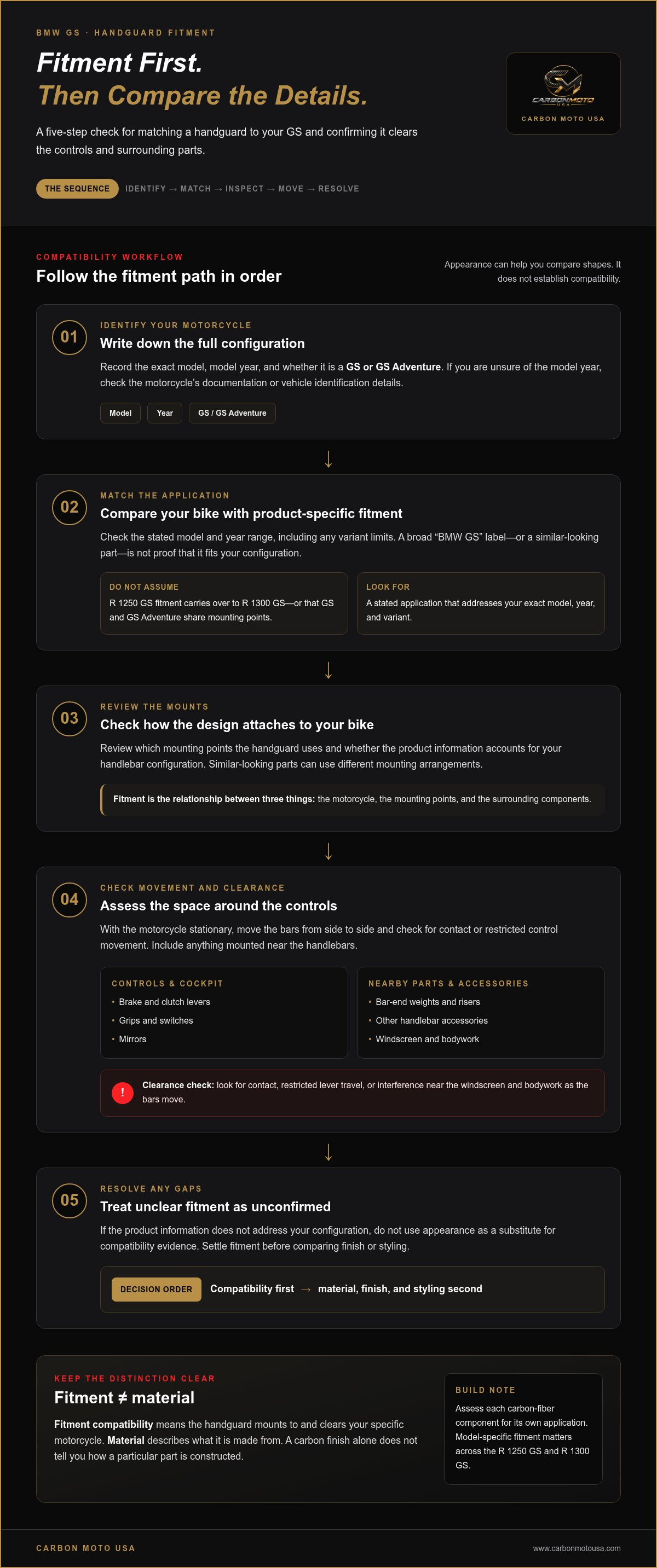
Use a consistent fitment sequence: identify your motorcycle, compare it with the handguard’s stated application, then assess the mounting points and clearance around the controls. Product photos can help you understand a guard’s shape, but they don’t establish compatibility. For carbon fiber handguards BMW GS riders are considering, the stated model and year range is more useful than visual resemblance.
Fitment depends on the relationship between the bike, its mounting points, and the surrounding components. Check all three. A guard can look as if it belongs on the motorcycle and still interfere with a control or accessory.
Check the exact GS model, year, and variant
Write down the model designation, model year, and whether the motorcycle is a GS or GS Adventure. Similar names don’t prove that two bikes share mounting geometry. Compare those details with the product’s stated fitment range, including any year or variant limits. If a listing doesn’t address your configuration, don’t treat a broad “BMW GS” label or a similar appearance as proof of compatibility.
Account for controls and existing accessories
List everything around your bike’s handlebars that needs usable space: levers, grips, switches, and mirrors. Include bar-end weights, risers, and other accessories. Once the product information supports a potential fit, check clearance across the full steering range and make sure the guard doesn’t obstruct control movement.
- Confirm identity. Record the full model, year, and GS or GS Adventure variant. Use the motorcycle’s documentation or vehicle identification details if you’re unsure of its model year.
- Compare the stated application. Match your bike against the handguard’s specific model and year range. Don’t carry a fitment claim from an R 1250 GS over to an R 1300 GS, or assume a GS and GS Adventure share mounting points.
- Review the mounts. Check which mounting points the design uses and whether the product information addresses your handlebar configuration. Similar-looking parts can use different mounting arrangements.
- Check movement and clearance. With the motorcycle stationary, assess the space around levers, switches, mirrors, and accessories as the bars move from side to side. Look for contact, restricted lever travel, or interference near the windscreen and bodywork.
- Resolve gaps before deciding. Treat unclear fitment information as unresolved. A finish or profile that suits your build is a preference, not evidence of compatibility.
Material and manufacturing are separate from fitment. IACMI’s work on innovations in carbon fiber manufacturing offers broader context on the field, but it doesn’t establish whether a specific handguard suits a specific GS. Base the compatibility decision on product-specific information.
Apply the same discipline across a coordinated build: assess each component for its own application. For a separate selection framework, see these BMW GS carbon-fiber engine guard buying criteria. To explore carbon-fiber components for the R 1250 GS and R 1300 GS, visit Carbon Moto USA’s BMW GS carbon-fiber components.
Carbon Fiber vs. Other BMW GS Handguard Choices: What to Compare
Material is one part of the decision, not a shortcut to predicting performance. Compare the part’s stated fitment, coverage, construction, finish, and care guidance together. Products made from the same material can differ in shape and design, so don’t assume they offer identical coverage or suit the same riding conditions.
Compare protection priorities and material trade-offs
Begin with the job you expect the guard to do. If your priority is screening your hands from debris, compare the shape and coverage. For everyday practicality, consider how the design works with your controls and accessories. Carbon fiber is a material choice, not proof of impact protection or universal off-road durability. Separate product-specific claims from general descriptions of the material.
Use this table to organize your comparison. The entries are questions to investigate, not universal performance claims about every product made from that material.
| What to compare | Carbon-fiber composite | Other material choices |
|---|---|---|
| Material | Review how the specific part describes its construction; don’t infer properties from a carbon-look surface. | Identify the stated material and construction rather than relying on category assumptions. |
| Fitment evidence | Look for product-specific BMW GS model, year, and variant details. | Use the same model-specific standard; material doesn’t establish compatibility. |
| Intended use | Compare stated coverage and use guidance with your riding priorities. | Assess the design and its stated use on their own merits. |
| Finish | Consider the visible pattern and surface finish as styling choices. | Compare the available surface appearance and how it suits the motorcycle. |
| Replacement considerations | Review the maker’s care and damage-assessment guidance for that part. | Apply the same check; replacement expectations depend on the specific product. |
Assess finish, construction, and ownership expectations
A carbon-fiber pattern can add a distinctive visual accent to a BMW GS, but appearance isn’t evidence of strength or protective performance. Read the product description and consider the finish, without letting styling take priority over fitment. Carbon Moto USA offers carbon-fiber components for the R 1250 GS and R 1300 GS for riders planning a model-specific build.
Make ownership decisions using product-specific information too. Don’t assume a particular weave, resin, thickness, repair method, or service life unless the maker provides those details. Follow the part’s care instructions and use its guidance to assess damage. If the instructions don’t address a concern, don’t guess based on the material label alone.
When comparing carbon fiber handguards BMW GS riders may be considering, look for fitment evidence, intended use, and product guidance that align with the motorcycle and your priorities. Choose the finish after those practical criteria are met.
Use This BMW GS Handguard Buying Checklist Before You Choose
Make the decision in order. First establish what your motorcycle needs and which products have fitment information for it. Then weigh design preferences. This keeps a preferred finish from distracting you from unresolved compatibility questions and gives you a practical way to compare carbon fiber handguards BMW GS riders may be considering.
- Identify your bike. Record the full model designation, model year, and whether it’s a GS or GS Adventure. Keep the R 1250 GS and R 1300 GS as separate references unless product-specific fitment information explicitly covers both. Similar names or styling aren’t evidence that a part fits both models.
- Define your riding priorities. Rank the factors that matter to you: hand coverage, control clearance, intended riding, and visual integration. A road-touring rider may prioritize wind deflection and everyday practicality. Mixed-use riding may call for a balance of coverage and access to controls. Off-road priorities may emphasize debris deflection. No single setup suits every use case.
- Check product fitment. Compare the stated model, year, and variant with your motorcycle. Treat these details as requirements, not styling preferences. If the product description doesn’t clearly address your configuration, consider the fitment unresolved rather than assuming a match from a photo or broad “GS” label.
- Review mounting and clearance details. Look for product photos and specifications that show how the guard mounts and address space around the levers, grips, switches, and mirrors. Account for your existing handlebar accessories, including bar-end weights or risers. Consider the full steering range and don’t overlook the windscreen or nearby bodywork.
- Compare preferences and make a final pass. Once compatibility information is clear, compare material, finish, shape, and how the design integrates with your bike. Then revisit your priorities: does the documented fitment match your model, and does the design suit the way you ride? Keep appearance and finish in the preference column, separate from required fitment evidence.
Use a simple two-part test before deciding. Your must-haves are the exact bike application and adequate clearance for your controls and accessories. Your preferences are the finish, styling, and how the handguards complement the motorcycle. If product-specific information is missing, don’t fill the gap with assumptions; leave the choice open until the details are clear.
Apply the same discipline to the broader build. Carbon Moto USA offers carbon-fiber components for the BMW R 1250 GS and R 1300 GS. Explore BMW GS carbon-fiber components as you plan model-specific additions.
Plan a BMW GS Carbon-Fiber Build Around Confirmed Fitment
A cohesive build starts with the motorcycle, not the parts list. Confirm the exact model fitment first, then weigh your riding use, material, and finish. This sequence keeps visual choices in perspective and helps each component serve a clear purpose. Carbon Moto USA offers carbon-fiber components for the BMW R 1250 GS and R 1300 GS, providing a model-focused starting point for a considered build.
Coordinate handguards with other GS components
Plan visible components as part of one overall design, but assess every part independently. A coordinated appearance doesn’t mean parts share fitment or function. Handguards, engine guards, and other additions have different mounting locations and compatibility requirements. R 1300 GS owners can use this R 1300 GS carbon-fiber parts guide as a reference for the wider build, while keeping each component’s application distinct.
Before making a final choice, run through the essentials in order:
- Confirm the motorcycle. Record the model designation, year, and whether it’s a GS or GS Adventure. Keep R 1250 GS and R 1300 GS references separate unless product-specific fitment information explicitly supports overlap.
- Match the stated fitment. Compare the exact motorcycle details with the product’s application. Don’t use a similar silhouette, shared brand name, or another rider’s setup as a substitute for fitment evidence.
- Review the mounting and clearance. Account for mounting points, controls, and accessories already on the bike. Consider lever movement and clearance throughout the steering range, not just how the component looks with the handlebars centered.
- Apply your riding priorities. Decide what matters most for your use, such as hand coverage, debris deflection, control access, or everyday practicality. Use the product’s specific information rather than assuming a material or style guarantees a particular result.
- Choose material and finish. Once fitment and intended use align, compare construction details and visual finish. Treat these as informed preferences, not proof of compatibility or performance.
Use the same discipline for related selections. A carbon-fiber component elsewhere on the motorcycle doesn’t automatically fit, replace, or include a handguard. Verify each item for its own application, then consider how its shape and finish contribute to the overall GS design. This is especially useful when building across generations, where visual similarity can hide important differences.
The principle is simple: choose for the exact bike first, then for the ride and the look. Explore Carbon Moto USA’s BMW GS carbon-fiber parts as you shape a fitment-led build.
Shape Your Next BMW GS Upgrade with Confidence
The right build is personal. Let the way you ride guide your choices, and treat every component as a considered addition rather than a visual shortcut. Keep fitment at the center of future changes so each part contributes to a coherent setup for your motorcycle.
If your search for carbon fiber handguards BMW GS riders can use has prompted a broader build, Carbon Moto USA offers carbon-fiber parts for the BMW R 1250 GS and R 1300 GS. Explore the model-specific components and decide which additions best complement your bike and riding priorities.
Explore BMW GS carbon-fiber components at Carbon Moto USA and take the next step toward a build that feels intentional and individual.
Frequently Asked Questions
Will carbon-fiber handguards fit every BMW GS model?
No. A handguard’s material doesn’t make it compatible across the BMW GS range. A part designed for one model or production year may use different mounting geometry from another. Before choosing carbon fiber handguards BMW GS riders should match the product’s stated application to their motorcycle. If your exact configuration isn’t covered by the fitment information, don’t treat a similar-looking GS as evidence that the part will fit.
How do I identify the correct handguards for my BMW GS model year?
Use your registration or motorcycle documentation to establish the model designation and model year, then note whether it’s a GS or GS Adventure. Don’t rely on the purchase date alone, since a motorcycle may have been sold after its model year. Compare these details with the handguard’s stated year range. If a listing gives a range but leaves out your variant, treat fitment as unresolved rather than assuming a match.
Can BMW GS handguards interfere with handlebar controls or accessories?
Yes. A design can crowd a lever, switch, mirror, or bar-end accessory. For example, a guard may appear clear with the bars centered but contact nearby equipment as you turn toward full lock. After reviewing the product’s fitment details, assess control movement and surrounding space while the motorcycle is stationary. Include added risers, replacement grips, and bar-end weights in your clearance review.
Are carbon-fiber handguards suitable for off-road riding?
Suitability depends on the specific handguard’s design and stated use, not the words “carbon fiber” alone. Off-road riders may prioritize coverage from trail debris, but that doesn’t establish how a component will respond to an impact or demanding conditions. Read the product’s use guidance and limitations. Don’t interpret carbon-fiber construction or an adventure-bike appearance as proof of crash protection or universal off-road durability.
What should I compare when choosing carbon-fiber handguards for a BMW GS?
Compare the stated motorcycle application, mounting arrangement, hand coverage, control clearance, intended use, finish, and care guidance. Review product photographs alongside written specifications: images can show shape and finish, while the text should clarify application and construction. Consider your current handlebar setup too, since accessories can affect clearance. Keep verified product claims separate from assumptions based on material or appearance.
Do BMW R 1250 GS and R 1300 GS handguards share the same fitment?
Don’t assume they do. The R 1250 GS and R 1300 GS are distinct models, and similar styling doesn’t establish identical mounting points or clearance. Treat each as a separate fitment reference unless the handguard’s product-specific information explicitly names both models and the relevant years. Apply the same model-by-model approach to standard GS and GS Adventure configurations: shared family branding doesn’t prove parts are interchangeable.