Carbon Moto USA / Rider support
BMW R 1250 GS Carbon Fiber Components: A Buyer’s Guide

The most visible carbon upgrade isn’t automatically the right first choice for your BMW R 1250 GS. Start by deciding what you want a part to do and whether it fits your exact motorcycle. When comparing BMW R 1250 GS carbon fiber components, consider fitment, intended use, and finish together.
A coordinated carbon look can be appealing, but model year and trim affect compatibility. Likewise, general claims about weight or protection don’t explain what a specific component will do. Compare the part’s stated application and product details instead of treating every upgrade as a performance essential.
This guide compares component categories by purpose, explains fitment checks for the standard GS and GS Adventure, and covers material and finish considerations. It also offers a practical way to assess weight and protection claims without assuming results that aren’t supported by product-specific information. Use the checklist to narrow your options and build an R 1250 GS that suits your riding priorities and design preferences.
Key Takeaways
- Start with your riding priorities to distinguish appearance upgrades from parts selected with protection or weight-conscious customization in mind.
- Compare the product listing’s stated application with your motorcycle’s exact model and trim.
- Separate general material descriptions from specific details about construction, finish, weight, and included hardware.
- Compare one component at a time so its fitment, purpose, and specifications are easier to assess.
- Explore Carbon Moto USA’s model-focused R 1250 GS category and use individual listing details to guide your selection.
What to Consider Before Choosing BMW R 1250 GS Carbon Fiber Components
Start with three questions: Is the component listed for your exact motorcycle? Does it suit how you ride? Does it contribute to a clear goal for your build? Answering them in that order helps distinguish a considered upgrade from a purchase driven only by appearance. A part may look right on an R 1250 GS but still be unsuitable if its stated application doesn’t match your bike.
Carbon fiber names a material category, not a guaranteed performance result. Carbon fibers are combined with a matrix to make composite materials, and the finished part’s properties depend on its design and construction. For an accessible overview, see Understanding Carbon Fibers. Don’t assume a component will deliver a particular weight reduction or level of protection unless product-specific information supports that claim.
Keep visual goals separate from practical priorities. A finish may help create a coordinated appearance, while a part selected for potential protection or weight-conscious customization calls for different evidence. The material alone doesn’t establish how a component will perform in a fall, on rough roads, or in everyday use. Look at its stated purpose and specifications rather than treating “carbon fiber” as proof of a particular outcome.
Define Your R 1250 GS Build Priorities
Write down your main goal before comparing parts. Are you looking for visual continuity, potential protection for a particular area, or a weight-conscious change? Then consider your typical riding. A street-touring setup, a commuter bike, and a motorcycle regularly used off pavement may call for different priorities. There isn’t one setup that suits every rider.
Rank your priorities and compare one component at a time. If appearance comes first, consider how the part’s shape and finish relate to the rest of the bike. If practical use comes first, focus on details that support that purpose. For example, a claim about protection should be assessed against the component’s stated use, not its appearance alone. Leave unrelated upgrades for later so each decision stays easy to evaluate.
Separate R 1250 GS Fitment from General GS Compatibility
A listing that says “BMW GS” may refer to a model family rather than every variant or configuration. Match the model year, trim, and stated application with your motorcycle before choosing a part. A broad GS description by itself doesn’t establish fitment.
The BMW R 1250 GS Adventure is related to the standard R 1250 GS, but it’s a distinct fitment consideration. Bodywork and configuration can differ, so rely on the application stated for the specific component. If a listing names one version, don’t assume it fits the other as well.
Use this quick priority check before adding a candidate to your shortlist:
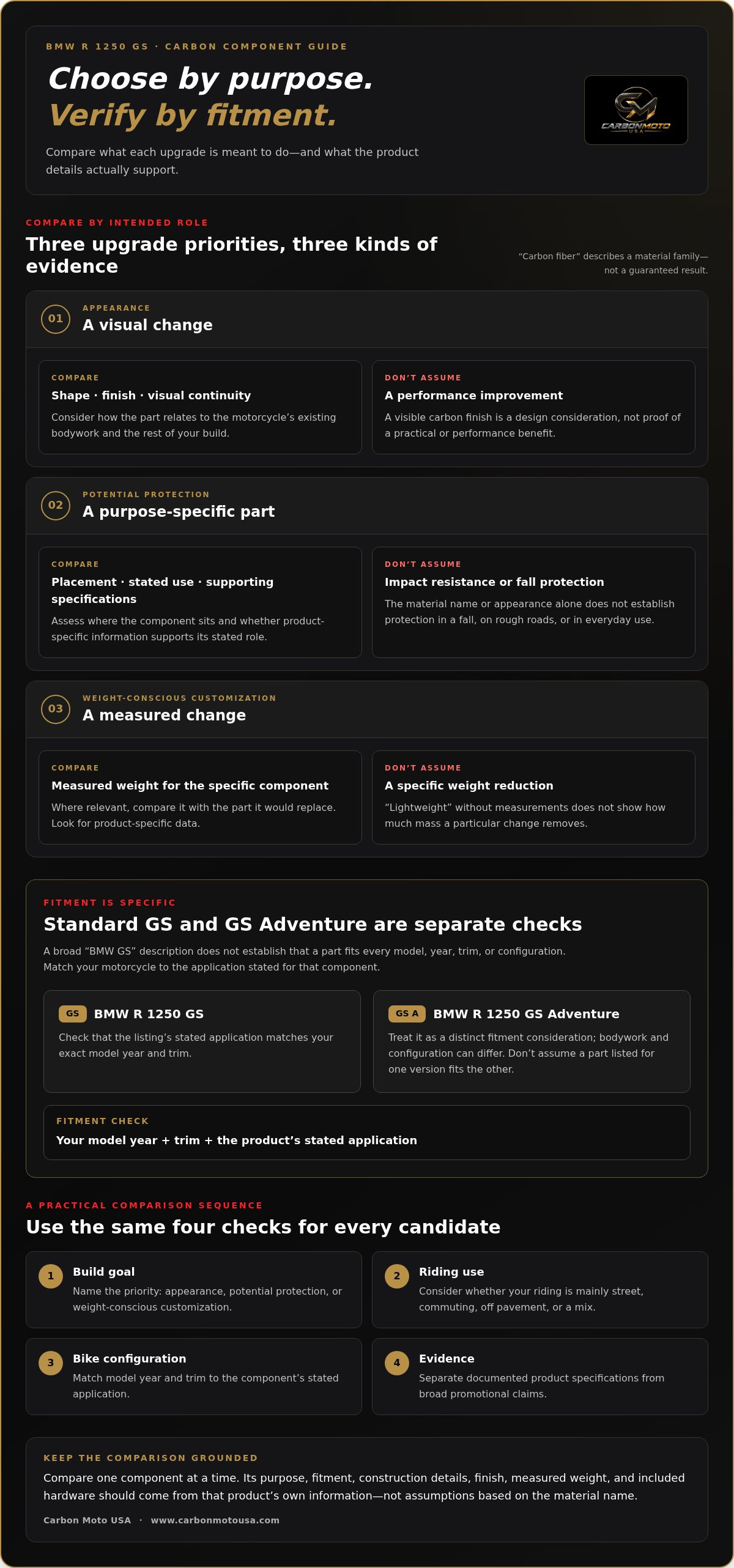
- Build goal: Record whether appearance, potential protection, or weight-conscious customization matters most.
- Riding use: Note whether your typical routes are mainly on the street, commuting, off pavement, or a mix.
- Bike configuration: Compare your model year and trim with the listing’s stated application.
- Evidence: Separate documented specifications from broad promotional claims.
Once your priorities and fitment match, compare options by their stated purpose instead of assumptions. This makes it easier to choose BMW R 1250 GS carbon fiber components that suit your motorcycle and intended use.
How Carbon Fiber Components Differ by Purpose and Construction
Carbon-fiber-reinforced polymer (CFRP) combines carbon fibers with a polymer resin to form a composite material. That describes a material family, not how a particular motorcycle component was made or what it can do. Parts described as carbon fiber may differ in fiber arrangement, resin, thickness, geometry, finish, and intended role. Treat each listing’s specifications as product-specific evidence, not details implied by the material name.
A component’s purpose depends on its design and location on the motorcycle. A shaped piece of bodywork, for example, has a different role from a component positioned where contact or road debris may be a concern. The material alone doesn’t make those parts interchangeable.
Compare Component Categories by Intended Role
Use purpose as the first comparison point for BMW R 1250 GS carbon fiber components. The categories below describe ways to evaluate parts, not a promise that every component serves every role. Check the stated application and product-specific information before drawing conclusions about protection or weight.
- Appearance: Assess the visible finish, shape, and how the part complements the motorcycle’s existing bodywork. Treat this as a design change, not an automatic performance improvement.
- Potential protection: Consider the component’s placement and stated use. A protection claim needs product-specific support; a carbon-fiber description alone doesn’t establish impact resistance or protection in a fall.
- Weight-conscious customization: Look for measured weight data for the specific component and, where relevant, a comparable part. “Lightweight” language without measurements doesn’t show how much mass a particular change removes.
Keep these roles distinct as you compare listings. A visually prominent part may suit an appearance-led build. A component selected for a practical role calls for closer attention to its location, intended use, and supporting specifications.
Understand Material Claims Before Comparing Parts
“Carbon fiber” doesn’t specify a particular layup, resin system, or production method. Those details can help compare construction, but don’t assume them from a product image or a broad material label. Oak Ridge National Laboratory’s overview of Carbon Fiber Manufacturing Processes discusses fiber-related materials and production. It provides useful context, but doesn’t verify how any motorcycle component was constructed.
Compare the details each listing actually states: visible finish, construction information, measured weight, and included items. A glossy or patterned surface describes appearance, not internal construction. An advertised weight advantage is not a substitute for component-level measurements. Don’t assume that products share the same construction standards just because they have the same material label.
For a focused comparison, browse carbon fiber components for BMW motorcycles and assess each R 1250 GS listing by its stated purpose and specifications.
How to Evaluate Fitment, Finish, and Value Before Buying
Start component-fitment checks with your exact model and year. Use the listing’s stated application and specifications as the basis for your decision. A similar shape or a broad “BMW GS” label isn’t enough to establish that a part is intended for your motorcycle.
Follow this review sequence before comparing options:
- Identify your motorcycle. Record the model year and whether it’s the standard R 1250 GS or the R 1250 GS Adventure.
- Check the listed application. Compare your motorcycle details with the listing’s explicit model and year information. Don’t infer compatibility from photographs or a general family name.
- Assess the specifications. Note the material, finish, construction details, and measured weight when the listing provides them.
- Compare the intended purpose. Decide whether the component supports your appearance goals, a stated protection role, or weight-conscious customization.
- Review what’s included. Check the listing for hardware or other included items and account for those details when comparing options.
Check Model Year, Trim, and Listed Application
Fitment starts with precision. Compare your motorcycle’s year and trim directly with the application stated for the part. The Adventure designation matters: don’t assume a component described for the standard GS also fits the GS Adventure, or vice versa. When the listing describes a specific configuration, use that description rather than visual resemblance as your guide.
Review Specifications and Included Items
Clear photographs can help you assess visible shape, surface finish, and design. The application description provides essential fitment context, but neither photographs nor a broad product description replace written specifications. Look for stated material details, finish, component information, and included hardware. If a detail isn’t provided, leave it out of your comparison rather than filling the gap with assumptions. This keeps your decision grounded in information you can evaluate.
Compare Options Against Your Riding Priorities
Organize the comparison around the role you want a part to serve. These categories are decision prompts, not performance rankings. For a wider view of model-specific choices, the BMW R 1300 GS Carbon Fiber guide covers a different motorcycle application. Don’t treat its fitment details as interchangeable with the R 1250 GS.
- Appearance: Compare finish, visible pattern, and how the shape complements the existing bodywork. Prioritize visual consistency.
- Potential protection: Look for a stated use and product-specific support for the claim. Consider whether the information relates to the component’s location.
- Weight-conscious customization: Compare measured component weight when listed. Give documented figures more weight than general “lightweight” language.
Value is more than a headline claim. Assess how clearly a listing identifies fitment, describes construction, shows the finish, and explains the component’s intended use. Applying the same criteria to each option makes BMW R 1250 GS carbon fiber components easier to compare without relying on unsupported claims or assumed benefits.
A Practical Checklist for Selecting R 1250 GS Carbon Components
A consistent selection process keeps a custom build focused. Evaluate one component at a time and use the same checks for each option. That makes it easier to distinguish a genuine fitment match from a part that simply looks right, and to decide whether it supports a clear priority.
Use This Five-Point Pre-Purchase Checklist
Before choosing BMW R 1250 GS carbon fiber components, note the details that matter for your motorcycle and plans. Treat every listing as a separate decision, and save the information so you can compare options consistently.
- Confirm your exact motorcycle. Record its model year and whether it’s the standard R 1250 GS or R 1250 GS Adventure.
- Match the stated application. Compare your motorcycle details with the listing’s fitment information. Don’t rely on a general GS description or a visual match.
- Connect the component to a priority. Note whether you’re choosing it for appearance, a stated protection purpose, or weight-conscious customization.
- Review available specifications. Check material, finish, dimensions, and included items when the listing provides them. Don’t fill gaps with assumptions.
- Save the details. Keep the application and specifications with your build notes so you can compare later choices against the same criteria.
Work through one part at a time. This gives you a clear fitment decision before you move on to another component, instead of mixing several purchases and purposes into one evaluation.
Build a Cohesive Setup Without Overbuying
Give every addition a reason to be there. A component chosen for a defined goal is easier to assess than one selected simply because it’s available. For visible parts, compare finishes and surfaces across the motorcycle to see whether they create the visual continuity you want. Keep that design judgment separate from claims about protection or weight.
Keep separate notes for each goal. Record appearance preferences apart from protection-related intent and weight-conscious considerations, then assess each claim against the relevant listing details. This helps prevent a visual feature from being treated as evidence of a functional benefit, or a general material description from standing in for measured component data.
Plan installation separately from product selection. Review the component’s instructions and stated requirements, then account for the tools, time, and technical support the work may call for. Choosing a component and planning its installation are related but separate decisions. Don’t assume that selecting a part includes installation.
Use your model details and build priorities to explore BMW R 1250 GS carbon fiber components. A one-component-at-a-time approach helps keep the process intentional and each choice tied to a clear purpose.
Explore Carbon Moto USA’s BMW R 1250 GS Carbon Fiber Components
Carbon Moto USA specializes in carbon fiber components for BMW motorcycles, including the R 1250 GS. Its model-focused category helps owners explore options for their builds. As you browse, start with your motorcycle’s exact configuration, decide what you want a component to contribute, and compare the details published for each listing.
Keep your decision grounded in information about the specific part. A category page helps you find relevant options, while each product listing provides the basis for evaluating its stated application and any published material, finish, or component details. Assess each item on its own merits rather than assuming all carbon fiber parts share the same fitment or construction.
What to Look for in the R 1250 GS Category
Begin with the application. Compare the model and variant named on a listing with your motorcycle before considering appearance or intended role. Then review the product details provided, such as material, finish, and included items. Photos can help you assess visible surfaces and how a component might work with your build; written specifications are the basis for comparing stated features.
Connect each listing to one clear priority. For visual continuity, consider how the finish relates to other parts of the motorcycle. For a protection-related purpose, look for product-specific information that supports that role. For weight-conscious customization, rely on measured component data when stated. Don’t turn a general carbon fiber description into a performance promise.
This approach keeps comparisons fair. Two listings may use similar material language but differ in application, finish, or published details. Record what each one states and what matters to your build. Leave unprovided specifications out of the comparison instead of treating them as known features.
Make the Next Step Deliberate
Browse the BMW R 1250 GS category with your priority in mind. Compare one relevant listing at a time, checking its stated application first and then reviewing its published product details. This makes it easier to avoid choosing a component simply because it looks appealing and focus instead on how it fits your motorcycle and build plans.
A measured selection process can stay simple. Keep your model information close, note the purpose you expect each part to serve, and use listing details to guide your comparison. The result is a more intentional shortlist, whether you’re refining the motorcycle’s visual character or considering a component for a specific use.
Use fitment, intended use, and published specifications to compare the options in the BMW R 1250 GS category.
Make Your Next Upgrade a Deliberate One
Choose one part that addresses the priority you identified, then consider how it fits the motorcycle’s overall direction before adding another. Taking upgrades in sequence helps keep a visual decision from being mistaken for a functional one and makes each change easier to assess on its own terms.
Keep a simple record of what you selected and why. If your riding needs or design goals change, those notes can guide future choices and keep the build from drifting toward parts without a defined role. Carbon fiber can shape the R 1250 GS’s character, but a considered result comes from matching each component to your intended use and relying on published details instead of assumptions.
When you’re ready to put your shortlist together, compare BMW R 1250 GS carbon fiber components at Carbon Moto USA against your build priorities. Choose each addition for a clear purpose.
Frequently Asked Questions
How do you clean carbon fiber motorcycle components?
Wash them gently with clean water, a soft microfiber cloth, and a mild cleaner suitable for motorcycle surfaces. Rinse away grit before wiping so particles don’t scratch the finish, then dry with a separate soft cloth. Avoid abrasive pads, harsh solvents, and unverified chemical products, which may affect the surface coating. For BMW R 1250 GS carbon fiber components, follow any care guidance provided with the specific part.
Can carbon fiber motorcycle components be repaired if damaged?
Some damage may be repairable, but the right response depends on its location and severity. A surface blemish differs from a crack, exposed fibers, delamination, or damage near a mounting point. Don’t treat a structurally damaged part as cosmetic or continue using it if its integrity is uncertain. Have a qualified composite specialist assess the component and determine whether repair or replacement is appropriate.
Does carbon fiber fade in sunlight?
Sunlight and ultraviolet exposure can affect a component’s resin or surface finish over time, potentially causing discoloration or loss of gloss. The rate and extent depend on the part’s materials, coating, and exposure, so there isn’t one timeline for every component. Reduce prolonged exposure by parking in shade or using a cover, and use only surface-care products labeled as compatible with the finish.
Is carbon fiber motorcycle bodywork waterproof?
Don’t assume a carbon fiber bodywork part is a waterproof seal. The composite surface may resist ordinary moisture, but seams, edges, mounting points, and the area behind the component can still allow water through. Its intended function and construction determine how it handles exposure. After riding in heavy rain or washing the motorcycle, dry trapped moisture and inspect nearby fittings rather than relying on the panel to seal them.
Can carbon fiber components be painted or refinished?
Yes, carbon fiber can be painted or refinished, but surface preparation and compatible coatings matter. Sanding too aggressively can damage the outer surface or expose fibers, while paint will cover the visible weave. Before refinishing, identify the existing coating and decide whether preserving the original appearance matters to your build. A refinisher experienced with composite parts can assess the surface and choose an appropriate preparation approach.
Do carbon fiber components change a motorcycle’s resale value?
They don’t guarantee a higher resale value. A buyer may appreciate a well-presented modification, while another may prefer the motorcycle in original condition. Keep any removed original parts, product records, and fitment details together, and document the component’s condition. Clear records help a prospective buyer understand what changed and make it easier to return the bike to its previous configuration if desired.