Carbon Moto USA / Rider support
Carbon Fiber Engine Guards for BMW GS: Fitment, Protection, and Buying Criteria

The lightest protection isn’t automatically the right protection. When assessing carbon fiber engine guards BMW GS riders should start with coverage: a component designed for a cylinder head may not protect the crankcase, exhaust, or nearby parts. Shape and mounting matter as much as material.
Carbon fiber is valued for its low weight and refined finish, but riding conditions should guide the choice. Carbon fiber, metal, and polymer options differ in construction and intended use. None should be treated as a universal shield against every impact. Check what each part covers, how it attaches, and whether its design suits your mix of road and off-road riding.
This guide explains what engine protection can and can’t be expected to do, compares material choices, and outlines the fitment details to verify before buying. A BMW GS label alone isn’t enough: standard and Adventure versions, model generations, and individual component shapes can differ. Carbon Moto USA offers carbon-fiber components for BMW R 1300 GS and R 1250 GS models, so exact model and component compatibility remain central to a considered selection.
Key Takeaways
- Use the component’s coverage and mounting design to judge what it may protect, rather than relying on the label “engine guard.”
- Compare carbon fiber, metal, and polymer by weight, intended use, and construction; material alone doesn’t determine impact performance.
- Before choosing carbon fiber engine guards BMW GS riders should identify their exact model, variant, and year to avoid assuming parts are interchangeable.
- Match protection priorities to your riding environment, from paved touring to more demanding off-road use.
- Explore BMW R 1250 GS and R 1300 GS carbon-fiber components with a precise understanding of their fitment and coverage.
What BMW GS Engine Guards Protect, and Where Their Limits Begin
A protection part is useful only for the area it actually covers. On a BMW GS, “engine guard” may describe a component positioned to shield exposed engine surfaces, but the label alone doesn’t tell you which parts it reaches or how it attaches. The model family has evolved across generations, as the history of the BMW GS motorcycle series illustrates, so don’t assume protection layouts and component fitment are identical across bikes.
An engine guard is a component intended to shield a defined area of the engine from contact, abrasion, or debris, depending on its design and mounting. It doesn’t promise that the engine will remain undamaged in every fall or crash.
Engine guards, skid plates, and cylinder-head protection
These terms describe different protection zones, even when product names overlap. An engine guard generally covers a specified engine area. A skid plate sits beneath the motorcycle to help shield lower components from contact with the ground or obstacles. Cylinder-head protection targets the exposed cylinder-head area. Frame protection is a separate category, aimed at parts of the frame rather than the engine itself.
- Upper or side area: engine guard or cylinder-head protection, depending on the component’s shape.
- Underside: skid plate coverage.
- Frame: dedicated frame-protection components.
Use those locations as a guide, not a universal map. Exact coverage depends on the guard’s profile, the motorcycle’s configuration, and how the component mounts. A part that protects one side or surface may leave nearby areas exposed.
What protection can, and cannot, mean
Protection can mean different things. A surface may help resist abrasion as the motorcycle slides, deflect some debris, or place a barrier between a vulnerable part and a contact point. Those functions aren’t interchangeable, and none guarantees impact protection in every condition. A low-speed tip-over onto a smooth surface differs from a hard impact against a rock, and the contact point can change the result.
Coverage and mounting matter as much as material because they determine which area is shielded, how the part is supported, and where contact forces may travel. A guard that doesn’t cover the contact point can’t protect that area. Its mounting and clearance also affect how it sits on the motorcycle.
When comparing carbon fiber engine guards BMW GS riders should look beyond appearance or material labels. Check the stated protection zone and intended mounting position, then consider what remains exposed. A carbon-fiber component may be designed for a particular surface or purpose, but material alone doesn’t establish how it will perform in a fall. Treat every guard as targeted protection, not an all-around substitute for other components or a guarantee against damage.
Carbon Fiber vs. Metal and Polymer: Compare the Trade-Offs for a BMW GS
Material is a useful starting point, not a verdict. Carbon fiber, metal, and polymer components can differ in mass, shape, and intended role, but the finished part’s construction and mounting determine how it behaves on a specific motorcycle. Compare the actual component, not just the material named in a listing.
| Material | Weight considerations | Coverage considerations | Typical selection priorities |
|---|---|---|---|
| Carbon fiber | Often chosen with low mass in mind; actual weight depends on the part’s construction and dimensions. | Shape and coverage are specific to the component design. | Low-mass components, finish, and integration with the motorcycle’s appearance. |
| Metal | Weight varies by material, thickness, and design. | Can be formed for different protection zones; coverage depends on the part. | Riders comparing a protection-focused design and its mounting system. |
| Polymer | Weight depends on material and component design. | Coverage varies by shape and application. | Riders assessing a specific part’s intended role and construction. |
Use the table to narrow your priorities, then assess the component’s documented purpose and fitment. It isn’t a performance ranking: no material has a universal advantage across every design or riding condition.
When carbon fiber may fit a rider’s priorities
Carbon fiber may appeal if you value a refined finish, integration with the motorcycle, or a design intended to keep mass low. Treat these as selection priorities, not guaranteed outcomes. A specific part’s dimensions, construction, and mounting affect its weight and coverage. Look for clear product details and distinguish genuine carbon-fiber construction from a carbon-look finish. Don’t infer impact capability from appearance.
When another material may better match the use case
Frequent riding on rough surfaces can shift attention toward the intended protection zone, component design, and mounting rather than finish or mass. Metal or polymer may suit a particular setup, but the material name alone doesn’t establish durability, maintenance needs, repairability, or crash performance. Compare published specifications for the exact part, and avoid extrapolating from one guard to another.
In short: choose by intended use and verified component details first, then weigh mass and finish against those needs. Riders considering carbon fiber can explore BMW GS carbon-fiber components with those priorities in mind. For carbon fiber engine guards BMW GS riders should judge the specific part’s construction and coverage, not rely on the material label alone.
BMW GS Engine Guard Fitment: Match the Part to the Exact Model
Fitment starts with the motorcycle, not the broad “BMW GS” label. Before comparing carbon fiber engine guards BMW GS riders should record the exact model designation, variant, and model year. A part described for an R 1300 GS doesn’t automatically fit an R 1250 GS, and a base GS listing doesn’t establish compatibility with an Adventure configuration. Treat each fitment claim as specific to the model details stated in its documentation.
Build a precise BMW GS fitment profile
Write down the information shown in your motorcycle’s documentation or model identification before shopping. Keep the base GS and Adventure designations distinct, even if a listing uses “GS” as shorthand. The family spans multiple generations, and model names alone don’t establish that mounting interfaces or surrounding parts match. Use the product’s stated fitment range as a starting point, then compare it with your complete motorcycle identification.
- Model: R 1250 GS or R 1300 GS.
- Variant: base GS or Adventure configuration.
- Model year: the specific year of your motorcycle.
- Component: the exact guard or protection part being considered.
Keep these details together when reviewing listings. “Fits BMW GS” is too broad to resolve differences between model generations, variants, or component designs. A fitment statement for one configuration should not be used as proof for another.
Check coverage, clearances, and mounting interfaces
Compare the component’s product photographs or technical diagrams with its stated coverage and mounting points. Look for views that show the part’s shape, attachment locations, and position relative to nearby bodywork. Don’t infer clearance or fitment from a photo taken at a different angle or from a related GS model.
Nearby components matter. Body panels, engine surfaces, existing protection, and adjacent hardware may affect how a guard sits or whether the documented installation applies. Use model-specific product documentation for claims about mounting points, clearance, and compatibility. A family-level label alone isn’t technical evidence.
For broader context on how components are organized around a particular model, the BMW R 1250 GS carbon-fiber buyer’s guide focuses on the R 1250 GS. Keep that model-specific lens as you compare parts: matching material or appearance doesn’t establish matching fitment.
Make the decision in sequence: identify your bike, isolate the exact variant and year, then match the component to documentation for that configuration. This helps distinguish a relevant fitment claim from a generic compatibility label, and keeps a promising part from being judged on appearance alone.
Choose BMW GS Engine Protection Around Your Riding and Priorities
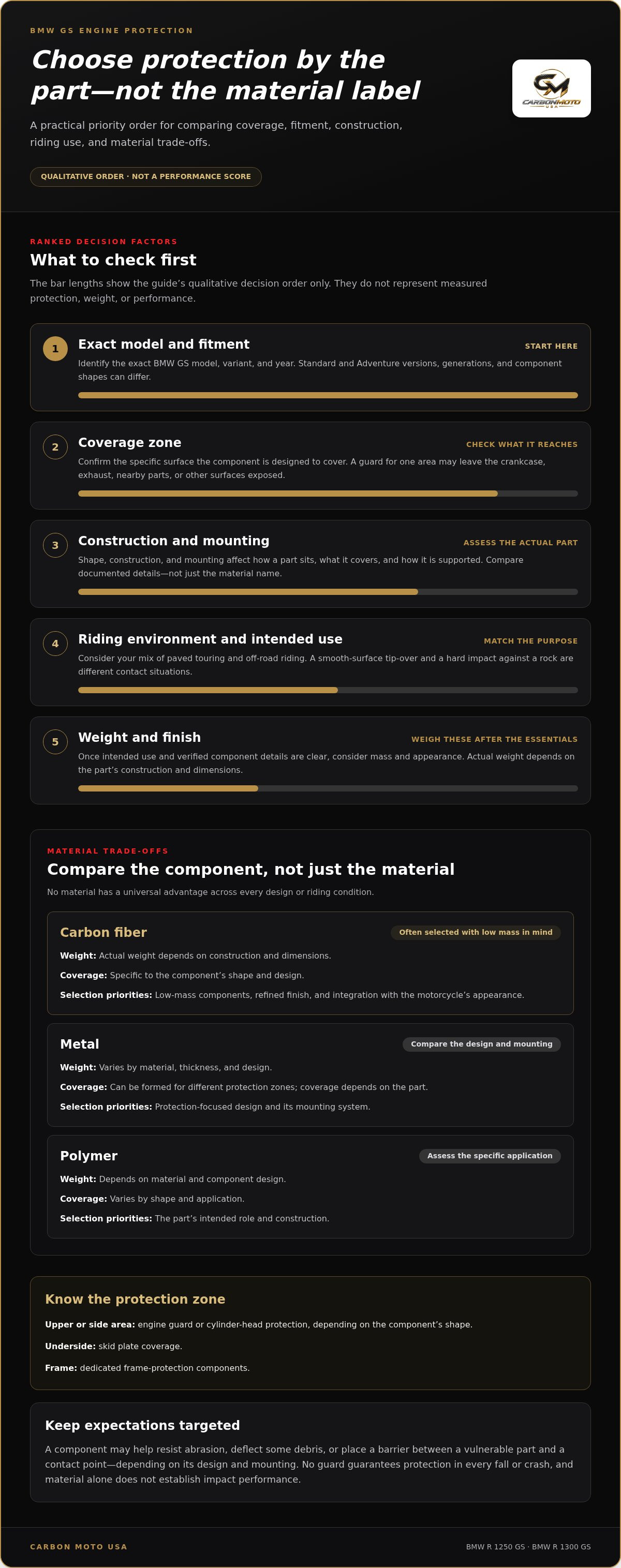
Choose protection for the riding you actually do, not an imagined worst-case scenario or a preferred finish alone. Paved touring, gravel roads, and sustained off-road riding can expose different parts of the motorcycle to different contact risks. Use this four-step process to narrow the decision, then compare individual components against their stated coverage and fitment.
- Define your riding environment. Paved touring may make road debris and occasional low-speed contact the main concerns. Gravel can increase exposure to stones and loose material. More demanding off-road riding may involve contact with uneven ground or obstacles, so identify which areas need attention rather than assuming one guard covers everything.
- Identify the protection area. Decide whether your priority is an exposed engine surface, the cylinder head, or the motorcycle’s underside. Match the component to that area, and note what remains uncovered.
- Confirm exact fitment. Record the GS model, variant, and model year. Compare those details with the component’s fitment documentation before considering appearance or material claims.
- Rank material priorities. Decide how you weigh mass, finish, maintenance, and intended use. Base those judgments on specifications for the actual part, not a general assumption about its material.
Match protection priorities to the terrain
Terrain changes what deserves attention. On paved routes, consider the surfaces exposed to road debris or contact during a tip-over. Gravel riding can bring loose stones into the picture, while rougher off-road use may increase the chance of contact with uneven ground. Inspect your bike’s configuration and typical routes, then prioritize the components most exposed. Protection parts don’t replace careful riding or suitable equipment.
Balance protection, weight, appearance, and maintenance
Set functional priorities first. A broader component may cover more area, but its shape and fit with nearby parts need to be verified for your exact motorcycle. Then weigh finish and mass against the part’s documented purpose. For carbon fiber engine guards BMW GS riders should compare specific coverage and fitment details, rather than treating a material label as proof of protection performance.
Use this checklist while comparing compatible components:
- Does the documented fitment match your model, variant, and year?
- Which surfaces does the part cover, and which remain exposed?
- Are the shape, mounting interfaces, and nearby clearances shown in product documentation?
- Are material, finish, and weight priorities supported by details for this specific component?
Once your priorities are clear, explore BMW GS carbon-fiber components with your model details and intended use in mind. A deliberate comparison keeps styling in its proper place: part of the decision, not a substitute for fitment and documented coverage.
Explore Carbon Moto USA's BMW GS Carbon-Fiber Components
A considered BMW GS build starts with the motorcycle’s exact model and the purpose of each component. Carbon Moto USA offers carbon-fiber motorcycle components for BMW R 1250 GS and R 1300 GS models. Use those model-specific categories as a starting point, then evaluate each component by its documented fitment, function, and finish.
Relate the component choice to a BMW GS build
Think of a carbon-fiber component as one part of a larger configuration, not an automatic solution for every protection need. If fitment comes first, focus on parts associated with your exact GS model and compare their compatibility details. If function is the priority, identify the area you want to address and check the component’s stated purpose and coverage. If finish matters most, consider how the part integrates visually with the rest of your motorcycle without treating appearance as evidence of impact performance.
That distinction is useful when researching carbon fiber engine guards BMW GS riders may encounter under different product labels. Carbon Moto USA offers carbon-fiber components for the R 1250 GS and R 1300 GS. Evaluate each component individually by its documented role and fitment.
For R 1300 GS-specific context, the BMW R 1300 GS carbon-fiber parts guide provides a focused look at components for that model. Keep the model distinction clear as you browse: information about an R 1300 GS component doesn’t establish compatibility with an R 1250 GS, or with a different variant.
Move from research to a model-specific selection
Turn your research into a short, practical sequence. Confirm the model designation, variant, and year of your motorcycle. Define the area you want a component to cover, then compare relevant parts against their stated fitment and purpose. If the goal is engine protection, look specifically for documentation that identifies the protection zone. A general carbon-fiber category alone doesn’t show whether a component functions as an engine guard.
Keep appearance and material in the decision, but let compatibility and intended function lead. Compare components documented for your bike against your priorities, rather than relying on broad claims about an entire material or model family. This helps you choose with clarity, whether your focus is a coordinated finish or a targeted functional update.
Ready to compare options for your motorcycle? Explore Carbon Moto USA’s BMW GS carbon-fiber components and browse with your model details and priorities in mind.
Make Your Next BMW GS Upgrade a Deliberate One
Let your next choice follow the motorcycle you own and the riding you plan to do. Keep a clear distinction between targeted engine protection and other carbon-fiber components, and use product-specific fitment details to shape your shortlist. That way, “carbon fiber engine guards BMW GS” remains a precise search for a defined need, not a shortcut to assuming every carbon-fiber part protects the engine.
Carbon Moto USA’s performance-focused catalog includes carbon-fiber components for BMW R 1250 GS and R 1300 GS models. Browse with your model details and priorities in mind, then compare the components that suit your build.
Explore BMW GS carbon-fiber components and take the next step toward a motorcycle setup that reflects your purpose, with fitment and function at the center of the decision.
Frequently Asked Questions
Can carbon-fiber engine guards be repaired after a fall?
Sometimes, but whether repair is appropriate depends on the part’s construction and the damage. A surface scuff may be cosmetic, while a crack, exposed fibers, or separation between layers can indicate damage that needs expert assessment. Don’t cover a damaged area with resin or continue relying on the guard without evaluation. For carbon fiber engine guards BMW GS owners should follow the component maker’s inspection and repair guidance.
Do carbon-fiber engine guards need special cleaning or maintenance?
Usually, careful routine cleaning is the sensible approach, but follow the care instructions for the specific part and finish. Rinse away grit before wiping, then use a soft cloth and a cleaner approved for the surface. Avoid abrasive pads and harsh solvents unless the manufacturer permits them. During cleaning, look for new scratches, chips, loose hardware, or changes around the mounting points.
Can BMW GS engine guards interfere with crash bars?
They can, depending on the shape and mounting arrangement of both components. Before fitting a guard alongside crash bars, compare their attachment points and clearances using documentation for your exact GS configuration. Check that the parts don’t press against each other or obstruct adjacent components. Don’t force a close fit or modify mounting hardware to make parts align; use compatibility guidance for the specific components.
Are carbon-fiber engine guards resistant to heat from the engine?
Heat tolerance depends on the component’s resin system, finish, construction, and distance from heat sources, so the words “carbon fiber” alone don’t establish a temperature limit. Check the part’s published specifications for heat exposure and keep its intended position in mind, especially near exhaust components. Don’t use a guard in a location beyond its stated limits, and inspect it if it develops visible heat-related changes.
How can I inspect a carbon-fiber guard after a stone strike?
Let the motorcycle cool, then clean the area gently so dirt doesn’t hide damage. Under bright light, inspect the strike point and nearby edges for cracks, chips, lifted layers, exposed fibers, or a change in shape. Check the mounts and fasteners too. If you find cracking, separation, or movement, don’t assume the mark is cosmetic; follow the component maker’s inspection guidance before relying on the guard again.
Does a carbon-fiber engine guard reduce a BMW GS’s weight?
It depends on what the part replaces and the weight of both components. Replacing a heavier part with a lighter one may reduce mass, while adding a guard to an otherwise unprotected motorcycle adds weight. Compare published weights for the exact components rather than assuming a material guarantees a reduction. Also consider the complete setup, including mounting hardware and any existing protection retained on the bike.