Carbon Moto USA / Rider support
BMW R1300GS Carbon Fiber Engine Covers: Price and Weight

The listed BMW R1300GS carbon fiber engine covers weigh 200 g. Fitment depends on the exact listing: the category is labeled for R 1300 GS models from 2024 onward, while fitment listings also cover the R 1300 GS from 2023-2026 and the R 1300 GS Adventure from 2025-2026.
Low weight is useful context, but it does not settle the buying decision. Compare the listed price and confirm that the fitment information matches your motorcycle’s exact model and year.
This guide brings those details together. It compares listed prices and product weights, explains how fitment ranges differ, and outlines what to consider when assessing a carbon-fiber engine cover for your GS. Use the comparison to weigh the specifications against your bike before choosing a part.
Key Takeaways
- Compare the listed 200 g product weight with your priorities for protection, finish, and overall build.
- Match the fitment range to your exact motorcycle: the category is labeled for R 1300 GS models from 2024 onward, while listings include the R 1300 GS for 2023-2026 and the R 1300 GS Adventure for 2025-2026.
- Learn what to distinguish when assessing carbon-fiber covers as genuine BMW parts or aftermarket components.
- Weigh the practical differences between carbon-fiber covers and aluminum guards before choosing an approach for your GS.
BMW R 1300 GS and R 1300 GS Adventure fitment
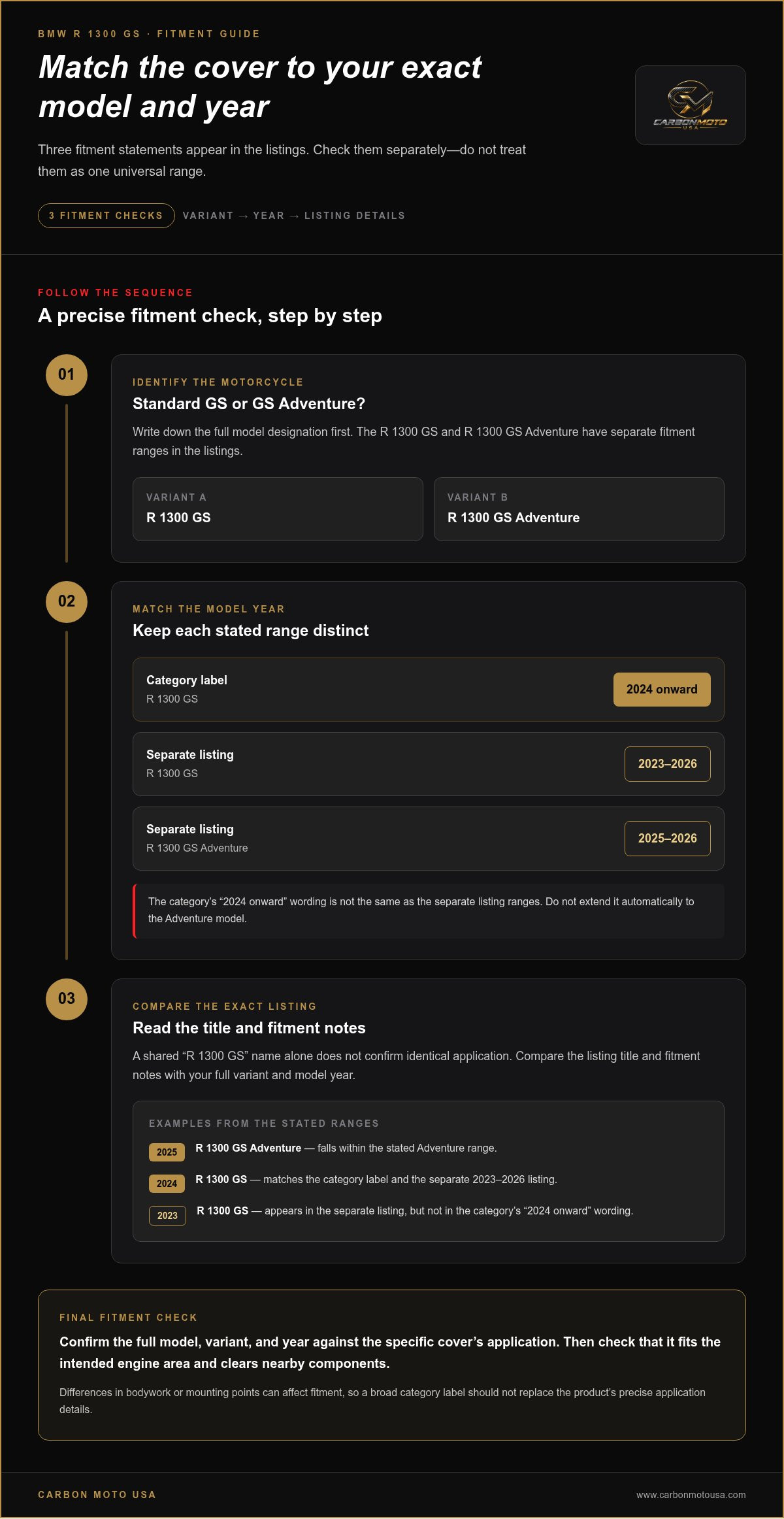
Start with the motorcycle’s full model name and model year. Fitment information gives three ranges that need careful reading. The category is labeled for R 1300 GS models from 2024 onward. Separate listings show the R 1300 GS for 2023-2026, and the R 1300 GS Adventure for 2025-2026. Those descriptions are not identical, so don’t treat them as one universal range.
Use this sequence before selecting a cover:
- Identify whether your motorcycle is an R 1300 GS or R 1300 GS Adventure.
- Match its model year against the range shown for that exact variant.
- Compare the listing title and fitment notes, not just the shared R 1300 GS name.
For example, a 2025 R 1300 GS Adventure falls within the stated Adventure range. A 2024 R 1300 GS matches the category label and the separate 2023-2026 listing. A 2023 R 1300 GS appears within that separate listing, but not the category’s “2024 onward” label. Keep those distinctions visible when comparing options.
Adventure and standard GS designations matter because a model name alone does not confirm identical component geometry. Covers need to fit the intended engine area and clear nearby parts. Differences in bodywork or mounting points can affect fitment. Start by checking the exact model-year range, then compare it with the cover’s stated application.
Do carbon fiber engine covers affect BMW warranty or insurance coverage? A cover alone does not determine whether a warranty or insurance claim is covered. The applicable warranty terms, policy wording, and any connection between the part and damage are key considerations.
How are carbon fiber engine covers installed on a BMW R 1300 GS? Installation is product-specific: the cover must align with its intended mounting points and clear adjacent components. Follow the supplied instructions, including the specified fasteners and torque values, rather than forcing a misaligned part.
Do carbon fiber engine covers protect the R 1300 GS engine in a crash or off-road impact? A cover may shield the area it covers from contact or abrasion, but it can’t establish crash protection by itself. The impact angle, force, coverage area, and mounting design all affect the outcome.
Before choosing, write down the model, variant, and year, then compare them against the product’s specific fitment range. If the listing says R 1300 GS from 2024 onward, don’t silently extend that wording to the Adventure. The separate Adventure range is 2025-2026. This simple distinction helps narrow the search and prevents a broad category label from replacing precise application details.
Listed product price
The listing presents the covers as discounted. Use the displayed price as a starting point, not a complete measure of value. Price matters only when the part fits your motorcycle and the listing describes the component you intend to buy. Compare the product scope and fitment alongside the amount shown.
Use a focused review before making a decision:
- Match the product title to the exact engine-cover component.
- Read the fitment details for your R 1300 GS variant and model year.
- Check whether the listing describes one component or a set.
- Review the displayed price again before proceeding.
These steps help prevent misleading comparisons. Two listings may both use “engine covers” in their titles while describing different components or applications. A lower price does not make the parts equivalent. Compare like with like: the same coverage, motorcycle application, and number of components.
A discount label also needs context. It describes how the listing presents its price, not how the product compares with every alternative. Do not infer material quality, protection level, or included hardware from the discount alone. Check the product description for those details.
Build your comparison around your use case. A rider seeking a coordinated carbon-fiber finish may value different features from someone focused on impact protection. The material description, coverage, mounting approach, and fitment information help explain what the displayed price includes. Apply the same criteria to each option.
Separate the listed price from your own purchase calculation. Use the amount displayed for the selected item, then review the order summary before completing a purchase. Do not assume another listing’s discount uses the same comparison basis. Similar promotional labels can refer to different products or configurations.
For a practical comparison, record the product name, motorcycle variant, model year, component scope, and displayed price in separate columns. Treat the comparison as incomplete until each row refers to a comparable part. This makes differences visible without treating a discount as proof of better value.
Once fitment and scope align, assess the price against the details that matter to your build. Review current product details as part of that comparison, and use the listing information to keep your decision grounded in the specific component.
Use that figure as the listing’s current reference point, then confirm that the selected item is the same component and configuration you evaluated. Tying the displayed amount to the precise product keeps the discount from overshadowing fitment, coverage, or the details in the listing.
Product weight
The listed carbon-fiber engine guards weigh 200 g. Use that figure as a reference for the component described, not as the weight of every part fitted to the motorcycle. A cover’s contribution to the build depends on which pieces the listing includes. Read the product description alongside the weight before comparing components.
Weight matters most as part of a complete setup. A rider assessing the R 1300 GS may be comparing covers with other protection, luggage, or accessories. Consider each component’s location as well as its mass. Parts mounted in different areas affect the overall build in different ways, so a single weight figure cannot describe the motorcycle’s total balance.
Use these steps to make the 200 g figure useful:
- Record the listed weight beside the exact component name.
- Check whether the product description refers to one cover or multiple pieces.
- Compare only components with similar coverage and intended fitment.
- Consider the rest of your R 1300 GS setup before judging the contribution.
For example, comparing a 200 g engine guard with a larger protective assembly would not be a direct comparison. The parts may cover different areas or include different pieces. A meaningful weight comparison starts with equivalent scope, then considers how each component serves the motorcycle.
Keep units consistent. The listing uses grams, so record the value as 200 g rather than rounding it or changing the stated figure. If your build notes use another unit, convert the value only for your own comparison, while retaining the original listing measurement as the reference. That keeps the source specification clear.
Weight is one selection criterion, not a standalone measure of protection or construction. The material, shape, mounting points, and covered area also affect how a guard suits the R 1300 GS. A lighter part doesn’t automatically provide more protection, and weight alone doesn’t establish impact performance. Assess the component’s stated purpose alongside its mass.
For a precise comparison, create a short table with columns for component, fitment, coverage, and listed weight. Enter 200 g for the carbon-fiber engine guards, then add other options only when their descriptions identify comparable parts. This method makes the trade-offs easier to see without treating a single figure as the whole decision.
Finally, consider your intended riding and current equipment. A road-focused R 1300 GS setup may prioritize different components than an off-road build. Keep the 200 g specification in view, but weigh it against fitment and the protection area you need. The best comparison is specific to the parts and configuration you’re evaluating.
Are BMW R 1300 GS carbon fiber engine covers genuine BMW parts or aftermarket?
Carbon fiber describes a material, not a manufacturer. A cover for the BMW R 1300 GS isn’t automatically a genuine BMW part because it uses carbon fiber or matches the motorcycle’s styling. Determine its status from the manufacturer and product identification, rather than appearance alone.
“Genuine BMW” means the part is identified as a BMW-manufactured or BMW-branded component. An aftermarket cover is produced or sold outside that genuine-parts designation. Fitment for an R 1300 GS doesn’t change that distinction. A component can be designed for the BMW and still be an aftermarket part.
The listed carbon-fiber engine covers are described as made from 100% carbon fiber. That material description does not establish BMW manufacture, BMW branding, or factory approval. Treat material, maker, and fitment as separate details. Each answers a different question about the component.
Use this simple sequence when assessing a listing:
- Read the manufacturer and brand identification.
- Look for an explicit genuine BMW part designation.
- Match the stated fitment to your R 1300 GS variant and year.
- Review the component description for its material and intended coverage.
For example, a listing that says “fits BMW R 1300 GS” describes application. It does not, by itself, identify BMW as the manufacturer. Likewise, a carbon-fiber weave or BMW-shaped profile cannot prove original-equipment status. Keep those labels distinct while comparing parts.
Aftermarket components may be chosen for their material, appearance, or coverage area. Suitability depends on the actual design and fitment details. Do not treat genuine and aftermarket parts as interchangeable based only on a shared model name. Compare the listed manufacturer, application, construction, and mounting approach.
Be precise with terminology. “Made for BMW” can describe intended fitment, while “made by BMW” identifies the manufacturer. “Genuine BMW” is a parts-status claim, not a synonym for compatible. If a product description only establishes R 1300 GS fitment and carbon-fiber construction, those are the claims it supports.
For a buyer comparing BMW R 1300 GS carbon fiber engine covers, record the brand, manufacturer designation, material, and fitment separately. This avoids mistaking compatibility for authenticity. It also keeps the decision focused on verifiable product attributes, rather than styling cues or broad phrases that don’t identify who made the part.
How do carbon fiber engine covers compare with aluminum guards for the R 1300 GS?
Carbon fiber and aluminum address protection differently on the BMW R 1300 GS. Carbon-fiber covers combine a composite material with a shaped surface. Aluminum guards use formed metal. Material alone doesn’t determine which option suits your riding. Coverage, construction, mounting, and intended use matter too.
A listed carbon-fiber engine guard uses a 3K twill weave. The displayed engine-cover example has a matte twill finish. These details describe its construction and appearance, not a tested impact rating. Compare them with an aluminum guard’s shape, thickness, coverage, and mounting design. Those specifications show what each part is built to do.
Impact response varies by material. Aluminum can dent or bend under force, while carbon-fiber composite can crack or delaminate when damaged. Neither response means every guard is safer. The direction and force of impact, contact point, and part design all affect the outcome. For example, a guard covering a vulnerable area may matter more than material choice alone.
Use this comparison sequence for your R 1300 GS:
- Identify the engine area each guard covers.
- Compare the mounting points and component shape.
- Review material and construction descriptions.
- Match the part to your riding conditions and protection priorities.
For mixed road and off-road use, consider the likely type of contact. A stone strike and a low-speed tip-over create different loads. The guard’s coverage and mounting arrangement matter in both cases. Do not assume a carbon-fiber cover replaces a larger aluminum guard, or that an aluminum guard protects every engine surface.
Weight can also enter the decision, but compare equivalent parts. The listed carbon-fiber engine guards weigh 200 g. That figure doesn’t establish how an aluminum alternative compares. Product size and coverage must match before their listed weights provide a useful comparison.
Choose carbon fiber when its fit, finish, and stated coverage align with your R 1300 GS build. Consider aluminum when its particular design better serves the area and impact conditions you’re addressing. For either material, inspect edges, contact points, fasteners, and clearance around adjacent components. Those details help determine whether the part integrates properly with the motorcycle.
Compare the material and fitment details against your priorities, then explore carbon-fiber options for the R 1300 GS as part of your build planning.
Carbon Moto USA: BMW R 1300 GS Carbon Fiber
Carbon Moto USA offers BMW R 1300 GS Carbon Fiber for riders refining their motorcycle’s component selection. Turn to this offering when carbon-fiber parts for the R 1300 GS fit your build priorities. Review the product details alongside your bike’s variant, model year, and intended use. That keeps selection focused on fitment and the component’s purpose, rather than appearance alone.
The broader lineup also includes BMW R 1250 GS Carbon Fiber, Harley Davidson Pan America Carbon Fiber, and Ducati Carbon Fiber. Each category speaks to a different motorcycle platform, so keep your search specific to your model. For the R 1300 GS, compare the listed details with the criteria covered in this guide.
For questions about Carbon Moto USA’s BMW R 1300 GS Carbon Fiber offering, contact Carbon Moto USA.
Make Your Next Build Decision With Confidence
Choose your next component with the full motorcycle build in mind. Consider how the selected part complements your riding priorities, existing equipment, and preferred finish. For BMW R1300GS carbon fiber engine covers, a deliberate selection process keeps the focus on fit, function, and a cohesive design rather than appearance alone.
Carbon Moto USA offers BMW R 1300 GS Carbon Fiber, BMW R 1250 GS Carbon Fiber, and Harley Davidson Pan America Carbon Fiber. These offerings serve riders refining different motorcycle platforms, with the model-specific category guiding the next step in your parts research.
Bring your model and build priorities into the decision. Review the relevant product details, then decide how the component fits your setup. For a closer look at Carbon Moto USA’s motorcycle carbon-fiber offerings, contact Carbon Moto USA for details. Take the next step at your own pace and build toward a motorcycle that reflects your priorities.
Frequently Asked Questions
What carbon fiber engine covers fit the BMW R 1300 GS?
For BMW R1300GS carbon fiber engine covers, match the part listing to your motorcycle’s variant and year. The category label covers R 1300 GS models from 2024 onward, while another fitment listing spans R 1300 GS model years 2023-2026. A separate listing covers the R 1300 GS Adventure for 2025-2026. Compare the component description and fitment details before selecting a part.
Which brands make carbon fiber engine covers for the BMW R 1300 GS?
Carbon Moto USA offers BMW R 1300 GS Carbon Fiber as an aftermarket option. These parts aren’t OEM or factory-installed BMW components. The available information identifies Carbon Moto USA’s offering, but doesn’t establish a complete roster of manufacturers. For any part, distinguish its manufacturer from its fitment: “for BMW R 1300 GS” describes the intended motorcycle application, not BMW as the maker.
How much do BMW R 1300 GS carbon fiber engine covers cost in the US?
There isn’t one uniform cost for every R 1300 GS cover; the amount depends on the specific item and its listing. Compare whether you’re considering an individual cover or a broader component set, then review the displayed listing and checkout total. Before comparing options, make sure their product scope, fitment, and included components match. That keeps your US price comparison focused on equivalent parts.
Where can I buy BMW R 1300 GS carbon fiber engine covers in the United States?
You can buy BMW R 1300 GS Carbon Fiber through Carbon Moto USA. Start with your motorcycle platform and exact model, then review the product information against your build. Confirm your exact model year, trim, factory configuration before ordering. For help before ordering, the guidance is: “Yes. Contact Carbon Moto USA with your motorcycle details,” and include the component you’re considering.
Are carbon fiber engine covers compatible with the R 1300 GS Adventure and model-year variations?
Some listings specify the R 1300 GS Adventure separately from the standard R 1300 GS, so don’t assume both variants share every application. The Adventure fitment listing covers 2025-2026; the standard GS has a separate 2023-2026 listing, alongside a category label for 2024 onward. Compare the exact variant, model year, trim, and factory configuration with the individual product details.