
Carbon Moto USA / Rider support
Adventure Bike Weight Reduction: A Practical, Balanced Guide

A lighter bike isn’t automatically a more capable one. If your fully loaded adventure bike feels awkward at low speed or on uneven ground, the issue may be where its weight sits, not just how much it carries. Published figures rarely reflect your fuel, luggage, accessories, and riding setup. Useful adventure bike weight reduction starts with measuring the bike as you actually ride it.
You’ll learn how weight placement affects balance and control, how to identify changes that suit your riding, and how to weigh potential benefits against range, protection, and durability. You’ll also see how to assess component claims using fitment for your exact model and comparable weight measurements. Model-specific carbon-fiber parts for bikes such as the BMW R 1300 GS, BMW R 1250 GS, and Harley-Davidson Pan America are one option to evaluate. The useful comparison is measured evidence, not material or marketing alone.
Key Takeaways
- Plan adventure bike weight reduction around your real riding setup, not the published figure alone.
- Consider where mass sits as well as how much the bike carries when assessing balance and handling.
- Compare load changes, accessory choices, and component replacements by function, trade-offs, and measured evidence.
- Use a consistent baseline and record fuel, luggage, accessories, and motorcycle details before retesting changes.
- Assess model-specific carbon-fiber parts by exact-model fitment, function, finish, and measured component weight.
Why Adventure Bike Weight Reduction Starts With Your Real Riding Setup
Weight reduction is a measured change, not a description of a part’s material or appearance. For useful adventure bike weight reduction, compare the motorcycle before and after a change under consistent conditions, then decide whether it helps with the riding you actually do. A bike set up for a day ride carries a different load from one packed with camping equipment, tools, and supplies for a remote trip.
Start by separating the motorcycle’s permanent mass from what you add for a ride. Permanent mass includes installed components. Variable mass includes fuel, luggage, tools, water, and removable accessories. Some equipment may stay on the bike most of the time, but recording it separately helps you decide what to remove, relocate, or replace.
What does adventure bike weight mean in practice?
A manufacturer’s published curb or wet weight is a reference point, not necessarily the weight of your travel-ready motorcycle. Definitions and included equipment can vary between manufacturer specifications. Added guards, luggage racks, auxiliary lights, and other accessories may not be represented in the published figure. Fuel state matters too: a partially filled tank and a full tank won’t produce the same measurement.
Build a baseline you can repeat. Record the motorcycle model and year, fuel state, installed accessories, luggage, and tools. Weigh the bike in the same configuration each time, using the same method and units. If you’re comparing individual components, measure the original and replacement parts on the same scale, including comparable mounting hardware. Keep the result tied to its conditions. A number without context can make a comparison misleading.
Why a lighter-feeling bike is not always a lighter bike
Total mass is only part of the experience. Balance, seat height, and load placement all affect how manageable a motorcycle feels at low speed. A heavy item mounted high or far behind the rider can make the bike feel less settled than the same mass carried lower and closer to the center. Motorcycle dynamics, including center of gravity and weight transfer, are explored in Motorcycle Dynamics and Weight Distribution.
Try a simple comparison in a clear, level area. With the engine off and the bike secure, gently push it upright from a stable position and notice the effort required to balance it. At walking pace, a slow turn can also reveal whether the bike feels reluctant to change direction or easy to guide. These are observations, not substitutes for a scale or controlled riding assessment. Use them to describe what you feel, then check whether a measured change addresses that specific concern.
The useful target isn’t the lowest possible number. It’s a setup that feels controllable in the situations you encounter while retaining the fuel range, protection, and carrying capacity your rides require. Measure first, change one variable at a time, and compare like with like.
How Weight Placement Changes Adventure Motorcycle Handling
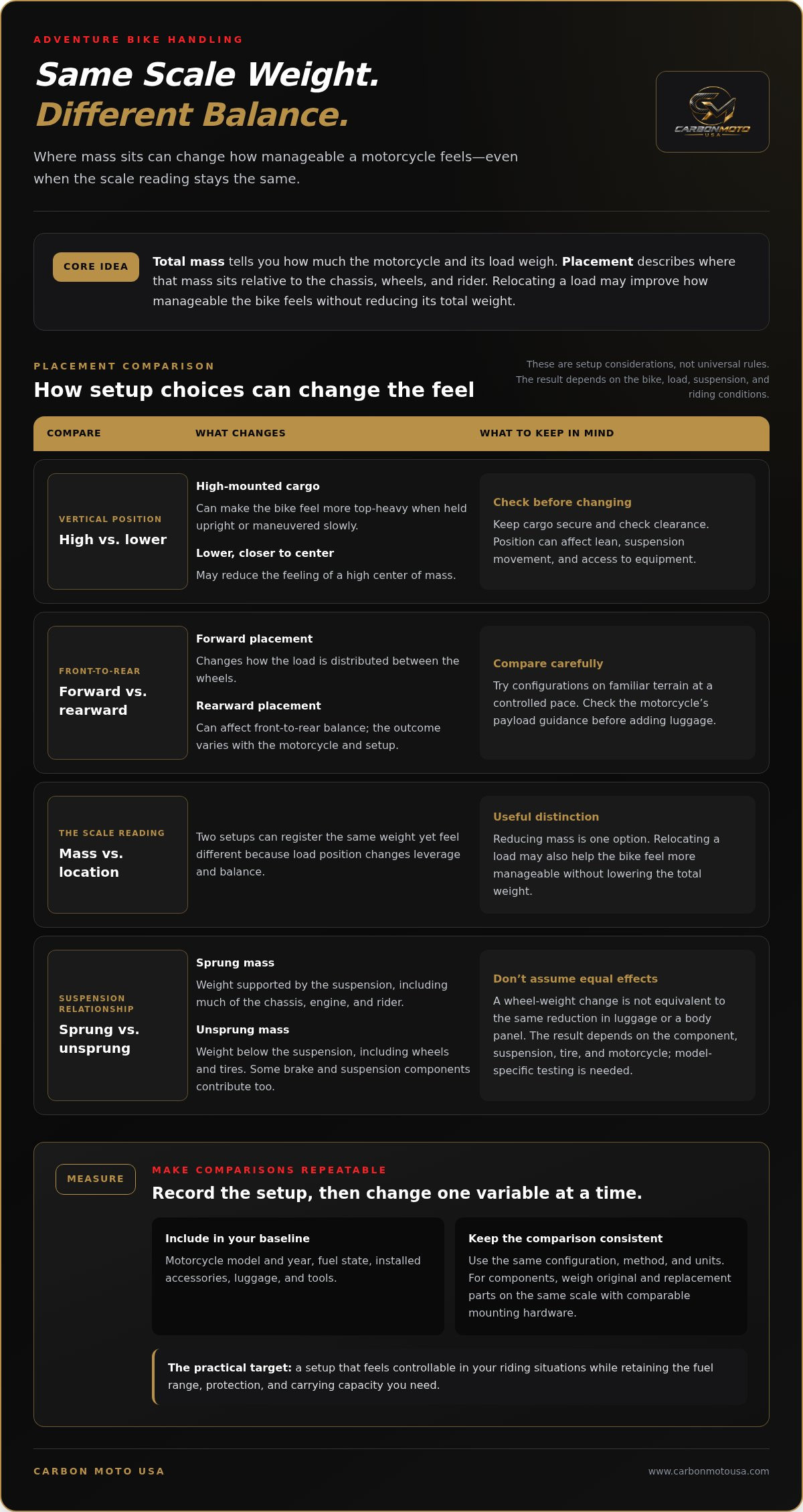
Total mass tells you how much the motorcycle and its load weigh. Placement describes where that mass sits relative to the chassis, wheels, and rider. Two setups can register the same scale reading yet feel different because their loads create different leverage and affect balance differently. That distinction matters in adventure bike weight reduction: reducing mass is one option, while relocating a load may make the bike feel more manageable without reducing its total weight.
High, low, forward, and rearward loads
Picture the same packed bag mounted on a rear rack or secured lower and closer to the motorcycle’s center. High-mounted cargo can make the bike feel more top-heavy when you’re holding it upright or maneuvering slowly. A top case or stacked luggage may also make the bike feel less settled as it leans or changes direction. A rearward load can affect front-to-rear balance, but the result depends on the bike, suspension, load, and riding conditions.
Lower placement may reduce the feeling of a high center of mass, but it isn’t automatically better. Cargo still needs secure mounting and adequate clearance, and its position can affect lean, suspension movement, or access to equipment. Forward placement also changes how load is distributed between the wheels. Treat these as setup choices, not universal rules: compare configurations on familiar terrain and at a controlled pace. Check the motorcycle’s payload guidance before adding luggage. Adventure Motorcycle Weight Capacity and Payload discusses the relationship between load, suspension, and handling.
Sprung mass and unsprung mass, explained simply
Sprung mass is the portion of the motorcycle’s weight supported by the suspension, such as much of the chassis, engine, and rider. Unsprung mass is the portion below the suspension, including the wheels and tires. Some components, such as brakes and parts of the suspension assembly, also contribute. The distinction matters because the suspension must control wheel movement over bumps while supporting the motorcycle’s sprung mass.
Changing mass at a wheel is not equivalent to removing the same amount from luggage or a body panel. Unsprung-mass changes can influence how the wheel responds to surface irregularities, but the outcome depends on the component, suspension, tire, and motorcycle. Don’t assume a fixed handling gain from a weight figure alone. Model-specific testing is needed to establish the effect of a particular change.
Weight placement isn’t the only factor. Suspension settings and condition, tire choice and pressure, terrain, speed, and rider inputs all shape the bike’s response. A change that feels noticeable on a slow, uneven trail may be less apparent on smooth pavement. Note where the bike feels unsettled, then assess one setup change at a time. If you’re comparing model-specific parts as part of that process, explore adventure-bike carbon-fiber components and compare exact-model fitment and measured component mass alongside function.
Compare Weight-Reduction Options by Benefit, Trade-Off, and Evidence
There are three distinct ways to change a bike’s weight: carry less, revise accessories, or replace a component. Each solves a different problem. Removing unused cargo is easy to reverse; changing an accessory can affect protection or storage; replacing a motorcycle part requires attention to fitment, function, and cost as well as mass. Compare each option against the riding need it addresses, not a weight claim in isolation.
Use this framework to compare the likely function, evidence, and trade-off for each approach:
- Reduce carried load. Likely function: remove items that aren’t needed for a particular ride. Evidence: weigh the luggage and contents as packed. Potential trade-off: carrying less may limit tools, supplies, or gear you rely on for longer or more remote trips.
- Change accessories. Likely function: revise add-on equipment such as luggage or mounts. Evidence: compare the complete accessory setup, including brackets and fasteners. Potential trade-off: a lighter arrangement may offer less storage, coverage, or convenience.
- Replace a component. Likely function: change a permanent part while retaining its intended role. Evidence: compare the original and replacement in the same configuration, and verify fitment for the exact motorcycle. Potential trade-off: differences in protection, durability, finish, or function may matter as much as mass.
These are decision categories, not promises of a particular result. The right choice depends on what the bike needs to do and what you’re willing to give up.
Remove unnecessary carried load before replacing components
Audit tools, luggage, and accessories against the trip ahead. Separate items you carry for every ride from those needed only for specific conditions. A packing change is temporary and easy to test; a component replacement is a more permanent decision. Don’t remove equipment required for safe operation or protection just to improve a scale reading. First decide what the bike must carry, then measure the difference between configurations.
Assess lightweight replacement parts with measured evidence
Material alone doesn’t establish a weight advantage. Carbon-fiber parts vary by design and construction, and a finished component’s mass depends on its complete specification. Compare the same part for the same model and model year, including any mounting hardware needed for a fair comparison. Use reliable measurements rather than broad material claims.
Mass is only one part of the evaluation. Confirm exact-model fitment and consider the component’s intended function, coverage, finish, and expected use. A replacement that changes how well a motorcycle is protected may not suit your priorities, even if its measured weight is lower. For adventure bike weight reduction, record what the component replaces and compare the whole configuration. That keeps the decision grounded in evidence and the bike’s purpose.
Build a Measured Adventure Bike Weight-Reduction Plan
A repeatable process keeps a promising modification from becoming guesswork. Start with the riding problem, not a target number: is the bike difficult to balance at low speed, overloaded for touring, or tiring to manage on rough terrain? That priority determines what to measure and which trade-offs matter. A thoughtful adventure bike weight reduction plan also records what changes, so you can tell whether the result addresses the original concern.
- Define the use. Identify the situation you want to improve, such as slow maneuvering, long-distance travel, or mixed-surface riding.
- Establish a baseline. Measure the bike in a clearly recorded configuration before making changes.
- Set a priority. Decide which load, accessory, or component is relevant to your riding need.
- Evaluate the change. Compare function, fitment, protection, durability, and reliable weight evidence.
- Retest. Use the same measurement conditions, then assess the bike in a controlled, familiar setting.
Set a baseline that makes comparisons fair
For each measurement, record the motorcycle model and year, fuel state, luggage, and accessories. Keep the method and removable equipment consistent between readings. Weigh individual components only when you have reliable scales and comparable parts; note whether mounting hardware is included. Record fitment, function, and any change in protection alongside the weight. A result is useful only when you know exactly what was measured.
Choose changes that match the bike’s mission
Touring riders can first review luggage and carried equipment for the route, then consider permanent changes. For mixed-surface use, weigh any potential mass benefit against the protection and durability the bike needs. After each change, reassess control and comfort under appropriate conditions. Avoid altering several parts at once, or it becomes difficult to identify which change affected the bike’s feel.
Quick checklist: define your riding use, record the bike and setup, choose one priority, verify the change’s evidence and trade-offs, then measure and assess again under comparable conditions.
For a component change, compare the exact model and year, the original and replacement parts, and the function each is designed to serve. Carbon-fiber components for adventure motorcycles are one option to evaluate within that broader process, not a guaranteed weight solution. Keep your records with the bike’s setup notes; they make later comparisons more reliable and help distinguish a measured difference from a change in load or conditions.
Once you’ve identified a component worth evaluating, explore model-specific adventure-bike carbon-fiber parts and compare fitment and measured component weights for your motorcycle.
Where Model-Specific Carbon Fiber Parts Fit the Weight-Reduction Decision
Model-specific carbon-fiber components can be one option in an adventure bike weight reduction plan, but the material alone doesn’t prove a part will reduce weight. A replacement’s value depends on what it does, how it fits the motorcycle, and how its measured mass compares with the original component. Treat weight as one factor alongside function, finish, and your riding priorities.
Start with the exact motorcycle, including its model and generation. Similar model names don’t guarantee identical fitment: component shape, mounting points, and surrounding parts can differ. A part intended for another model or year may not be an appropriate comparison, even if it looks similar. Confirm the specific fitment information before assessing a part as a replacement.
Match the component to the exact adventure bike
Use model-focused references to narrow your research, then compare specifications with your own motorcycle. Riders considering components for the BMW R 1300 GS can consult this BMW R 1300 GS carbon-fiber parts guide. For the BMW R 1250 GS, the BMW R 1250 GS carbon-fiber buyer’s guide is another model-specific resource for evaluating components.
For a meaningful weight comparison, look at the same component and configuration: original part against replacement, with mounting hardware treated consistently. A reliable measurement is more useful than an unqualified claim or a comparison between parts serving different purposes. Record what each part is designed to do, too. If its role includes coverage or protection, consider how that function fits your routes and riding conditions rather than judging by mass alone.
Finish also belongs in the decision. Consider whether the part’s appearance and surface treatment suit the motorcycle, while keeping those qualities distinct from evidence about weight or performance. Fitment, intended function, finish, and measured mass answer different questions. Evaluate them together, but don’t let one stand in for another.
Explore components without chasing an unsupported number
Carbon Moto USA’s adventure-bike carbon-fiber category includes model-specific components for motorcycles such as the BMW R 1300 GS, BMW R 1250 GS, and Harley-Davidson Pan America. Use the category to discover options, then assess fitment for your exact model and compare component weights using reliable measurements. No material label can substitute for that comparison.
Keep the goal practical: choose a component because its fit, function, finish, and evidence make sense for your bike, not because you expect a particular outcome from a broad claim. To browse model-specific options, explore adventure-bike carbon-fiber parts.
Choose Your Next Change With Purpose
Let your next ride inform your next decision. Pick one situation where the bike feels harder to manage than you’d like, then identify a single change that could address it. Keep the bike’s purpose in view: a setup that works for a loaded tour may not be right for a short off-road ride. Progress comes from making deliberate choices, not chasing the smallest possible number.
If a model-specific carbon-fiber component is on your shortlist, treat it as one option within your broader adventure bike weight reduction plan. Review its fitment and function for your motorcycle, and use measured component evidence to judge whether it supports your priorities. Carbon Moto USA’s adventure-bike offerings include parts for the BMW R 1300 GS, BMW R 1250 GS, and Harley-Davidson Pan America.
Explore Carbon Moto USA’s adventure-bike carbon-fiber parts as you plan your next considered upgrade. Choose deliberately and build a motorcycle that suits the way you ride.
Frequently Asked Questions
Does reducing weight make an adventure motorcycle easier to handle?
It can, but the effect depends on what’s removed, where it was carried, and the riding situation. A bike that’s easier to lift off its stand may not feel noticeably different at cruising speed. For adventure bike weight reduction, define the specific challenge first, such as correcting a loaded bike on a cambered trail or maneuvering it through a tight parking area. Then assess whether the change addresses that task without compromising what you need to carry.
Which matters more on an adventure bike: total weight or weight placement?
Neither matters in isolation; the useful priority depends on the problem you’re trying to solve. Total mass affects the effort required to support or move the motorcycle, while placement can change how a load influences balance. For example, if the bike feels awkward when upright but manageable once moving, examine where bulky cargo sits as well as its mass. Compare changes in a controlled setting, since suspension, terrain, and rider technique also affect the response.
Can luggage make an adventure motorcycle feel heavier than its published weight?
Yes. A published figure describes the motorcycle under a manufacturer-defined condition, not necessarily your loaded travel setup. Panniers, a top case, tools, and packed gear add mass, and cargo mounted high or far behind the rider may make the bike feel more cumbersome. For a useful comparison, consider a short ride with your regular luggage and another with only the equipment required for that route. Keep the motorcycle and fuel condition consistent.
Does carbon fiber always make motorcycle parts lighter than OEM parts?
No. Carbon fiber identifies a material, not a guaranteed weight difference. A replacement’s construction, shape, reinforcement, and mounting hardware all contribute to its finished mass. Compare the same component against the OEM part, including the hardware needed in use, and rely on measurements rather than a general material claim. Also check that the replacement is designed for your exact model and retains the function you expect before treating it as a sensible modification.
How should I measure my adventure bike before changing components?
Use a suitable scale on a firm, level surface and follow its instructions to keep the motorcycle stable. Record the scale setup, fuel level, model and year, luggage, and installed accessories so the reading has context. If measuring a part, weigh the removed and replacement components separately with comparable hardware included. Note what the part does, too. A precise number is useful only if the two configurations represent the same motorcycle and function.
Can I reduce weight without sacrificing protection or durability?
Often, but you’ll need to judge each change by its role, not mass alone. A guard used on rocky trails may be more valuable than a lighter alternative if the replacement doesn’t provide suitable coverage for your routes. Review the part’s intended function, fitment, construction information, and measured weight together. Consider how you ride: a component’s priorities for frequent off-road impacts may differ from those for primarily paved touring.
Does removing weight from wheels affect handling differently from removing bodywork?
It can, because wheels and tires are unsprung components that move with the suspension, while most bodywork is supported by the chassis. Their locations and roles differ, so equal weight changes in those areas aren’t automatically equivalent in effect. The outcome depends on the specific parts, motorcycle, suspension, and tires. Don’t assume a particular handling improvement without comparable testing. Check that any wheel or bodywork change preserves the component’s intended function and fit.