
Carbon Moto USA / Rider support
Street Glide Front-End Instability: Diagnose the Cause and Choose a Solution

What if the right Street Glide front end instability solution isn’t a steering stabilizer, at least not yet? A wobble or vague steering can unsettle even an experienced rider. Adding a component before identifying the cause may leave the underlying issue unaddressed.
Take a change in handling seriously. Tire condition and pressure, wheel balance, steering-head bearings, and suspension components are all worth assessing. If the bike feels unstable, don’t push its speed or handling limits. Arrange a careful mechanical inspection, especially if the symptom is severe, recurring, or getting worse.
This guide explains how to describe the symptom, what to have inspected, and when a stabilizer may belong in the plan. It also covers the Harley-Davidson Street Glide Death Deleter Steering Stabilizer Kit as a model-specific option, including why exact model-year fitment matters. The goal is a measured decision: assess the motorcycle first, then choose components that suit its condition and your intended setup.
Key Takeaways
- Learn how wobble, shimmy, and vague steering can feel different, so you can describe the symptom without treating it as a diagnosis.
- Consider tire condition and pressure, wheel balance, steering-head bearings, and suspension as inspection points rather than assuming one cause.
- Choose a Street Glide front end instability solution by separating mechanical assessment and repair from routine maintenance and stabilizer evaluation.
- If instability is significant, end the ride safely. Record when it began, the conditions, recent service, and any changes without trying to recreate it.
- Assess the Harley-Davidson Street Glide Death Deleter Steering Stabilizer Kit as a handling component, and match its listed fitment to your exact model year.
Street Glide Front-End Instability: Recognize the Symptom Before Choosing a Fix
A Street Glide that shakes, wanders, or suddenly feels less precise can make a familiar ride feel uncertain. Take the change seriously, but don’t assume the sensation identifies the fault. “Front-end instability” describes a handling concern, not a diagnosis. The symptom is what you feel; the mechanical cause is the condition producing it. They aren’t the same.
That distinction matters when choosing a Street Glide front end instability solution. Your description helps a technician understand the complaint, but it can’t establish what’s wrong on its own. Explain what you felt, how severe it was, when it happened, and whether it returned. Those details give the inspection a useful starting point.
How wobble, shimmy, and vague steering can feel different
Wobble commonly describes a noticeable side-to-side oscillation involving the handlebars or front end. Shimmy is often used for a narrower, quicker shaking or vibration. Riders may use these terms differently, and the sensations can overlap, so treat them as descriptions rather than precise diagnoses.
Vague steering feels different: the bike may seem loose, wander from its line, or respond less clearly to small steering inputs without an obvious back-and-forth shake. When describing it, note whether the bars visibly moved, the whole motorcycle felt unsettled, or it simply took more effort to hold a steady line. These observations explain what you experienced without assigning a cause remotely.
Speed, road surface, wind, and whether you were accelerating, slowing, or holding a steady pace are useful context, not proof of a particular fault. Motorcycle stability involves interacting forces and movement, as outlined in this overview of motorcycle dynamics and stability. A technician needs to assess the motorcycle rather than infer a diagnosis from one condition or one word.
When Street Glide instability calls for an immediate response
Let the severity of the event guide your next move. A mild sensation that occurs once still deserves attention, especially if it’s new. Severe, recurring, or worsening instability is a safety concern. Don’t accelerate to see whether it happens again, repeat the same road conditions, or test the bike at speed.
If the motorcycle becomes difficult to control, ease out of the situation and bring it to a safe stop when you can do so without abrupt maneuvers. Don’t continue riding a bike with severe or recurring instability. Arrange for a qualified motorcycle technician to inspect it before further riding. If it doesn’t feel safe to move, arrange transport instead.
Keep your account factual: describe the sensation, its severity, when it began, the conditions, and whether it repeated. That record is more useful than a guessed diagnosis and helps direct the next step toward a proper mechanical assessment.
What Can Contribute to Street Glide Front-End Instability?
Several conditions may contribute to front-end instability, and a rider’s description alone can’t identify which one is present. Treat each possibility as an inspection point, not a diagnosis. Tires and wheels, steering-head and wheel bearings, alignment, and suspension condition may all warrant assessment. A systematic inspection is more useful than replacing parts based on a guess.
Tell the technician what you noticed and what changed before the handling concern began. A recent tire change, service visit, modification, or impact such as striking a pothole can help focus the inspection. Timing is useful context, but it doesn’t prove that a particular change caused the symptom.
Tires and wheels: observations worth recording
Look for visible tire damage or unusual wear, and note whether the tires were changed shortly before the concern began. Uneven wear is useful to report, but it doesn’t establish the cause of instability. Record what you can observe without attempting a repair or deliberately reproducing the handling symptom.
Inflation and wheel balance also deserve attention. Have tire pressure checked against the motorcycle’s applicable specifications, and have wheel balance assessed using appropriate procedures. Don’t assume a tire-related issue explains every wobble or vague steering complaint. A qualified inspection should assess the whole wheel and tire assembly.
Steering and suspension: why inspection matters
Steering-head bearings and wheel bearings are important inspection areas because their condition can affect how the motorcycle responds. Alignment and suspension condition also warrant assessment. These checks may involve measurements and procedures best handled by a qualified motorcycle technician, rather than conclusions drawn from how the handlebars feel during a ride.
Similar handling symptoms can come from different mechanical causes, so the sensation alone can’t tell you which component needs attention. A Street Glide front end instability solution should follow an assessment of the motorcycle, not substitute for one. NHTSA’s motorcycle safety guidance also offers useful context on safe riding practices and motorcycle safety, alongside model-specific maintenance information.
Before the inspection, make a brief record of when the symptom appeared and any recent work, parts changes, or impacts. Note visible tire wear or damage, but leave component diagnosis to the technician. If the motorcycle has severe or recurring instability, don’t ride it for further tests. Arrange an inspection before returning to the road.
Once the mechanical checks clarify the next step, consider whether a handling component belongs in the plan. Carbon Moto USA offers the Harley-Davidson Street Glide Death Deleter Steering Stabilizer Kit as a product option to evaluate, not as a diagnosis or guaranteed fix. Compare the listing’s fitment with your exact model before purchase.
Would a Steering Stabilizer Help, or Is Another Check Needed First?
A steering stabilizer may be worth evaluating as a handling component, but it isn’t a diagnosis. It can’t tell you whether a tire, bearing, alignment, or suspension issue is present, and it shouldn’t replace inspecting or correcting an underlying mechanical problem. First establish the motorcycle’s condition. Then decide whether a stabilizer suits your handling goals and intended use.
Use this comparison to keep three different decisions separate:
| Decision | Purpose | When it belongs in the plan |
|---|---|---|
| Diagnosis and repair | Identify and address a worn, damaged, or incorrectly adjusted component. | First, if instability is new, severe, recurring, or the motorcycle has not been assessed. |
| Stabilizer evaluation | Consider a handling component as part of the bike’s setup. | After the motorcycle’s mechanical condition is understood. |
| Routine maintenance checks | Keep specified maintenance items within the motorcycle’s requirements. | As part of ongoing care, not as a substitute for investigating a new symptom. |
What a stabilizer can, and cannot, be expected to address
A steering stabilizer is a handling component. Riders may consider one when assessing how the motorcycle feels and responds, but its presence doesn’t prove that a specific fault existed. Evaluating a stabilizer also doesn’t establish that the source of instability has been found or corrected.
Keep the distinction clear: considering a handling upgrade is different from repairing worn, damaged, or incorrectly adjusted components. A stabilizer shouldn’t be treated as a cure for every wobble or vague steering complaint. Any observed result depends on the motorcycle’s condition and setup, so don’t assume the same outcome across different bikes.
A practical decision framework for Street Glide owners
Make the decision in sequence. This keeps a component choice from distracting from a safety concern or needed mechanical correction.
- Assess safety. If instability is severe or recurring, stop riding and arrange an inspection before returning to the road.
- Understand the motorcycle’s condition. Have relevant mechanical concerns assessed and address any identified issue before treating a stabilizer as the next step.
- Consider your setup and use. Once the bike has been assessed, decide whether a handling component aligns with your needs. Don’t use it as a substitute for routine maintenance or repair.
- Check fitment. Compare the product listing with your exact Street Glide model before purchase. Don’t assume a model name alone establishes fitment.
The Harley-Davidson Street Glide Death Deleter Steering Stabilizer Kit is a purpose-built product option to evaluate within that process. It isn’t a guaranteed fix or a replacement for inspection. A sound Street Glide front end instability solution starts with understanding the motorcycle, then choosing components that fit its condition and intended setup.
Fixing Street Glide Instability: A Step-by-Step Plan
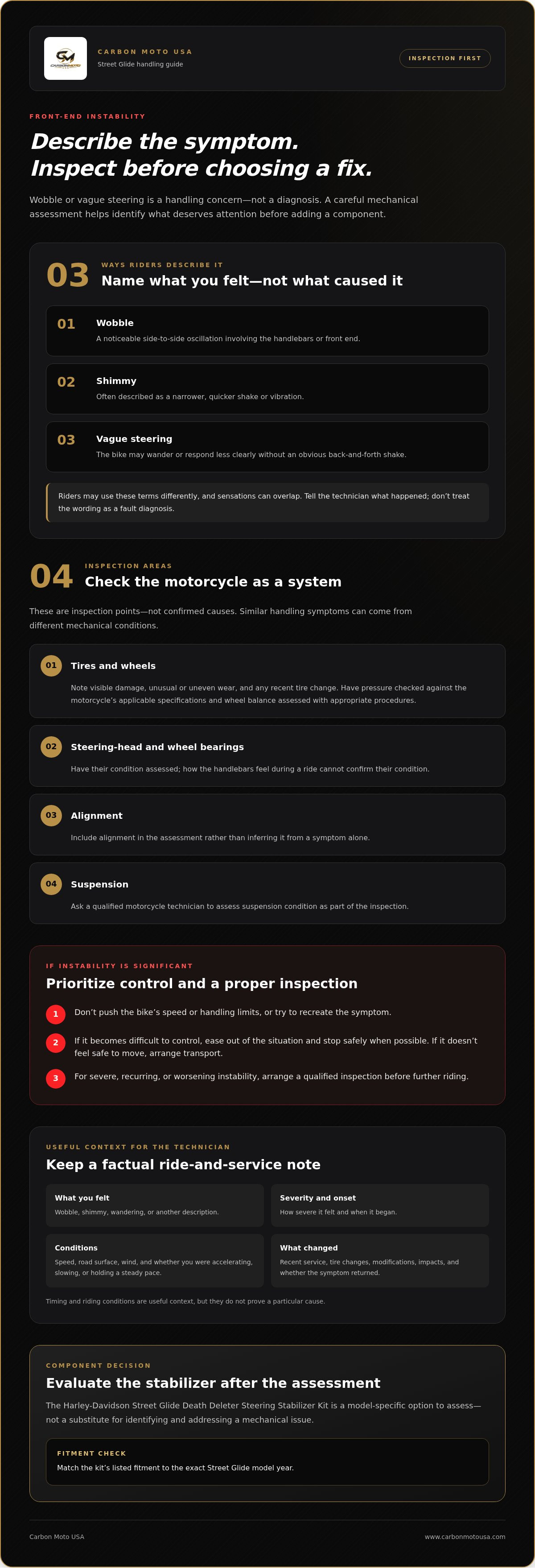
Use a sequence, not a quick parts swap. The right Street Glide front end instability solution starts with a safe response, followed by useful documentation and a qualified inspection. Once you understand the motorcycle’s condition, decide whether a handling component belongs in the setup.
- End the ride safely if instability is significant. If the motorcycle feels difficult to control, find a safe place to stop without abrupt maneuvers. Don’t continue riding a bike with severe, recurring, or worsening instability, and don’t test it at speed to see whether the symptom returns. Arrange an inspection before riding again.
- Write down what happened. Note when you first noticed the symptom, whether it happened once or repeated, and the conditions at the time. Describe what you felt in plain language, such as shaking at the bars or wandering from your line. Record observations rather than deciding which part is at fault.
- Record recent changes. Include service, a tire change, replacement parts, modifications, setup changes, or an impact that occurred before the symptom began. The timing may help guide an inspection, but it doesn’t prove that a change caused the handling concern. Don’t recreate the conditions to gather more evidence.
- Arrange a qualified inspection. Ask for assessment of relevant tires and wheels, including condition, inflation, and balance, as well as steering components, bearings, alignment, and suspension. The technician can determine which checks are appropriate and whether a repair or adjustment is needed. Share your recorded timeline during the inspection.
- Separate repairs from optional components. Address any identified mechanical issue before weighing a handling upgrade. A stabilizer is a component to consider as part of the setup, not a replacement for correcting worn, damaged, or incorrectly adjusted parts. Don’t assume it will resolve an unexplained symptom.
- Check exact fitment before purchase. If a stabilizer still makes sense after inspection, compare its stated Street Glide fitment with your motorcycle’s exact model. Avoid assuming that a product fits every Street Glide simply because it’s listed for the model family.
What to document before a technician inspects the bike
A concise timeline is more useful than a confident guess. Record when the symptom began, the riding conditions, whether it repeated, and any recent service or changes. Include a tire replacement or impact if relevant. Share this information with the technician, but don’t conduct a high-speed test or make adjustments to reproduce the symptom.
How to move from inspection to a considered upgrade
Use the inspection findings to distinguish necessary repairs from optional handling choices. If the motorcycle’s condition is understood and a stabilizer suits your intended setup, compare the product listing with your exact model before buying. Diagnose first, then consider an upgrade.
For a model-specific option, explore the Harley-Davidson Street Glide Death Deleter Steering Stabilizer Kit and review its stated fitment for your motorcycle.
Evaluate the Street Glide Death Deleter Steering Stabilizer Kit
The Harley-Davidson Street Glide Death Deleter Steering Stabilizer Kit is a model-specific product for riders considering a steering stabilizer as part of their handling setup. Evaluate it after you understand the motorcycle’s mechanical condition. The kit isn’t a diagnosis, a substitute for repairing an identified fault, or a guaranteed cure for front-end instability.
Keep the decision in order: understand the symptom, have relevant mechanical concerns inspected, address any identified issues, then decide whether a stabilizer belongs in your setup. This helps distinguish a repair the motorcycle needs from a component you’re choosing to evaluate.
Check Street Glide fitment before choosing the kit
Street Glide model names alone aren’t enough to establish fitment. Compare your motorcycle’s exact model and year with the fitment stated on the current product listing before purchase. Don’t rely on a general description, another rider’s setup, or assumptions about compatibility across model years.
Keep product selection separate from mechanical diagnosis. A fitment match indicates that the listing addresses your model; it doesn’t identify the cause of a handling symptom or establish that a stabilizer is the right response. If instability is unresolved, prioritize inspection rather than using a product choice in place of mechanical assessment.
Choose the next step with the motorcycle’s condition in mind
If the instability is severe, recurring, or worsening, or if the bike hasn’t been inspected, make safety and mechanical assessment the priority. A technician’s findings can clarify whether a component needs repair or adjustment. A stabilizer is a separate handling decision, and any observed result depends on the motorcycle’s condition and setup.
If the motorcycle has been assessed and you’re ready to consider the kit, review the current listing carefully. Match the exact model and year, and follow the applicable product and motorcycle instructions for next steps. Don’t infer specifications, included components, or installation requirements from the product name alone.
A careful choice is a measured one. The Death Deleter gives Street Glide owners a purpose-built option to evaluate, not a promise that every cause of instability will be resolved. If it fits your motorcycle and suits your intended setup, view the Street Glide Death Deleter listing and use its stated fitment details to guide your decision. Diagnose first, then consider an upgrade.
Make Your Next Handling Decision With Confidence
A composed ride starts with a motorcycle you understand. Let the inspection findings guide your next decision, rather than choosing a component simply because it seems like the fastest answer. The right Street Glide front end instability solution responds to the bike’s actual condition and your goals for its handling setup.
Carbon Moto USA offers a Death Deleter steering stabilizer kit specifically for Harley-Davidson Street Glide models. If a stabilizer makes sense as your next step, review the product listing and match its stated fitment to your exact motorcycle before deciding.
Explore the Street Glide Death Deleter Steering Stabilizer Kit as you plan your next move. Put mechanical integrity first, then choose a handling component that fits your motorcycle and intended setup.
Frequently Asked Questions
Can an unbalanced front tire cause a Street Glide to wobble?
An unbalanced front wheel can contribute to vibration or unsettled handling, but it isn’t the only possible explanation for a wobble. Note whether the sensation began after tire or wheel work, and describe when it occurs. Have a technician assess tire condition, inflation, and wheel balance using the motorcycle’s appropriate specifications. Don’t assume balancing alone is the Street Glide front end instability solution without checking for other possible contributors.
Can carrying a passenger or luggage affect Street Glide handling?
Yes. A passenger or added luggage changes the motorcycle’s load and can affect how it feels through turns, over bumps, and during steering inputs. Secure luggage, distribute it carefully, and follow the motorcycle’s owner manual for loading and suspension guidance. If the handling change is pronounced, new, or persists when riding without the added load, don’t attribute it to cargo alone; have the motorcycle assessed.
Should I keep riding my Street Glide if the front end wobbles?
Don’t continue riding if the wobble is severe, returns repeatedly, worsens, or makes the motorcycle hard to control. Bring the bike to a safe stop without abrupt inputs, then arrange an inspection before riding again. If it doesn’t feel safe to move, transport it rather than riding it to a shop. A brief, mild sensation still merits attention if it’s new.
Can a steering stabilizer repair worn steering-head bearings?
No. A steering stabilizer doesn’t repair worn or incorrectly adjusted steering-head bearings. Those components need appropriate inspection and, if necessary, repair or adjustment by a qualified motorcycle technician. Treat the stabilizer as a separate handling component, not a way to compensate for a mechanical fault. If bearing condition is uncertain, establish that first before changing the handling setup.
Does a new front tire mean the Street Glide's wobble is solved?
Not necessarily. A new tire may address a tire-related concern, but it doesn’t confirm that the original wobble came from the old tire or that another contributor is absent. The replacement must also be appropriate for the motorcycle and correctly installed, inflated, and balanced. If the symptom continues after the change, avoid repeated road tests and have the tires, wheels, steering, and suspension assessed.
How do I check whether a Death Deleter kit fits my Street Glide?
Compare your exact Street Glide model and year with the fitment information on the current Death Deleter product listing. Don’t assume that a listing for Street Glide models applies to every year or variant. Fitment helps determine whether the kit is intended for your motorcycle; it doesn’t diagnose a wobble or confirm that a stabilizer is the right response. Resolve mechanical concerns separately before choosing a handling component.
Can road grooves or strong crosswinds feel like front-end instability?
Yes. Grooved pavement or a crosswind can change the steering feedback you feel, particularly as the road surface or wind exposure changes. A sensation that occurs in one specific environment doesn’t prove the motorcycle has a mechanical fault, but it doesn’t rule one out either. Note where and when it happens. Don’t deliberately seek out grooves or wind to reproduce a concerning symptom.