
Carbon Moto USA / Rider support
How to Stop High-Speed Wobble on a Road Glide: A Safe, Step-by-Step Guide

If you’re searching for how to stop high speed wobble on Road Glide, start by staying composed and reducing risk, not by adding a steering stabilizer. A stabilizer may be part of a handling setup, but it won’t repair a tire, bearing, alignment, or suspension problem. The priority is to respond safely and identify what needs attention.
A sudden handlebar oscillation is unnerving, and it’s reasonable to wonder whether the bike is safe to ride afterward. Don’t assume the wobble is harmless or that one aftermarket part will solve it. This guide explains how to respond if wobble begins, then sets out a practical inspection sequence covering tires, steering components, suspension, wheel alignment, and loading. It also explains how a Road Glide steering stabilizer, including the Death Deleter kit, may fit into a handling plan after mechanical causes have been assessed. The goal is a clear next step, not a quick fix that masks a problem.
Key Takeaways
- If wobble starts, avoid provoking or testing it again at speed. Prioritize a safe response and record what you noticed.
- Use a structured inspection sequence to consider tires and wheels, steering components, suspension, and setup.
- Learn how to stop high speed wobble on Road Glide without risky road testing by separating safe visual observations from checks that need tools and technical skill.
- Compare clues you can observe while the motorcycle is stationary with the follow-up each issue may require.
- Understand where a Road Glide Death Deleter steering stabilizer may fit into your handling plan, and why it cannot replace correcting mechanical faults.
Road Glide high-speed wobble: recognize the risk and respond safely
Don’t provoke, reproduce, or keep testing a wobble at speed. A high-speed wobble is a rapid, repeated movement of the handlebars that can make the front end feel as if it’s oscillating from side to side. It can develop suddenly. The sensation alone can’t identify a failed component or establish that the motorcycle is safe to ride.
An unexplained wobble is a reason to stop speed testing and assess the motorcycle. Treat it as a warning, not a handling characteristic to push through. Learning how to stop high speed wobble on Road Glide starts with managing the immediate risk, then recording the conditions so the cause can be investigated.
How wobble differs from weave and ordinary vibration
Wobble is typically felt as a fast oscillation at the handlebars. A weave is more likely to feel like broader side-to-side movement through the motorcycle. Ordinary vibration may feel like a buzz or repeated shake rather than a distinct steering oscillation. These descriptions can help you report what happened, but they aren’t reliable diagnoses. Riders may experience overlapping sensations, especially during a stressful event. For general background on the phenomenon, see understanding speed wobble.
Once stopped somewhere safe, write down what you remember while it’s fresh: approximate speed, road surface, whether you were accelerating or decelerating, wind or passing traffic, and any passenger or luggage. Note whether the handlebars moved, the whole motorcycle shifted, or both. Don’t return to the same conditions to test your impression.
What to do if a Road Glide starts wobbling
Keep your response smooth and deliberate. Avoid abrupt steering corrections, grabbing the brakes, or making a sudden throttle change. Maintain a controlled line and allow the motorcycle to slow gradually when traffic and road conditions permit. Prioritize leaving the flow of traffic safely. Don’t make a sharp maneuver just to reach a shoulder or exit.
After stopping, assess your own condition and the motorcycle from a safe position. If you can’t reach a safe stopping place immediately, focus on steady control and avoid inputs that could intensify the disturbance. Once stopped, don’t resume high-speed riding to see whether the symptom returns. If the motorcycle feels unstable at lower speeds or you notice visible damage, avoid riding it and arrange an appropriate assessment.
- Remember the sequence. Control the motorcycle smoothly, reduce speed gradually when safe, and leave traffic without a sudden maneuver.
- Preserve useful details. Note when the symptom began and what the bike was doing, but don’t attempt to recreate it.
- Don’t treat a quiet ride afterward as proof. A symptom that disappears doesn’t establish that its cause is gone or that the motorcycle is safe.
Use your observations as clues for the next step, not as a verdict. A wobble can have more than one possible cause. Distinguishing tire, steering, suspension, or setup issues requires a systematic inspection rather than a high-speed experiment.
What can cause a Road Glide to wobble at speed?
A wobble can have several possible contributors, and more than one may be present at once. Tires and wheels, steering components, suspension condition, and changes to the motorcycle’s setup are all areas to inspect, not diagnoses to make from the saddle. Wobble speed alone cannot identify the failed component. A symptom appearing at a particular speed is useful information to record, but it doesn’t prove which part is responsible.
That distinction matters before considering a steering stabilizer. A handling component may have a role in a broader setup, but it shouldn’t take the place of finding and correcting a mechanical fault. Background on motorcycle roll stabilization research offers technical context for vehicle stability. It isn’t a diagnostic guide for a specific Road Glide.
Tires and wheels: inspect before assuming a stabilizer is needed
Start with what you can observe while the motorcycle is parked. Look over each tire for damage, unusual or uneven wear, and anything visibly embedded in the tread. Check cold tire pressure against the specification in the owner’s manual. Don’t change pressure or alter the setup based on an online anecdote. Use the specification for your motorcycle and tires.
A tire can appear serviceable while a balance or wheel condition issue still needs closer inspection. Those concerns can’t be ruled out by appearance alone. Include tire, wheel, and balance condition in a qualified mechanical assessment rather than trying to diagnose them through another high-speed ride.
Steering, suspension, and load-related checks
Steering-head bearings, wheel alignment, and suspension condition also belong on the inspection list. Problems in these areas may not be obvious from a walk-around, and checking them can require appropriate tools and technical skill. Note recent changes such as new luggage, accessories, suspension adjustments, or other setup work. That history helps focus an assessment, but it doesn’t prove a particular change caused the symptom.
- Tires: Record visible wear or damage, then compare cold pressure with the owner’s manual.
- Wheels: Include balance and wheel condition in a qualified inspection. Don’t rely on appearance alone.
- Steering and alignment: Have steering-head bearings and alignment assessed rather than assuming the handlebars’ feel identifies the fault.
- Suspension and setup: Document recent changes, luggage, and accessories so they can be considered alongside the mechanical checks.
No single adjustment is a universal cure. If you’re researching how to stop high speed wobble on Road Glide, use a clear sequence: document the conditions, inspect the motorcycle systematically, and address any identified fault before returning to faster riding. Don’t use changed tire pressure, altered suspension settings, or added steering hardware as a substitute for that assessment.
After the motorcycle’s condition has been assessed, a stabilizer can be considered as a handling component within the overall plan. For a Road Glide, Carbon Moto USA’s Road Glide steering stabilizer is an option to consider after diagnosis, not a repair for an unresolved fault.
Compare likely Road Glide wobble causes without risky road testing
Use the motorcycle’s history and what you can safely observe while it’s parked to organize the next inspection. The clues below are prompts, not proof. A speed-specific symptom or visible mark may help guide an inspection, but neither confirms a failed component. Don’t take another high-speed ride to compare sensations. A visual check also can’t reveal every internal wear or adjustment issue.
| Inspection area | Possible clue | Safe stationary check | Professional follow-up |
|---|---|---|---|
| Tires and wheels | Visible tire damage, unusual wear, or a symptom first noticed after tire or wheel work | Look over the tires and note their wear pattern. Check cold pressure against the owner’s manual. | Have tire condition, wheel condition, and balance assessed. Don’t treat appearance or pressure alone as a full diagnosis. |
| Steering components | Abnormal steering feel when moving the motorcycle slowly by hand, or a recent steering-related repair | With the motorcycle parked securely, note anything visibly loose or unusual without dismantling parts. | Have steering-head bearings and related components checked using suitable procedures and tools. |
| Suspension | A change in ride feel after adjustment, service, or a change in carried load | Record current settings if known, and note visible damage or leakage. | Have suspension condition and setup evaluated for the motorcycle and its load. A motorcycle suspension system guide provides background, not a diagnosis. |
| Recent setup changes | The symptom began after adding luggage or accessories, changing tires, or adjusting the suspension | Write down what changed and when. Note passenger or luggage load during the ride. | Share the timeline and setup details so they can be considered alongside mechanical inspection findings. |
Separate observable clues from confirmed causes
A cut, bulge, or unusual tire wear is a reason to stop riding and arrange an inspection, not a basis for declaring the cause of wobble. Likewise, “it happened at a certain speed” is useful history, but it doesn’t identify a specific part. Internal wear, bearing condition, balance, or setup issues may not show up in a walk-around. Keep observations factual and let the inspection establish what needs attention.
When a qualified inspection is the next step
Arrange a qualified inspection if wobble recurs, tires are damaged, steering feels abnormal, or you’re uncertain about a component’s condition. If you’re unsure the motorcycle is safe, don’t ride it to an inspection. Arrange a suitable way to have it assessed. Record recent tire or wheel work, suspension changes, and added accessories. This history helps direct troubleshooting without assuming the last change caused the problem.
After diagnosis and correction of any mechanical fault, a steering stabilizer may be considered as a handling component, not as a diagnostic tool or repair for an unresolved issue. The Road Glide Death Deleter steering stabilizer is one option in that broader plan. It can’t establish that the motorcycle is safe or replace inspection and repair. For anyone researching how to stop high speed wobble on Road Glide, keep the order clear: assess the bike first, then consider handling components.
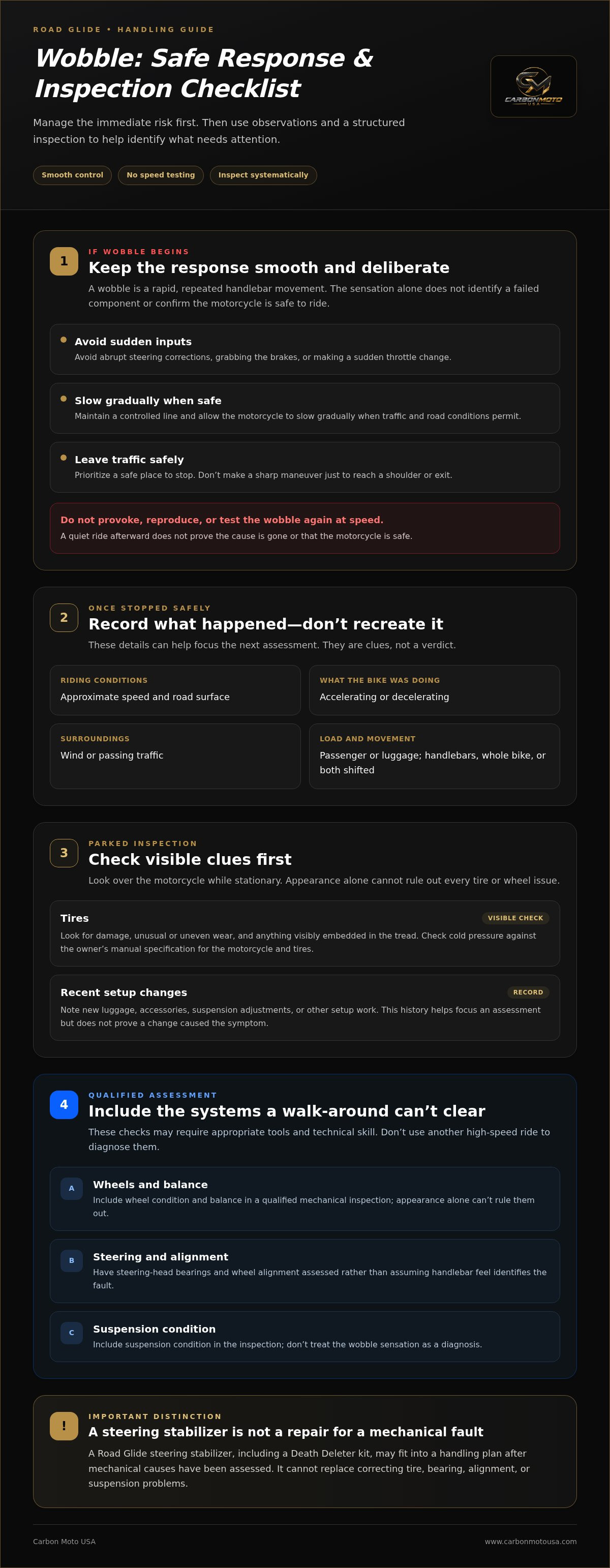
A safe step-by-step plan to troubleshoot Road Glide wobble
A disciplined inspection is safer and more useful than trying to reproduce the symptom. Start with your observations, then move from simple parked checks to technical assessment. Keep owner-level checks separate from work that requires service information, suitable tools, and mechanical experience. If you’re unsure whether the motorcycle is safe to move, don’t ride it for troubleshooting.
- Stop speed testing. Don’t ride faster, repeat a maneuver, or seek the conditions where the wobble began. A symptom that doesn’t immediately return isn’t proof that the motorcycle is safe.
- Write down what happened. Record the approximate speed, road surface, weather or wind conditions, whether you were accelerating or decelerating, and how the motorcycle was loaded. Describe what you felt without trying to name a failed part.
- Make a parked visual check. Look for obvious tire damage, unusual wear, or other visible concerns. Check cold tire pressure using the method and specifications in your owner’s manual. Don’t substitute an online recommendation or change pressure to see whether the wobble goes away.
- Note recent changes. Record tire or wheel work, maintenance, new accessories, luggage, passenger load, and suspension adjustments. Include when each change happened and whether it came before or after the symptom.
- Arrange a mechanical assessment. Have relevant tires and wheels, steering-head bearings, alignment, and suspension condition assessed. These checks may require tools and technical skill. Don’t loosen, adjust, or replace steering components unless you have the correct service knowledge and procedures.
- Review the findings before riding again. Keep confirmed inspection results and completed repairs distinct from guesses based on a forum post or an apparent connection to a recent change. If work is needed, follow the guidance provided for next steps.
Checks to make while the motorcycle is parked
Limit your own inspection to observations you can make safely. Note tire condition, wear, and pressure concerns, and gather the motorcycle’s recent service and setup history. Don’t dismantle steering or suspension parts to search for a cause. A visual check can identify a reason to escalate, but it can’t rule out internal wear, incorrect adjustment, or other faults.
What to document for a mechanical inspection
Provide a concise account of when the wobble occurred, the road and weather conditions, the load, recent maintenance, and any tire, wheel, accessory, or suspension changes. Have the relevant systems assessed rather than treating one suspected cause as fact. A clear timeline makes troubleshooting more focused and keeps decisions tied to inspection findings.
After repair, validation should follow the relevant guidance. Don’t conduct a deliberate high-speed test to prove the wobble is gone. If you’re researching how to stop high speed wobble on Road Glide, keep the sequence clear: stop testing, document, inspect, correct identified faults, and follow professional direction before returning to normal riding.
Once diagnosis and necessary repairs are addressed, a steering stabilizer may be considered as a handling component, not as a substitute for inspection or repair. The Road Glide Death Deleter steering stabilizer is one option in that broader handling plan.
When a Road Glide steering stabilizer makes sense, and what it cannot do
A steering stabilizer belongs in the handling discussion after the motorcycle has been assessed and any mechanical faults have been addressed. It’s a component to consider as part of a deliberate setup, not a shortcut around diagnosing wobble. A stabilizer can’t repair damaged tires, worn bearings, incorrect wheel alignment, or suspension problems, and it can’t establish that an unsafe motorcycle is ready to ride.
Keep two decisions separate: first, whether the motorcycle needs inspection or repair; then, whether a handling component suits your goals and setup. Don’t treat a change in steering feel after adding a stabilizer as proof that an underlying fault has disappeared. The cause still matters.
What a stabilizer can contribute to the decision
The Death Deleter is Carbon Moto USA’s steering stabilizer kit for Harley-Davidson Road Glide models. It is designed to improve handling on Harley touring models, making it an option to evaluate after diagnosis when considering handling components for a Road Glide. It doesn’t correct tire, bearing, alignment, or suspension faults, and no stabilizer should be treated as a guaranteed cure for every wobble.
- Consider it after assessment: Establish the motorcycle’s condition before deciding whether a handling component is appropriate.
- Keep its role specific: A stabilizer is a handling component, not a replacement for mechanical inspection or repair.
- Avoid assuming an outcome: Don’t infer that an unresolved fault has been fixed simply because the motorcycle feels different.
Choose a Road Glide kit only after the cause is addressed
Make repair decisions before upgrade decisions. If an inspection finds a damaged tire, steering concern, alignment issue, or suspension fault, address that finding rather than using an accessory to mask a symptom. If the bike has been assessed and you’re considering a stabilizer as part of its handling setup, review the product information for your specific Road Glide model year before purchase.
Fitment matters. Confirm that the current product information applies to your motorcycle’s model year, and follow the relevant technical instructions for the component. Don’t assume fitment or installation details carry over across model years or configurations.
If you’re weighing how to stop high speed wobble on Road Glide, keep the order disciplined: diagnose first, correct identified faults, then consider whether a stabilizer fits your handling plan. The Death Deleter is a Road Glide handling upgrade to consider after diagnosis. It doesn’t guarantee wobble prevention or make an unresolved mechanical issue safe.
View the Road Glide Death Deleter steering stabilizer kit and review its current product information to verify model-year fitment before purchase.
Make your next Road Glide decision with confidence
Let the evidence guide your next move. A clear record of the symptom and the motorcycle’s inspection findings gives you a sound basis for deciding what belongs in the repair plan and what belongs in a handling upgrade. Accessories should support a considered setup, not stand in for resolving uncertainty about the motorcycle’s condition.
If you’re still weighing how to stop high speed wobble on Road Glide, prioritize informed decisions over another high-speed test. Once the motorcycle has been assessed, review the current model-year fitment details for Carbon Moto USA’s Death Deleter steering stabilizer kit for Harley-Davidson Road Glide models.
Explore Carbon Moto USA’s Road Glide Death Deleter steering stabilizer as a handling component to consider after diagnosis. Review the product information for your model year and take the next step deliberately.
Frequently Asked Questions
Is high-speed wobble the same as motorcycle weave?
Not necessarily. Wobble commonly describes oscillation felt through the steering, while weave may feel like broader side-to-side movement of the motorcycle. Riders may use the terms interchangeably, and the sensations can overlap, so the label alone can’t identify a fault. Describe what moved, how it felt, and whether it changed as you slowed. If instability recurs or feels severe, have the motorcycle assessed before riding at speed again.
Can a Road Glide wobble happen only at one speed?
A symptom may appear within a particular speed range, but that pattern doesn’t pinpoint its cause. Tires, wheels, steering, suspension, and setup can all warrant inspection. Don’t repeatedly reach that speed to see if the wobble returns. Instead, write down the conditions you already experienced, including road surface, load, and recent changes to the motorcycle, and share those details during a qualified inspection.
Is it safe to keep riding a Road Glide after it wobbles?
Don’t assume it’s safe simply because the wobble stopped. Treat an unexplained event as a reason to avoid high-speed riding until the motorcycle has been assessed. Reduce speed smoothly when conditions allow and move to a safe place. If you notice tire damage or unusual steering behavior, use particular caution and avoid riding the motorcycle if its condition feels uncertain. Arrange an assessment before returning to speed.
Can incorrect tire pressure contribute to Road Glide instability?
Yes, tire pressure is one factor to check, but it can’t explain every instability symptom. Use the owner’s manual for the correct pressure guidance and measurement conditions, including whether the tires should be cold. Don’t copy another rider’s settings or make repeated pressure changes to test the handling. Tire condition and wheel, steering, and suspension concerns may also need assessment to understand the motorcycle’s behavior.
Does a Road Glide wobble always mean the steering-head bearings are bad?
No. Steering-head bearings are one inspection area, not a diagnosis that follows automatically from wobble. Tire or wheel condition, alignment, suspension, and setup may also be relevant. Avoid adjusting or replacing bearings based only on a symptom description or forum advice. A qualified assessment using the appropriate service procedure can determine whether the bearings need attention or whether another part of the motorcycle needs investigation.
Should I test my Road Glide at high speed after a repair?
No. Don’t deliberately recreate a dangerous wobble as a road test. Follow the guidance and applicable service procedures for checking the motorcycle after repair. If the instability remains, stop high-speed riding and arrange further assessment rather than making repeated test runs. A controlled inspection and technician-directed validation provide a more responsible basis for deciding whether the bike is ready to ride.