
Carbon Moto USA / Rider support
Harley Death Wobble Fix in 2026: Diagnose Before You Upgrade

A steering stabilizer may be the wrong first fix for a Harley that wobbles. The Harley death wobble fix 2026 starts with treating a violent front-end oscillation as a warning sign, not proof that a particular upgrade is needed. If it happens, stay focused, avoid abrupt steering or braking inputs, ease off the throttle, and pull over safely when you can. Don’t continue riding until the motorcycle has been inspected.
It’s understandable to worry about a repeat, especially when the cause could involve tires, steering-head bearings, alignment, suspension, or loading. A stabilizer may have a role, but it should not replace finding and correcting a mechanical fault. That distinction matters for safety and for choosing parts that suit your bike.
This guide explains a practical diagnostic sequence, from tire condition and pressure to steering and chassis checks, and describes when a stabilizer may belong in the solution. You’ll also learn why exact model and year fitment matters when considering Carbon Moto USA’s Death Deleter kits for Harley-Davidson Road Glide and Street Glide models. Diagnose first, then decide whether added steering control is appropriate for your motorcycle.
Key Takeaways
- Recognize the difference between rapid front-end oscillation and ordinary vibration so you can respond appropriately.
- If instability is severe or returns, stop safely and don’t continue riding before the motorcycle is assessed.
- Use the Harley death wobble fix 2026 troubleshooting sequence to record symptoms and identify areas for inspection, not to diagnose the cause yourself.
- A steering stabilizer can help control steering movement, but it won’t repair worn, damaged, or incorrectly adjusted components.
- Before choosing a Death Deleter kit for a Road Glide or Street Glide, match the exact motorcycle model and year to current fitment information.
Harley Death Wobble: What It Feels Like and What to Do First
A death wobble is a rapid, repeated side-to-side oscillation of the front end, often felt through the handlebars. It can make the steering feel unstable, rather than simply rough. The movement may start or worsen under particular riding conditions, but the sensation alone can’t identify the cause. Death wobble describes rapid front-end oscillation, not the fault that caused it.
How a Harley death wobble differs from ordinary vibration
Routine vibration may come through the seat, pegs, or handlebars as engine pulses or feedback from the road and tires. A wobble is different: the steering assembly swings from side to side, and the front end feels difficult to keep tracking steadily. It may not be easy to tell the difference while riding, so don’t try to diagnose the motorcycle in motion. The overview of motorcycle speed wobble describes the oscillation as a dynamic event, but it can’t determine what is happening on a particular Harley.
What to do if the front end starts oscillating
Focus on reaching a safe stopping place, not attempting a roadside repair. Avoid abrupt braking, sharp steering inputs, and sudden throttle changes that could further unsettle the motorcycle. Keep your grip controlled, look toward a clear path, and reduce speed smoothly as conditions allow. Move out of traffic and stop somewhere safe. No technique can guarantee recovery, so don’t treat these steps as a promise that the wobble will stop.
If the instability is severe, returns, or has no clear explanation, don’t continue the ride. Arrange safe transport and have the motorcycle inspected before riding again. A wobble that disappears after slowing down still warrants attention. The absence of symptoms at a lower speed doesn’t establish that the motorcycle is safe.
Once you’re stopped somewhere secure, record what you remember while the details are fresh:
- Approximate speed and whether the motorcycle was accelerating, decelerating, or holding speed.
- Road surface, curves, wind, and any bumps or impacts just before the oscillation.
- Whether the motorcycle was carrying luggage or a passenger, and how it was loaded.
- What you felt, where you felt it, how long it lasted, and whether it has happened before.
Don’t inspect the motorcycle beside moving traffic or attempt adjustments without the right procedures and expertise. Share your notes during a proper inspection. They can help focus attention, but they don’t replace a mechanical assessment. A sensible Harley death wobble fix 2026 begins with a safe response and a clear record of the event, then moves to diagnosis instead of guessing which part to replace.
Why Harley-Davidson Motorcycles Can Develop Front-End Wobble
Front-end oscillation doesn’t point to one universal Harley-Davidson fault. More than one condition may be involved, and an item worth inspecting isn’t automatically the root cause. A worn or incorrectly inflated tire, for example, deserves attention, but that observation alone doesn’t prove it caused the wobble. The aim is to identify and verify mechanical conditions that could affect stability before choosing a repair or upgrade.
Assess tires, wheels, steering-head bearings, suspension, alignment, loading, and chassis components as a system. Treat each as a possible contributor until a proper assessment confirms otherwise.
Tires, wheels, and steering-head condition
Start with the tire and wheel assembly. Tire wear, visible damage, pressure, and balance are all relevant inspection areas. A tire can look serviceable at a glance and still need closer assessment, so a quick visual check isn’t proof that it’s sound. Use the pressure and service guidance for the exact motorcycle rather than applying a generic value.
Wheel condition matters as well. Damage, runout, or an issue with balance may be relevant, but it takes an appropriate inspection to establish that. Steering-head bearings also deserve attention. Excessive play, wear, damage, or incorrect adjustment can affect steering behavior, but checking bearing condition and adjustment requires the correct model-specific method. Don’t diagnose a bearing problem from the wobble sensation alone or adjust it by guesswork.
Suspension, chassis setup, and recent changes
Suspension condition and setup can influence how the motorcycle responds to the road and its load. Note whether the bike carried a passenger, luggage, or a different load when the symptom appeared. Alignment and other chassis components should also be considered during a systematic assessment. These are inspection categories, not a checklist that lets a rider identify the cause without testing.
Recent changes provide useful context. Record whether the wobble began after a tire change, wheel work, suspension adjustment, accessory installation, or an impact. The timing can guide an inspection, but it doesn’t prove that the latest change caused the symptom. Check the owner and service information for the motorcycle’s exact model and year. Don’t assume procedures and specifications are the same across Harley-Davidson models.
- Note the motorcycle’s tire condition and any recent tire or wheel work.
- Record the load, suspension changes, and modifications made before the first occurrence.
- Share the timeline during the assessment, distinguishing what you observed from what has been confirmed.
This evidence-first approach keeps the Harley death wobble fix 2026 focused on verified causes, not parts chosen by assumption. If inspection supports adding steering control after mechanical concerns have been addressed, explore Harley-Davidson steering stabilizer kits as one possible part of the broader solution, not a substitute for diagnosis.
Will a Harley Steering Stabilizer Fix Death Wobble?
Not by itself. A steering stabilizer is designed to resist or damp steering movement. It can influence how the front end responds, but it doesn’t identify why an oscillation started or repair a mechanical fault. Think of it as one component in the motorcycle’s handling system, not a universal cure for instability.
That distinction matters. If a tire is damaged, a bearing is worn or incorrectly adjusted, or another component has a problem, adding a stabilizer doesn’t correct that condition. It may change how the steering feels, but a changed sensation isn’t proof that the underlying issue is resolved. Never use a stabilizer to justify riding a motorcycle with severe, recurring, or unexplained wobble.
When a stabilizer may be part of a considered setup
A stabilizer may be worth considering after the motorcycle’s condition has been assessed and there’s a clear reason to add steering control. Suitability depends on the exact motorcycle, correct fitment, and installation according to the applicable product instructions. A stabilizer isn’t automatically appropriate for every Harley or every rider who has experienced wobble.
Carbon Moto USA offers Death Deleter steering stabilizer kits for Harley-Davidson Road Glide and Street Glide models. Treat fitment as a precise match: identify the motorcycle’s exact model and year, then compare those details with the current kit fitment information before ordering. Don’t assume similar model names or adjacent model years use the same configuration.
When diagnosis should come before an upgrade
Put diagnosis first if the symptom is new, severe, worsening, or unexplained. An inspection should establish whether steering, tire, wheel, suspension, or chassis conditions need attention before you decide whether an upgrade belongs in the setup. If the motorcycle hasn’t been assessed since the wobble occurred, buying a part is not a substitute for that evaluation.
A part that changes steering response could make a symptom less noticeable without correcting its source. That could delay attention to a worn, damaged, or incorrectly adjusted component. Follow model-specific service information and the stabilizer’s current instructions. Don’t rely on generic installation steps or assume that the product fits based on appearance alone.
- Potential role: Add steering control as part of a considered setup after evaluating the motorcycle.
- Limit: A stabilizer cannot diagnose or repair another component’s fault.
- Decision point: Confirm exact model and year fitment and follow applicable installation instructions.
Symptom control can influence steering movement; root-cause repair addresses the fault that produced the instability. Keep that distinction at the center of any Harley death wobble fix 2026 decision. A stabilizer may be one considered component, but a verified diagnosis comes first.
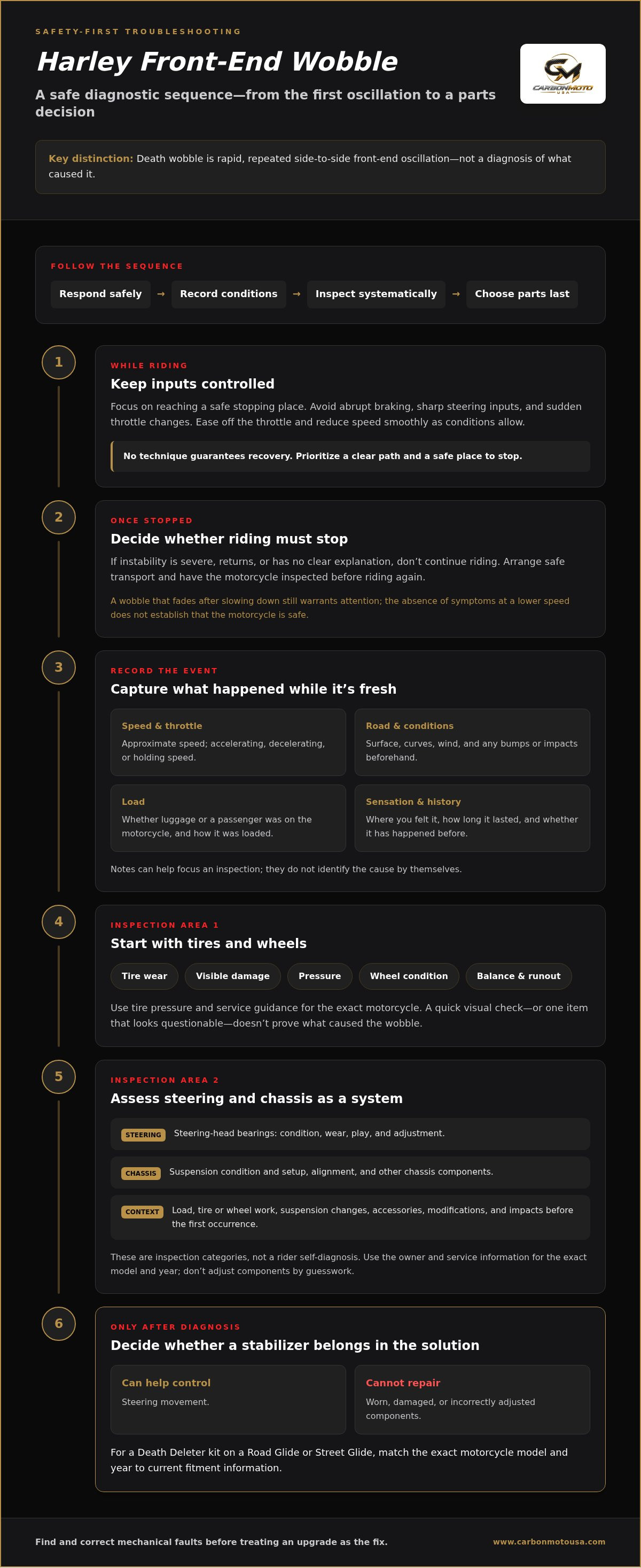
A Safe Step-by-Step Harley Death Wobble Troubleshooting Plan
Follow a sequence that separates your observations from a mechanical diagnosis. Don’t try to reproduce the wobble or identify a fault by guesswork. Preserve useful information, get the motorcycle assessed, and consider changes only after you understand the findings.
- Stop safely. If the front end oscillates, focus on reaching a safe stopping place. Don’t continue riding if the wobble was severe, has happened more than once, or remains unexplained. Arrange safe transport if needed.
- Write down the conditions. Once safely stopped, record what happened while your memory is clear. Don’t deliberately ride again to test whether the symptom returns.
- Make a limited visual check. With the motorcycle parked securely and away from traffic, note visible tire damage, unusual wear, or anything obviously displaced. Don’t dismantle parts or adjust steering and suspension based on a visual check.
- Arrange a proper diagnosis. Have the relevant steering, tire, wheel, suspension, alignment, and chassis components assessed using procedures for the exact motorcycle.
- Choose a remedy based on the findings. Address confirmed mechanical concerns before considering an upgrade. Return to riding only after the fault has been addressed and the motorcycle has been judged safe.
Record the conditions surrounding the wobble
Build a clear account, not a theory about the cause. Note the approximate speed or speed range, road surface, weather or wind, whether you were braking, and whether a passenger or cargo was aboard. Include known tire age, recent tire or wheel service, suspension work, accessories, and other modifications. If you’re unsure about a detail, mark it as unknown rather than filling the gap with a guess.
- When did the oscillation begin, and how long did it last?
- What were the road and weather conditions?
- What load was the motorcycle carrying?
- What maintenance or changes happened before the first event?
Use inspection findings to guide the next decision
Share your notes during the assessment, then compare the findings with official service information for the motorcycle’s model and year. Check applicable manufacturer safety notices or recall information using the motorcycle’s identifying details. A notice is relevant only if it applies to that exact motorcycle and concern. Don’t substitute general online adjustment instructions for model-specific procedures.
This disciplined process is the foundation of a Harley death wobble fix 2026: observe carefully, diagnose systematically, then decide. If the assessment supports adding steering control after mechanical issues are addressed, explore Harley-Davidson steering stabilizer kits and match the kit to the exact motorcycle model and year before ordering.
Choosing a Death Deleter Kit for Road Glide or Street Glide
Once inspection has addressed mechanical concerns, a steering stabilizer may be worth considering as one part of a deliberate handling setup. Carbon Moto USA offers Death Deleter steering stabilizer kits for Harley-Davidson Road Glide and Street Glide models. The kit is a component option, not a guaranteed death-wobble fix. Consider it only after diagnosis, and make exact fitment your first purchase check.
Confirm exact Road Glide or Street Glide fitment
Start with the motorcycle’s model year and full model designation. Don’t assume a kit fits every Road Glide or Street Glide simply because the family name matches. Use the current product fitment information to verify the specific year and configuration before ordering. If those details don’t match, don’t rely on a guess based on appearance or another rider’s setup.
| Motorcycle model | Death Deleter kit | Fitment decision |
|---|---|---|
| Harley-Davidson Road Glide | Offered by Carbon Moto USA | Match the exact year and configuration to current product fitment information. |
| Harley-Davidson Street Glide | Offered by Carbon Moto USA | Match the exact year and configuration to current product fitment information. |
The table identifies the model families for which kits are offered. It doesn’t establish year-by-year compatibility. Check the motorcycle’s registration or identification records to confirm its trim, year, and model, then compare those details with the current kit listing. Fitment is a mechanical requirement, not a cosmetic preference.
Plan the purchase around diagnosis and installation
Before ordering, make sure the inspection findings support adding a stabilizer and that unresolved tire, steering, suspension, wheel, or chassis concerns have been addressed. Read the current kit instructions alongside the service information for your motorcycle. Installation requirements and procedures must match the exact fitment. Don’t substitute generic steps or assume installation is identical across model years.
A sound decision has three parts: the motorcycle has been assessed, the kit matches its exact model and year, and installation follows the applicable instructions. Resolve any uncertainty before proceeding. The Harley death wobble fix 2026 is not a matter of fitting a stabilizer by default. It’s a sequence: understand the symptom, identify and address mechanical issues, then consider a compatible component for the setup.
If your diagnosis supports that next step, explore Carbon Moto USA’s Harley-Davidson stabilizer range and use current fitment information to guide your Road Glide or Street Glide selection.
Make Your Next Setup Decision With Confidence
Make your next decision with the inspection findings and your motorcycle’s exact model and year in view. That gives you a sound basis for deciding whether added steering control suits your setup, rather than treating an upgrade as a shortcut to diagnosis. A responsible Harley death wobble fix 2026 is built around informed choices and components matched to the motorcycle.
Carbon Moto USA offers Death Deleter steering stabilizer kits for Harley-Davidson Road Glide and Street Glide models. Review the current fitment details for your exact bike before ordering, and follow the applicable product instructions when planning installation.
Explore Carbon Moto USA’s Harley-Davidson steering stabilizer kits and compare the fitment information with your motorcycle’s details before choosing a kit.
Frequently Asked Questions
Can a steering stabilizer fix Harley death wobble?
A steering stabilizer may help control steering movement, but it can’t establish or repair the cause of a wobble. If a Harley has damaged tires, loose or worn components, or an adjustment issue, those conditions need proper attention regardless of how the steering feels after an upgrade. For a Harley death wobble fix 2026, treat a stabilizer as a possible setup component after diagnosis, not a stand-alone repair or a reason to keep riding an unsafe motorcycle.
Is it safe to ride a Harley-Davidson after it has death wobble?
Don’t ride it again if the wobble was severe, has returned, or remains unexplained. A brief episode doesn’t prove the motorcycle is safe, even if the steering feels normal after stopping. Arrange an assessment before riding, and use safe transport if the bike needs to be moved. The evaluation should address the reported event, not just whether the motorcycle feels stable during a stationary check.
What causes a Harley death wobble?
There isn’t one cause that applies to every Harley. Conditions involving tires, wheels, steering-head bearings, suspension, alignment, loading, or chassis components may contribute, sometimes in combination. Recent service or modifications can offer useful clues, but timing alone doesn’t confirm a fault. For example, if wobble begins after tire work, that work deserves review, but inspection is still needed to determine whether it relates to the symptom.
How do I diagnose a Harley death wobble?
Start with an account of when it happened, including speed, road surface, braking, weather, load, and any recent service or changes. Don’t recreate the wobble to gather evidence. Share those observations during a systematic inspection of the motorcycle’s relevant systems, using service information for its exact year and model. Diagnosis means verifying a mechanical condition, not choosing a part based only on when or how the handlebars moved.
Can low tire pressure cause a Harley to wobble?
Incorrect tire pressure can affect handling and deserves a check, but low pressure alone doesn’t confirm the source of a wobble. Use the pressure guidance for the exact motorcycle and tire setup rather than relying on a generic internet figure. Also consider tire wear or damage, and have the wheel assembly assessed if needed. If the motorcycle has already experienced severe or recurring instability, don’t use a pressure adjustment as a reason to resume riding without inspection.
Does the Death Deleter fit every Harley-Davidson?
No. Carbon Moto USA offers Death Deleter steering stabilizer kits for Harley-Davidson Road Glide and Street Glide models, not a universal kit for every Harley. Compatibility depends on the precise motorcycle, so identify its model and year and compare those details with current product fitment information before ordering. Don’t infer compatibility from a shared model-family name, similar appearance, or another rider’s motorcycle.
What should I check before buying a Harley steering stabilizer?
First, confirm that mechanical concerns have been assessed and addressed. A stabilizer isn’t a replacement for diagnosis. Then verify the exact motorcycle model and year against current kit fitment information. Review the applicable product instructions and model-specific service information so installation planning is based on the correct procedure. These checks help establish whether the component suits the motorcycle and its condition, rather than treating an upgrade as an automatic response to wobble.