Carbon Moto USA / Rider support
Aftermarket Steering Damper for Harley Touring Guide

What makes the best aftermarket steering damper for Harley touring? Start with a part matched to your exact motorcycle, not a broad fitment claim. A damper can resist unwanted steering movement, but it doesn’t fix worn parts, setup problems, or other handling faults.
Before comparing products, identify your model, year, and front-end configuration. Then check whether you’re looking at a complete mounting kit or a damper component alone. These details help you compare like with like and avoid assuming a part will fit because it’s listed for a Harley Touring model.
This guide explains what a damper does, how to check fitment, and what to compare when choosing a setup. It also covers Carbon Moto USA’s Death Deleter steering stabilizer kits for Harley-Davidson Road Glide and Street Glide models. Use the steps below to narrow your choice based on your motorcycle and intended use.
Key Takeaways
- Choose an aftermarket steering damper for Harley touring by matching the application to your exact model, year, and front-end configuration.
- Compare kit contents, mounting hardware, and stated damper specifications instead of assuming every listing includes the same components.
- A steering damper resists unwanted steering movement; it doesn’t replace diagnosing mechanical or handling issues.
- Road Glide and Street Glide applications aren’t interchangeable by default. Check each model’s fitment and mounting requirements separately.
- Carbon Moto USA offers Death Deleter steering stabilizer kits for Harley-Davidson Road Glide and Street Glide models.
Purpose of Harley Touring Aftermarket Steering Dampers
A steering damper connects the motorcycle’s steering assembly to its chassis and resists unwanted steering movement. It adds damping to the steering system; it doesn’t lock the handlebars or correct the front end. Think of an aftermarket steering damper for Harley touring as one part of a complete handling setup, not a standalone fix.
Damping moderates how quickly steering movement develops. It may help manage abrupt oscillations, but it can’t guarantee that a wobble will stop or prevent every handling concern. Tire condition and pressure, steering-head bearings, suspension condition, load distribution, and chassis setup can all affect how a motorcycle behaves. Assess the bike’s condition and setup as part of the decision.
The result depends on the motorcycle, the damper’s design and fitment, and riding conditions. A loaded touring bike crossing a rough pavement seam, for example, may respond differently from the same bike on smooth pavement. A damper can resist unwanted movement, but it won’t remove the road impact or guarantee a particular response.
How a steering damper affects steering movement
Damping is controlled resistance to steering motion. It influences steering response, while suspension springs support the motorcycle and respond to bumps. Neither function replaces careful chassis setup. If a sharp road edge prompts a quick handlebar movement, damping may moderate that movement, depending on the setup and conditions. It won’t remove the impact or diagnose its cause.
If the steering feels unusually loose, harsh, or unstable, don’t assume a damper will address the underlying issue. Check the motorcycle’s condition and setup. The part is intended to manage steering movement, not compensate for worn components or incorrect adjustments.
Steering damper versus steering stabilizer: what buyers should know
Retailers may use “steering damper” and “steering stabilizer” for related components. The name alone doesn’t tell you the mechanism, included hardware, fitment, or expected result. For a broader overview, see Steering Damper.
Compare the kit’s design and stated motorcycle application rather than relying on its label. A product called a stabilizer isn’t automatically compatible with every Harley Touring model, and “damper” doesn’t promise a particular handling outcome. Treat the terms as a starting point, then assess the product’s purpose and fitment for your bike.
What to Compare in a Harley Touring Steering Damper Kit
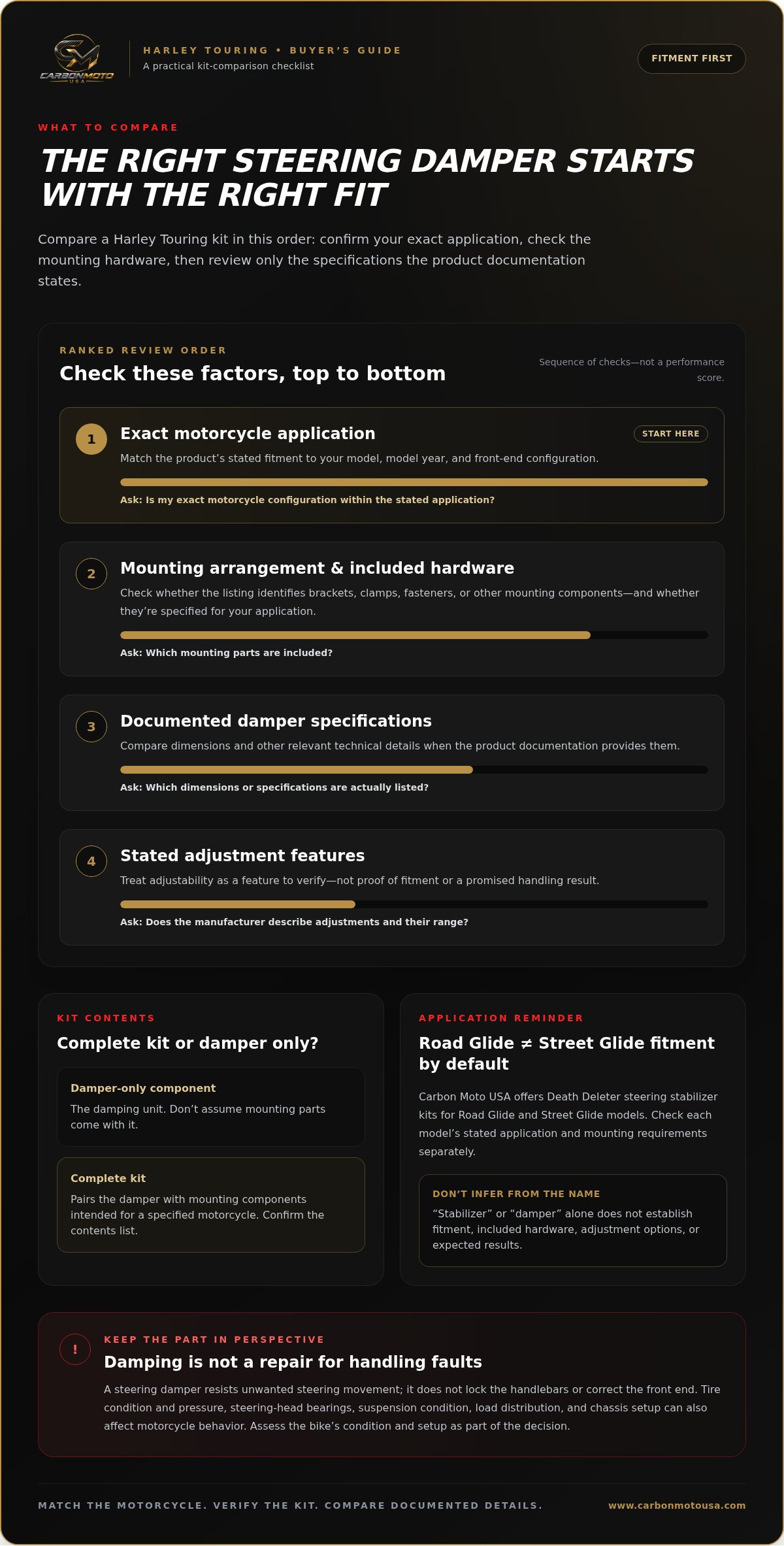
Compare the application and mounting arrangement before focusing on brand, finish, or adjustment features. A standalone damper may require separate mounting parts, while a complete kit may include hardware intended for a specific motorcycle. For an aftermarket steering damper for Harley touring, start with the stated fitment.
Use the table to distinguish the details a listing provides from the questions its product documentation should answer. Don’t assume an unstated feature or component is included.
| Comparison point | What to look for | Question for the product documentation |
|---|---|---|
| Application | Harley model, model year, and front-end configuration named for the product. | Is my exact motorcycle configuration within the stated application? |
| Mounting hardware | Whether the listing identifies brackets, clamps, fasteners, or other mounting components. | Which mounting parts are included, and are they specified for this application? |
| Damper specifications | Documented dimensions and other relevant technical details. | Which dimensions or specifications are provided for this damper? |
| Stated adjustments | Any adjustment feature and range explicitly described by the manufacturer. | Does the documentation state adjustments, and how are they described? |
Complete kit or damper-only component?
A standalone damper is the damping unit. A complete kit pairs it with mounting components intended for a specified motorcycle. Read the contents list for named brackets, clamps, and fasteners rather than assuming they come with the damper. The mounting arrangement must suit the application and allow the assembly to work as designed. RevZilla’s guide to steering stabilizers offers background on the component’s role, but product-specific fitment still matters.
Which specifications deserve a close comparison?
Compare dimensions, adjustment range, serviceability, and supplied hardware only when the product documentation states them. Separate verified specifications from promotional wording and rider impressions. “Premium” describes positioning, not compatibility; adjustability describes a feature, not proof of fitment. One manufacturer’s specifications don’t establish another kit’s details.
For Harley applications, Carbon Moto USA offers Death Deleter steering stabilizer kits for Road Glide and Street Glide models. Evaluate each model’s application separately, and use the product-specific information to compare the stated details. The name “stabilizer” alone doesn’t establish kit contents, adjustment options, or fitment.
Start with the stated application, then review the listed mounting components and technical details. Carbon Moto USA’s Harley steering stabilizer kits include options for Road Glide and Street Glide models.
Harley Touring Fitment: Check Model, Year, and Front-End Configuration
Fitment depends on the motorcycle’s specific model and configuration, not just a broad category label. Before choosing an aftermarket steering damper for Harley touring, compare your bike with the product’s stated application. A part described for a Touring bike isn’t automatically suitable for every model in that family.
Check fitment in this order:
- Identify the model. Record whether your motorcycle is a Road Glide, Street Glide, or another Touring model. Treat each as a separate application unless the product information explicitly groups them together.
- Match the model year. Use the motorcycle’s exact year and compare it with the years stated in the product information.
- Check the fork or front-end configuration. Note your bike’s configuration and compare it with any front-end details specified for the product. Similar-looking models don’t necessarily share mounting geometry.
- Review mounting requirements. Compare the stated mounting points and required components with your motorcycle’s setup. Use product-specific notes about surrounding parts where provided.
Why Harley Touring model and year matter
Model generations and front-end changes can affect the space, mounting points, or brackets a component needs. Road Glide and Street Glide are separate applications, not interchangeable labels. Two bikes that look similar may also differ in ways that matter to a mount. Use the model and year stated in the product information; appearance and a general “Touring fitment” claim aren’t enough to establish compatibility.
For a Death Deleter steering stabilizer kit, match your Road Glide or Street Glide and model year to the product’s stated application. A year range from another brand’s listing doesn’t establish fitment for this kit. Fitment claims apply to the specific product and application they describe.
Check mounting and surrounding components
After matching the model and year, compare the documented mounting points with your bike. Review any product information about the fork or front-end configuration and nearby fairing, crash bar, or other components that could affect mounting or clearance. Don’t assume a note for one manufacturer’s design applies to another kit.
If your motorcycle has modifications, include them in the comparison. A changed front end or added component may affect whether the stated mounting arrangement suits your bike. Look for a clear match between the product application and your actual configuration, not just a shared model family.
If a fitment detail doesn’t line up, recheck the model, year, configuration, and mounting notes before treating the product as a match. This helps keep the decision specific to your Harley instead of relying on a general Touring claim.
Is an Aftermarket Steering Damper Right for Your Harley Touring Bike?
A damper may suit a rider considering a handling component to resist unwanted steering movement, but the decision depends on the bike’s condition, verified fitment, and the concern you want to address. Use these criteria to decide whether to evaluate a damper or investigate the motorcycle first.
- Riding concern: If you want damping as part of a considered performance setup, compare products designed for your exact application. If you notice a new wobble or sudden change in steering, prioritize diagnosis.
- Motorcycle condition: Unresolved tire, wheel, steering, or suspension concerns need assessment before an upgrade. A damper isn’t evidence that those systems are sound.
- Fitment certainty: Evaluate a kit when its stated model, year, front-end configuration, and mounting requirements match your motorcycle.
- Intended use: Consider how you ride and what steering behavior you want to manage. Don’t assume a product will produce the same result across different bikes or conditions.
When a damper may fit the rider’s goals
A steering damper may be worth considering when the motorcycle is in sound condition, the application matches, and your goal is to add resistance to unwanted steering movement. Keep the decision tied to your use and the product’s documented purpose. A broad promise of greater control or confidence doesn’t replace confirmed fitment or specific product information.
This applies whether you’re assessing an aftermarket steering damper for Harley touring generally or considering a model-specific steering stabilizer kit. A damper may complement a suitable setup, but it can’t guarantee how the motorcycle will respond on every road, with every load, or in every riding situation.
When to investigate the motorcycle before upgrading
New, severe, or recurring handling symptoms need attention before you choose a damper. Tires and pressure, wheel condition, steering-head components, suspension, load distribution, and setup can all affect how a motorcycle behaves. A qualified technician can help assess persistent or sudden problems. Don’t treat an added component as a diagnosis or assume it resolves an underlying fault.
When arranging an assessment, describe when the symptom occurs, whether the bike is loaded, and whether anything changed before it began. That context can help direct attention to relevant systems. Once the motorcycle’s condition is understood, return to the product criteria: application, configuration, and intended use.
If your evaluation points toward a model-specific handling component, explore Harley steering stabilizer kits for Road Glide and Street Glide applications. Consider product fitment and your motorcycle’s condition as separate parts of the decision.
Choosing a Death Deleter Steering Stabilizer Kit for Road Glide or Street Glide
Carbon Moto USA offers Death Deleter steering stabilizer kits for Harley-Davidson Road Glide and Street Glide models. These handling-oriented components are intended to address unwanted steering movement. Choose based on your motorcycle’s specific application, not an assumption that one Touring kit suits every model.
Use the product information to match the stated model-year application and any configuration details. Keep expectations realistic: a steering stabilizer is one component in the overall setup, not a guarantee of a particular riding result or a replacement for diagnosing a handling problem.
Match the Death Deleter kit to your touring model
Start with the model. Road Glide owners should consider the Road Glide application, while Street Glide owners should consider the Street Glide application. Match your exact year to the product’s stated fitment. Don’t transfer a model-year range or configuration note from another product, even if it also fits a Harley Touring motorcycle.
Similar appearance, a shared model family, or the broad “Touring” label doesn’t establish that a kit suits your bike. If the motorcycle has a changed front end or other relevant modifications, account for them when comparing its configuration with the stated application. Don’t assume fork dimensions, supporting components, or kit contents unless the product information specifies them.
Move from comparison to a confident purchase
Follow a clear sequence: define your intended use, match the model and year, review the kit’s stated application and details, and set realistic expectations for what a steering stabilizer can do. This keeps your choice grounded in the actual motorcycle and the component’s stated purpose.
Whether you’re comparing an aftermarket steering damper for Harley touring generally or narrowing your options to a model-specific kit, prioritize application over branding. A product name doesn’t prove universal compatibility or guarantee an outcome. If a handling symptom is sudden or persistent, address the underlying concern before treating an upgrade as the answer.
Once you’ve identified the correct model category, compare the Road Glide or Street Glide kit application with your motorcycle. Focus on the details relevant to your bike instead of relying on a general fitment claim.
Explore Carbon Moto USA to find the Death Deleter steering stabilizer options for Road Glide and Street Glide models.
Make Your Next Touring Upgrade a Deliberate Choice
Keep a record of your motorcycle’s exact configuration and any changes made over time, along with the product details you use to plan upgrades. This makes future parts decisions more precise as your touring bike evolves.
Choose a part that suits both the motorcycle and your intended use. An aftermarket steering damper for Harley touring belongs in a broader build plan, not as an isolated answer to every handling concern. Carbon Moto USA specializes in motorcycle performance parts, including Death Deleter steering stabilizer kits for Road Glide and Street Glide models.
Ready to plan your setup? Explore Carbon Moto USA and review the Harley performance parts available for your build.
Frequently Asked Questions
Can a steering damper fix a Harley touring bike that wobbles?
No. A steering damper can moderate steering movement, but it shouldn’t mask a mechanical or setup problem. If the wobble began after a tire change, a change in load, or recent front-end work, note what changed and when the symptom occurs. That information can help a qualified technician assess the motorcycle before you choose an aftermarket component.
Is a steering damper the same as a steering stabilizer on a Harley?
In motorcycle retail, the terms often refer to related steering-control components, but the label doesn’t establish how a particular product is built or mounted. Compare the stated application and technical description, not just the name. Two listings may both say “stabilizer” while describing different motorcycle applications. Use the product information to understand what the component is intended to fit.
Do Harley Road Glide and Street Glide models use the same steering damper kit?
Not automatically. A Road Glide listing doesn’t prove that the same kit suits a Street Glide, or vice versa. Look for the exact model named in the application information, then compare your motorcycle’s year and configuration. For a Death Deleter kit, choose the Road Glide or Street Glide application that corresponds to your bike rather than relying on the Touring family name alone.
Can I install an aftermarket steering damper without changing other parts?
That depends on the kit and motorcycle. Don’t assume existing hardware can be reused or that the kit includes every mounting component. Review the manufacturer’s instructions and listed contents for the exact application. If the installation involves unfamiliar work or you’re unsure about clearance and steering movement, use qualified service. Follow the product instructions and resolve any interference or unexpected behavior before riding.
Will a steering damper make my Harley harder to turn at low speeds?
It may affect steering feel, depending on the damper, its setup where applicable, and the motorcycle. Don’t assume an adjustment feature exists or that every unit feels alike. If steering effort changes unexpectedly after installation, stop and have the installation and motorcycle assessed before riding again. Follow the product’s instructions for setup guidance specific to that damper.
What should I check before ordering a Harley touring steering damper?
Start with your motorcycle’s exact model and year, then compare them with the product’s stated application. Check the front-end configuration, mounting requirements, and listed kit contents against the bike, including modifications that could affect fit. For an aftermarket steering damper for Harley touring, keep the product information you used for the fitment comparison so you can refer to the same details when planning installation.